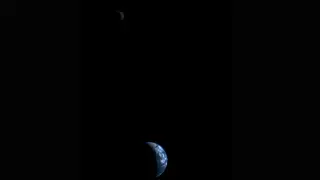
Voyager 1’s Earth image—the Pale Blue Dot—almost didn’t get taken because engineers feared solar glare would damage the cameras and mission resources were being cut; Carl Sagan repeatedly pitched turning the camera back toward Earth, and after eight years and six requests NASA approved the shot in 1990, producing a tiny pixel-sized dot that became a defining perspective on humanity.
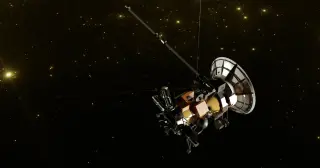
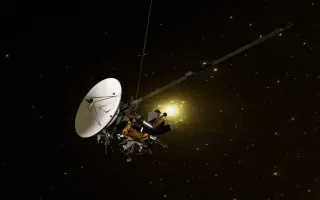
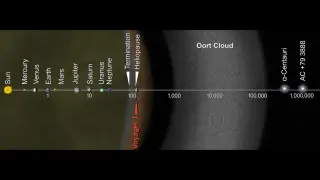
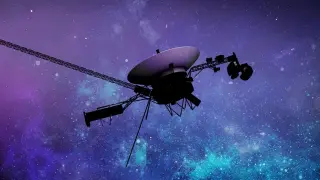
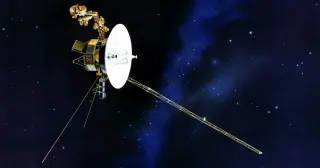
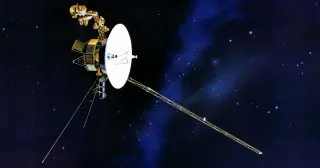
NASA’s Voyager 1 is set to reach exactly one light-day from Earth in November 2026, about 25.9 billion kilometers away, continuing to send science data despite aging power and limited instruments. It has already crossed the termination shock and heliopause into the interstellar medium, but remains far from the Solar System’s edge; by around 2036 it could become undetectable, after which it will drift through the Milky Way for eons as a relic of humanity’s first grand interstellar-leaning probes.
In 1990, after Carl Sagan urged it, Voyager 1 photographed Earth from about 6 billion kilometers away, capturing a sub-pixel Pale Blue Dot; though scientifically minimal, the image gained iconic status through Sagan’s writing and a 2020 processing update, and with Voyager’s cameras long since turned off, it stands as the mission’s last full-family portrait of the solar system.
Voyager 1 is about 16 billion miles from Earth and moving away from the Sun, so a command sent at the speed of light takes roughly 22.5 hours to reach it and the reply takes about 22.5 hours to return, creating a two‑day command‑and‑response cadence. After a memory‑chip failure in 2023, a 2024 patch and careful line‑by‑line code review restored coherent data transmission, and the current data rate is about 160 bits per second as the probe slowly powers down its instruments. By November 2026 Voyager 1 will become the first human‑made object to pass one light‑day from Earth, while Voyager 2 remains on a longer, slower path toward similar autonomy and fading transmissions.
NASA's JPL shut down Voyager 1's Low-energy Charged Particles instrument in 2026 due to dwindling plutonium power; both Voyager probes will likely go quiet in coming years, but the Golden Record—carrying greetings in 55 languages from Akkadian to Wu—remains as a timeless, symbolic self-portrait of humanity, a gesture rather than a scientific instrument, designed to convey Earth's diversity to any distant listener.
Voyager 1’s communications have grown so distant that one-way signals now take over 23 hours to reach Earth, with projections toward roughly 24 hours by late 2026. As the probe cruises outward at about 17 km/s, the data arriving on Earth corresponds to a position the spacecraft has already left, effectively making the telemetry a late snapshot from interstellar space. The milestone of one light-day (about 25.9 billion km) will be reached around November 2026, turning every command a full day to arrive and a full day for a reply. The data stream remains slim (roughly 160 bits per second), and only two instruments on Voyager 1 stay active, with power-management decisions looming as NASA relies on DSN facilities like Canberra’s DSS-43 for ground control. Voyager 2, on a different path, won’t reach this mark for years, and both probes continue to operate as the few direct data sources from beyond the heliosphere, even as power fades and operations tighten.
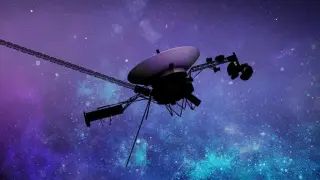
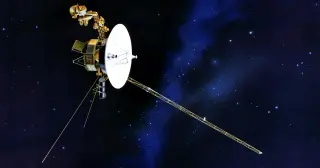
Voyager 1, about 172.6 AU from Earth, continues to transmit from beyond the heliosphere on roughly 22 watts; seven of its ten original instruments are shut down to conserve power, with only the Plasma Wave Subsystem and magnetometer remaining and a small 0.5-watt motor kept spinning to preserve revival chances. The RTGs now deliver around 220 watts total, and NASA plans a long-term 'Big Bang' power-swap strategy—starting with Voyager 2 in mid-2026—to extend telemetry into the 2030s, though one-way signals already take about 23 hours to reach Earth.
NASA plans a risky “Big Bang” engineering move on Voyager 2 in May–June 2026 to swap which devices stay powered (turning off heater-related lines, turning on others) to save about 10 watts and extend the probes’ operations. If successful, Voyager 1 would undergo the same adjustment later that summer. With roughly 230 watts left for systems and a transmitter around 200 watts, the twin spacecraft—launched in 1977 and now in interstellar space (V1 since 2012, V2 since 2018)—could keep returning science into the 2030s, potentially reaching around 200 astronomical units, though power will keep dwindling and some instruments may be shut down.
To conserve dwindling power from its plutonium RTG, NASA turned off the Low-energy Charged Particles (LECP) instrument on Voyager 1 after 49 years, a decision that preserves essential systems and could buy roughly one more year of operation in interstellar space; a small portion of LECP will stay active, and engineers plan a broader, lower-energy 'Big Bang' power-saving approach to be tested on Voyager 2 in 2026 and possibly applied to Voyager 1 afterward.
Voyager 1 has shut down its Low-energy Charged Particles (LECP) instrument to conserve power as it travels farther into interstellar space. NASA plans a bold, one-shot power-swap—a “Big Bang” fix—by turning off some systems and switching to lower-power options, first on Voyager 2 and then on Voyager 1, to keep two remaining instruments alive for about a year and potentially extend the mission toward its 50th anniversary, with the hope LECP could be revived later if power allows.
NASA's Voyager 1 has shut down the Low-energy Charged Particles instrument to conserve dwindling power from its aging RTGs. The move is part of a broader “Big Bang” plan to power down nonessential systems and keep heaters on, allowing the mission to continue collecting data beyond the heliosphere. Voyager 2 has already shed similar instruments, and planners will test the approach in May–June with the goal of implementing it on Voyager 1 by July, potentially reactivating LECP if more power becomes available.
NASA commanded April 17 to shut down Voyager 1’s Low-energy Charged Particles instrument to conserve power as it drifts deeper into interstellar space, mirroring a similar move on Voyager 2 last year. Engineers hope a bold “Big Bang” power-swap upgrade—first tested on Voyager 2 this spring and then on Voyager 1 in July—will keep the venerable probes producing data for about another year, helping mark Voyager 1’s 50th anniversary while two other instruments remain active.
NASA’s Voyager 1 is on track to become the first human-made object to travel a full light-day away from Earth (about 25.9 billion km), with the milestone expected in late 2026 to early 2027 as it drifts through interstellar space about 166 AU from Earth. Signals take roughly 23 hours to reach the craft, and power is expected to last into the early 2030s, after which Voyager 1 will continue its endless journey beyond the Solar System toward the stars.
Voyager 1 and Voyager 2, launched in 1977, are nearing the end of their missions as decaying Plutonium-238 power forces NASA to shut down instruments; yet after almost five decades they’ve delivered unprecedented data from the outer planets and now interstellar space, and NASA hopes to extend their lives into the 2030s while newer observatories—Rubin Observatory, James Webb, Hubble, and the upcoming Roman Space Telescope—carry the torch of cosmic exploration.
NASA has shut down the Low-energy Charged Particles (LECP) instrument on Voyager 1 to conserve power and extend the mission, keeping two other instruments active as the spacecraft—more than 15 billion miles from Earth—drifts through deep space; a 0.5-watt motor on LECP remains running to keep the door open for possible reactivation, while the RTG’s power slowly declines by about 4 watts per year.