
JWST Detects Ancient Clay on Neptune’s Moons, Hinting at a Catastrophic Past
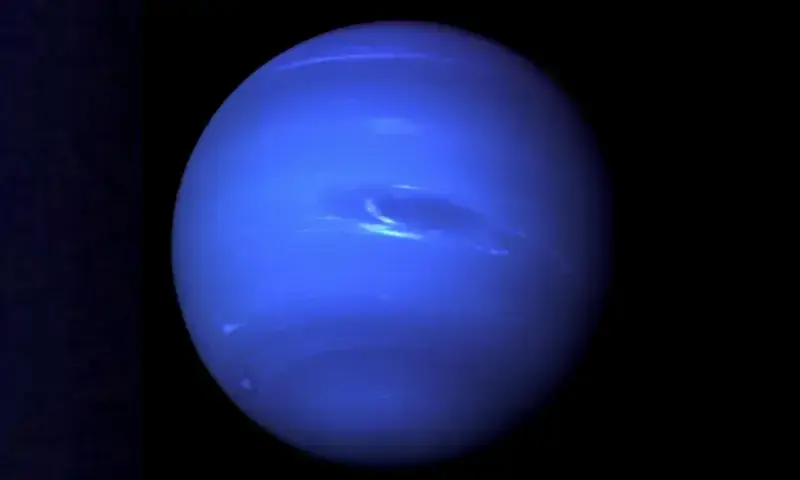
James Webb Space Telescope observations of Neptune’s inner moons, Proteus, Larissa, and Galatea, reveal the presence of magnesium-rich clay minerals. These minerals, which require liquid water and rock interaction to form, cannot exist on the small, cold moons themselves. Researchers propose that a catastrophic event billions of years ago, likely triggered by the capture of the large moon Triton, destroyed Neptune’s original larger moons. The current inner moons and rings are believed to be debris from this ancient destruction, exposing deep interior materials that are otherwise hidden.
Key points
- JWST spectroscopic analysis detected phyllosilicate clay minerals on Larissa and Galatea, but not on Proteus.
- The presence of these minerals implies they originated from the deep interiors of larger, warmer bodies that once orbited Neptune.
- The leading theory suggests Triton’s capture by Neptune destabilized the original moon system, causing collisions that shattered the larger moons.
- A second, unidentified hydrated mineral was also detected across all three moons, which does not match any known spectral libraries.
- The study was published in Science Advances by a team led by Ryleigh Davis of Caltech and UC San Diego.
Background
Previous coverage in August 2026 highlighted similar findings, noting the absence of surface water ice on these moons and the complexity of their origin. Earlier reports also emphasized the need for a dedicated ice-giant mission to further study Neptune’s violent history and the mysterious nature of the unidentified mineral detected by JWST.
How outlets are covering it
Dawn and Futura both emphasize the 'catastrophic disruption' model, where Triton’s capture destroyed Neptune’s original regular moons. Space.com’s headline focuses on the moons as 'remnants of ice worlds shattered in a catastrophic crash.' While all sources agree on the presence of clay minerals, Futura notes that the minerals were not detected on Proteus, a detail also present in the archive but less emphasized in Dawn. Futura also highlights an alternative hypothesis: that the minerals could stem from an ancient Kuiper Belt object torn apart by Neptune’s tidal forces, rather than just the destruction of original moons. All sources agree that the unidentified mineral remains a mystery, with Davis describing it as 'truly unlike anything else we’ve identified in the Solar System.'
Why it matters
This discovery provides direct evidence of a violent past for Neptune, a planet that has never been visited by a spacecraft. It suggests that Neptune’s current moon system is not native but a result of a catastrophic event, offering a rare glimpse into the deep interiors of icy worlds that are otherwise inaccessible. The findings also highlight the potential for new materials and the need for future missions to explore the outer solar system.
What to watch
Researchers will continue to analyze the unidentified mineral detected by JWST. There is a growing call for a dedicated mission to Neptune to study the planet and its moons in more detail, potentially using future telescopes or probes to confirm the origins of the debris and the nature of the mysterious mineral.
- Webb telescope finds signs of ancient disaster on Neptune’s moons Dawn
- Webb telescope finds signs of ancient disaster for Neptune's moons Reuters
- 3 moons of Neptune may be remnants of ice worlds shattered in a catastrophic crash Space
- Neptune’s moons were born from cosmic disasters—scientists stunned by new evidence Futura, le média qui explore le monde
- Webb Telescope Found Forensic Evidence of Ancient Disaster That Destroyed Neptune’s Moons Yahoo
Want the full story? Read the original reporting
Read on Dawn