
Artemis III Engines Installed as Chinese Rocket Debris and European Funding Shifts Dominate Space Week
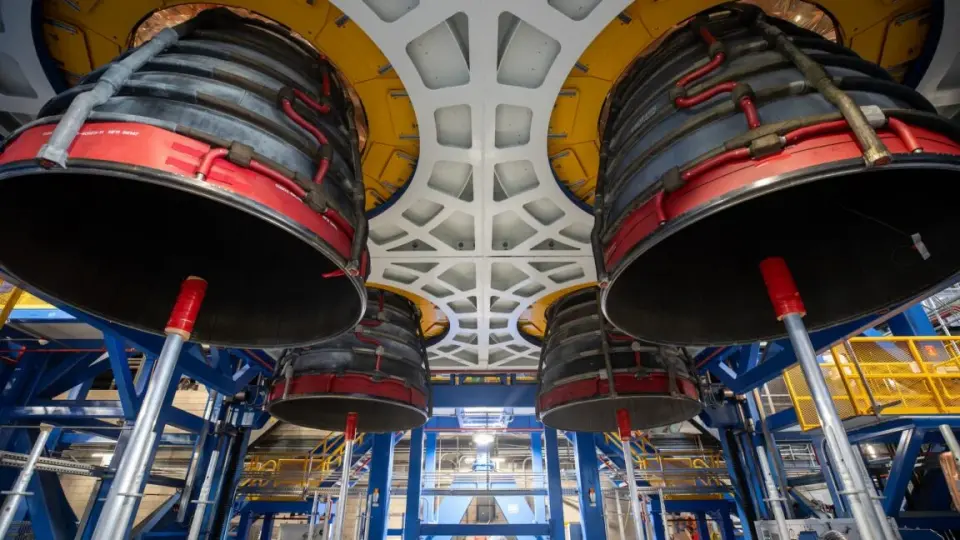
NASA completed the installation of four historic RS-25 engines on the Artemis III core stage, while a Chinese Long March 6C upper stage fragmented in orbit. European launch startups Isar Aerospace, PLD Space, and HyImpulse secured significant new funding, and NASA announced plans to consolidate launch procurement into a single office to enable bulk buying.
Key points
- Technicians at NASA’s Kennedy Space Center finished installing four RS-25 engines on the Artemis III core stage on September 1, 2026. These engines, including E2048 and E2052, previously powered Space Shuttle missions, including one that carried Senator John Glenn to orbit in 1998.
- A Chinese Long March 6C rocket upper stage fragmented in low Earth orbit shortly after delivering a seven-satellite rideshare mission on August 24. LeoLabs confirmed the breakup, noting that tens to hundreds of fragments were generated. This adds to a series of fragmentation issues affecting the Long March 6 series, which uses the YF-115 engine.
- European launch startups Isar Aerospace, PLD Space, and HyImpulse announced new funding and contracts. Isar Aerospace won a 200 million euro contract from the European Space Agency, while PLD Space secured 108 million euros in funding and a 159 million euro ESA contract. HyImpulse extended its Series A funding by 50 million euros.
- NASA is consolidating its launch programs into a new Commercial Access to Space office within the Human Spaceflight Mission Directorate. This office aims to aggregate launch demand and enable bulk buys, similar to the US Space Force’s procurement strategy, to lower costs and support new market entrants.
- Arianespace completed its first Geostationary Transfer Orbit mission with an Ariane 6 rocket, deploying the MTG-I2 weather satellite for Eumetsat on August 27. This marks Eumetsat’s return to European launch services after previous missions used SpaceX Falcon 9 rockets due to Ariane 6 delays.
Background
Recent archive articles highlight ongoing reliability concerns with Chinese rockets, including a Long March 7A explosion in August 2026 that destroyed a military communications satellite. This incident raised questions about shared engine components and potential delays to lunar missions like Chang'e 7. Additionally, earlier coverage noted the competitive landscape for lunar resource extraction, with startups like Interlune targeting helium-3 mining, reflecting broader international efforts to expand space capabilities.
How outlets are covering it
Ars Technica and NASA emphasize the historic nature of the RS-25 engines used for Artemis III, highlighting their previous roles in Space Shuttle missions. SpaceNews focuses on the broader success of Artemis 1 and 2 as precursors to the 2027 lunar landing, though it does not provide specific details on the engine installation. European Spaceflight and NRK highlight the financial momentum of European launch startups, contrasting with the technical setbacks of Chinese rockets. Ars Technica and SpaceNews both note the fragmentation of the Long March 6C upper stage, but Ars Technica provides more detail on the debris count and the history of Long March 6 issues. Yahoo News Canada was inaccessible due to a technical error, so no perspective could be extracted from it.
Why it matters
The installation of RS-25 engines on Artemis III marks a critical step toward NASA’s 2027 lunar landing goal, leveraging historic hardware to ensure mission reliability. The fragmentation of the Long March 6C upper stage underscores ongoing safety and reliability concerns with Chinese rockets, potentially affecting international confidence in their launch services. The new funding for European startups and NASA’s shift to bulk procurement indicate a growing emphasis on cost efficiency and market stability in the global launch industry. These developments reflect the competitive and collaborative dynamics shaping the future of space exploration and commercial launch capabilities.
What to watch
Isar Aerospace is set to attempt its next Spectrum rocket launch from Andøya Spaceport in Norway, with a weeklong window opening on September 4, 2026. SpaceX is preparing for Starship Flight 14, the first orbital test, which will deploy Starlink V3 satellites. Blue Origin is continuing construction of its Payload Processing Facility in Florida, targeting completion by 2028. NASA’s new Commercial Access to Space office will likely announce its first bulk procurement strategy in the coming months. European Space Agency contracts with Isar Aerospace, PLD Space, and Rocket Factory Augsburg will drive further development of new launch vehicles in the next 12-18 months.
Want the full story? Read the original reporting
Read on Ars Technica