
Europa Clipper’s Journey to Jupiter Faces New Challenges from Ice Shell Barriers
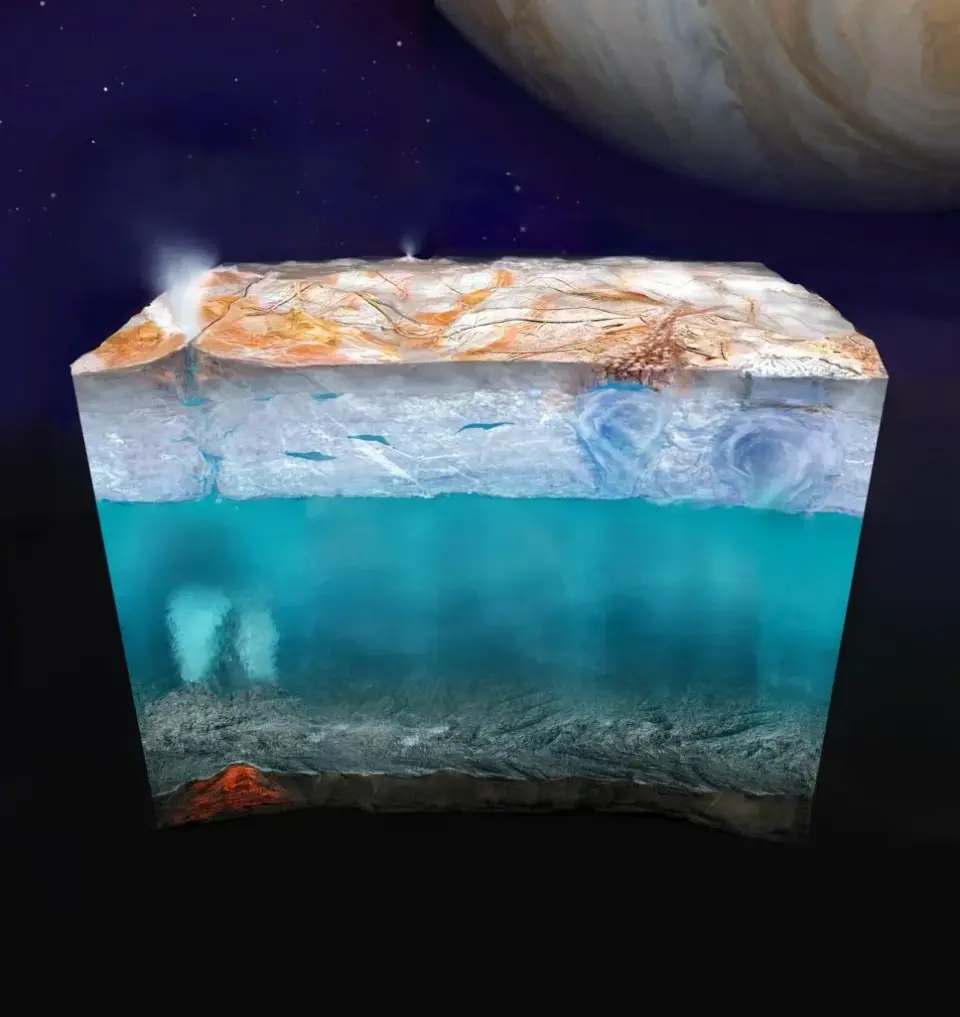
NASA’s Europa Clipper, launched in October 2024, is currently traversing a 1.8-billion-mile trajectory toward Jupiter, utilizing gravity assists from Mars and Earth to reach the moon by April 2030. The mission aims to assess whether Europa’s subsurface ocean, which may hold more water than Earth’s combined oceans, possesses conditions suitable for life. However, recent simulations suggest the moon’s ice shell may be a more effective barrier than previously thought, potentially preventing direct exchange between the deep ocean and the surface. While Clipper will conduct 49 flybys to map the ice and ocean, it cannot drill or directly detect life, focusing instead on habitability indicators.
Key points
- Europa Clipper is currently in transit, having passed Mars in March 2025 and planning an Earth gravity assist in December 2026 before arriving at Jupiter in April 2030.
- The mission will perform 49 close flybys of Europa, using nine instruments to study the ice shell, ocean depth, and surface chemistry without landing or drilling.
- New research from Rutgers University suggests that turbulence in the ice shell may rapidly freeze water trying to rise from the deep ocean, challenging the idea that surface features are direct samples of the subsurface ocean.
- The mission’s primary goal is to determine if Europa’s environment could support life, rather than directly detecting organisms, by assessing the presence of liquid water, energy sources, and chemical ingredients.
- ESA’s JUICE mission, launched in 2023, will arrive at Jupiter in July 2031 to complement Clipper’s findings by investigating Europa, Callisto, and Ganymede.
Background
Previous coverage has established that Europa’s subsurface ocean is a leading candidate for habitability, with estimates suggesting it could contain more than twice the water of Earth’s oceans. The ocean is believed to be kept liquid by tidal heating from Jupiter’s gravity. Earlier missions, such as Galileo, provided initial evidence of a subsurface ocean, but direct measurements have remained elusive. The Europa Clipper and JUICE missions are designed to address these gaps by mapping the ice shell and ocean in unprecedented detail.
How outlets are covering it
Space Daily emphasizes the mission’s trajectory and the importance of gravity assists in reaching Jupiter, highlighting the cautious approach to avoid radiation damage. SciTechDaily focuses on the challenges posed by the ice shell, citing new simulations that suggest direct exchange between the deep ocean and the surface may be minimal. Space.com, while largely obscured by technical content, implies a broader interest in the potential for life in Europa’s ocean, aligning with the mission’s habitability focus. The outlets differ in their emphasis: Space Daily on the mission’s logistics, SciTechDaily on the physical barriers to accessing the ocean, and Space.com on the broader implications for astrobiology.
Why it matters
The Europa Clipper mission represents a critical step in understanding the potential for life beyond Earth. By assessing the habitability of Europa’s subsurface ocean, the mission could provide insights into the conditions necessary for life to exist in extreme environments. The findings will also inform future missions, such as potential landers or sample-return missions, by identifying the most promising areas for further exploration. Additionally, the mission’s success in navigating the challenges of Europa’s ice shell and radiation environment will demonstrate the feasibility of exploring other icy moons in the solar system.
What to watch
The next major milestone for Europa Clipper is the Earth gravity assist in December 2026, which will adjust its trajectory toward Jupiter. Upon arrival in April 2030, the spacecraft will begin its 49 flybys, with the main science campaign starting in 2031. ESA’s JUICE mission is expected to arrive at Jupiter in July 2031, providing complementary data on Europa and other icy moons. Future missions may focus on direct sampling or drilling, depending on the findings from Clipper and JUICE.
- Europa Clipper is already in space, travelling 1.8 billion miles toward Jupiter's moon Europa, where a subsurface ocean holds more water than every ocean on Earth combined — it arrives April 2030 to ask whether anything is alive inside Space Daily
- A 2026 study modelling Europa's interior finds its seafloor is probably too quiet for the hydrothermal vents that support life in Earth's oceans, while a separate paper the same month proposes nutrients could reach its ocean anyway, carried down by sinking poc Space Daily
- Jupiter's moon Europa may have signs of life in its buried ocean — but can we get to them? Space
- APOD: 1998 January 02 - Europa's Disconnected Surface science.nasa.gov
- Europa’s Hidden Ocean May Be Locked Beneath a Frozen Wall SciTechDaily
Want the full story? Read the original reporting
Read on Space Daily