New simulations suggest that while giant impacts can shatter icy moons, large bodies can reform and retain subsurface oceans, whereas smaller moons likely lose or fail to form them due to rapid cooling.
A Bangor resident at St. Xavier’s Apartments faced repeated bat intrusions, sleeping on a bathroom floor and even in an indoor tent, leading to eight rabies shots and a dispute over landlord responsibility and Maine habitability laws.
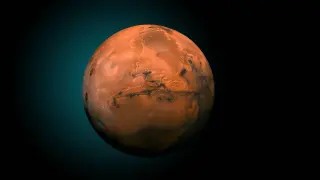
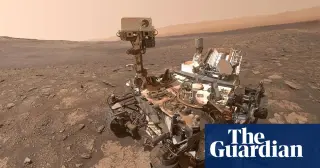
A Nature study using NASA's Curiosity rover finds mud-crack formations indicating long-lasting water cycling on Mars, suggesting the planet could have supported life in the past and perhaps even hosted humans, though many questions remain about how and why conditions changed.
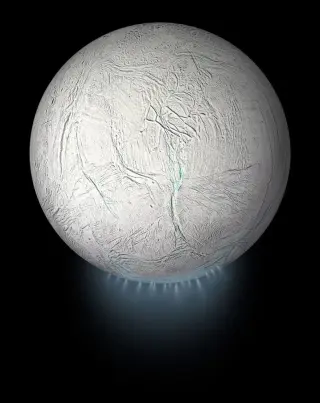
Enceladus hosts a global ocean with water–rock chemistry, energy sources and a rich organic inventory, making it plausibly habitable over geological ages. But a search for life via plume sampling would need to be comprehensive and sensitive; a negative result could still be scientifically meaningful by bounding the circumstances under which life arises, demonstrating that habitability and abiogenesis are not the same.
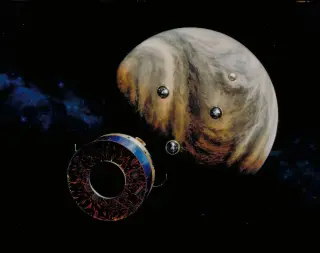
A peer‑reviewed reanalysis of NASA’s 1978 Pioneer Venus data suggests that material trapped in Venus’s middle-to-lower cloud aerosols is about 60% water by mass, with ferric sulphate and sulphuric acid each contributing ~20%. The water is likely bound in hydrated minerals rather than free liquid water, and the finding is provisional, based on an unplanned aerosol collection during descent. While it does not imply life in the clouds, it reopens questions about cloud chemistry and underscores the need for a dedicated aerosol instrument on a future mission (e.g., NASA’s DAVINCI) to test these compositions directly.
A speculative arXiv preprint outlines a megaproject to keep Earth habitable for 9.1 quadrillion years: build a 435,000‑mile sunshade just outside the Moon’s orbit to block the Sun, mine Moon and Ceres for materials to anchor a vast tether, and power an artificial Sun via fusion reactors in Jupiter beamed to Earth; to avoid the Sun’s red giant engulfment, Earth would be nudged outward to about 1.2 AU, with additional safeguards addressing tectonics, water loss and other cosmic threats. The concept remains theoretical and unproven.
Researchers using MAVEN and Tianwen-1 show that solar wind drives Kelvin-Helmholtz waves at Mars’ atmospheric boundary, creating giant waves that strip atmospheric particles into space. This effect is uneven around the planet and depends on the solar wind's electric field, offering a key explanation for Mars’ historic atmosphere loss and implications for other unmagnetized worlds.
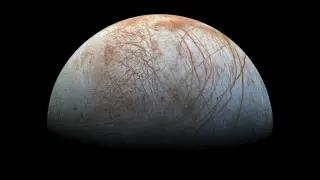
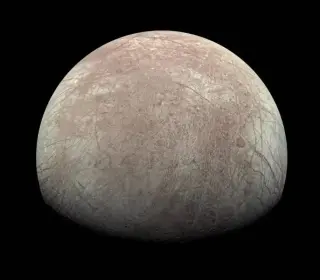
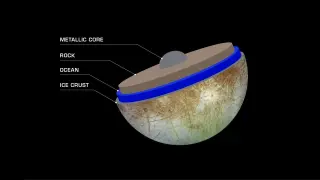
A Juno Microwave Radiometer study estimates an average conductive ice shell of about 29 ± 10 km over Europa’s ocean in the observed region, favoring a thick-shell interpretation. The result is model-based and region-specific, not a global map, and factors like salt content or convection could shift the thickness. This finding tightens the barrier between surface ice and the ocean and underscores why Europa Clipper’s radar, gravity and other measurements are needed to test regional variation and the moon’s habitability potential.
Enceladus’s global ocean—heated, chemically active, with hydrogen as an energy source, plus phosphorus and complex organics—might remain lifeless, and such a null result would be as consequential as a life detection because it would show that the ingredients for life can exist without it. A robust search would use multiple independent biosignatures (cell-like structures, organic distributions, handedness, isotope signals, and metabolic disequilibria) and strict baselines to separate abiotic chemistry from biology, with plume sampling, surface investigations, and contamination controls. If life isn’t found despite sensitive probing, Enceladus would delineate a boundary between habitability and habitation and sharpen origin-of-life research.
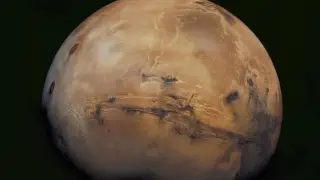
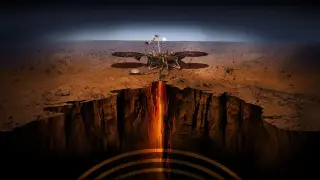
Seismic data from NASA’s InSight lander indicate a deep, interconnected magma system beneath Mars, formed by molten rock pooling and extending hundreds to thousands of miles. This challenges the idea of isolated magma chambers and implies a chemically active crust capable of recycling elements, potentially supporting atmosphere and ocean formation and offering a habitable window for rocky planets even without plate tectonics.
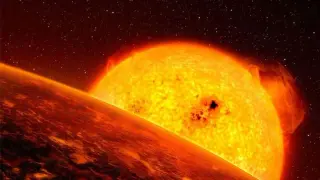
A Cambridge study of four tightly packed exoplanets around Barnard’s Star links their magnesium-rich periclase composition to poor water storage, suggesting these worlds cannot hold onto atmospheres and are likely tidally locked and extremely hostile to life; a stabilizing 9:12:16 resonance among the inner planets may influence their orbits, and future missions like PLATO could discover more small planets around nearby stars.
Despite being only about 500 km across, Enceladus vents a global plume of water, ice and salts from fractures near its south pole; JWST mapped water as far as about 10,000 km away, and Cassini detected salts, phosphates, hydrogen and a suite of organic compounds, pointing to a global salty ocean beneath the ice with hydrothermal activity and chemical energy—making Enceladus a potentially habitable ocean world, though no life has been detected and future missions could sample plume grains directly.
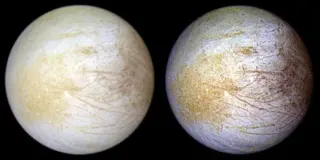
New evidence from magnetic data, surface geology, and interior models points to a global salty ocean beneath Europa’s ice, potentially containing more than twice Earth's ocean water and kept warm by tidal flexing from Jupiter; the Europa Clipper mission will map ice thickness, ocean depth, and chemistry to assess habitability, though no direct measurements have yet confirmed life or sea depth.
A 2025 arXiv modelling study suggests moons bound to planets ejected by supernovae could remain in interstellar space and heat internal oceans via tidal flexing, potentially keeping subsurface oceans for billions of years without sunlight. In simulations, 12–15% of cases yielded heating within the Europa/Enceladus range; surfaces would stay frozen and oceans would be buried, but the internal heat could sustain liquid water. The work is theoretical and depends on model inputs, and no confirmed rogue-planet moons have been observed yet; still, it widens habitable-setting thinking beyond star warmth.
NASA's InSight seismic data reveal a deep crustal boundary on Mars formed by vast magma pools, suggesting the crust differentiated into mafic and ultramafic layers and implying interconnected, long-lived magmatic systems beneath the planet. This transcrustal magmatism could have reprocessed mantle material, releasing greenhouse gases and thickening the early atmosphere to sustain warmer conditions, potentially making Mars habitable in its past, while also hinting at near-surface mineral wealth.