
NASA Advances Nuclear Propulsion to Cut Mars Transit to 60 Days
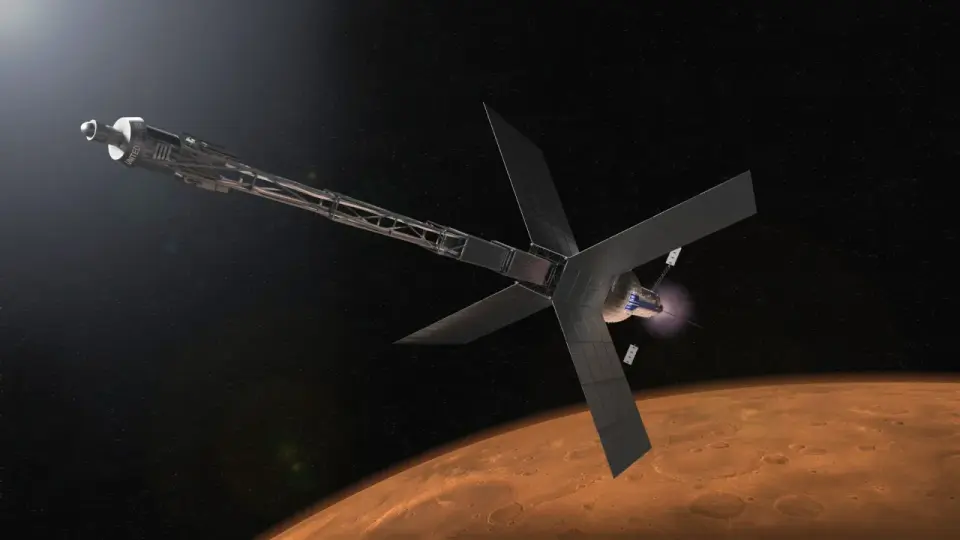
NASA is developing nuclear-powered spacecraft to overcome the limitations of solar energy in deep space, aiming to reduce crewed travel time to Mars from months to approximately 45-60 days. The agency is testing fission surface power units and advanced radioisotope generators to enable missions to icy moons like Europa and the distant Oort cloud.
Key points
- Nuclear propulsion offers a solution for deep space travel where solar power becomes insufficient beyond Mars.
- NASA is advancing two main technologies: radioisotope systems for steady power and fission systems for high-thrust or electric propulsion.
- The SR-1 Freedom initiative is developing lightweight 10- to 40-kilowatt fission units for future lunar and Martian bases.
- Nuclear thermal engines could reduce crewed transit times to Mars to 45-60 days, significantly lowering radiation exposure.
- NASA has successfully deployed over 20 radioisotope systems since the 1960s, including those powering Voyager and Mars rovers.
Background
This development aligns with NASA's broader push to accelerate lunar and deep-space missions. Recent efforts include Administrator Jared Isaacman’s vow to achieve annual SLS launches to land astronauts on the Moon by 2028, ahead of China’s 2029 target. Additionally, SpaceX’s recent Starship orbital debut and the delivery of final solar arrays to the ISS highlight the ongoing transition toward more capable launch and power systems, though nuclear propulsion specifically addresses the energy constraints of destinations far from the Sun.
Why it matters
Nuclear propulsion is critical for expanding human exploration beyond the inner solar system. By reducing travel time to Mars, it mitigates life-support and radiation risks for astronauts. Furthermore, it enables missions to subsurface oceans on icy moons like Europa and Enceladus, which are prime targets in the search for extraterrestrial life, as well as potential interstellar probes.
What to watch
NASA will continue testing High-Assay Low-Enriched Uranium (HALEU) fuel formulations and advanced radioisotope thermoelectric generators to ensure reliability in space. The agency aims to validate these systems for use in upcoming Moon and Mars base operations, with prototypes designed to withstand launch vibrations and operate for decades in the vacuum of space.
Want the full story? Read the original reporting
Read on Interesting Engineering