
JAXA’s MMX Mission to Return Phobos Samples to Australia by 2031
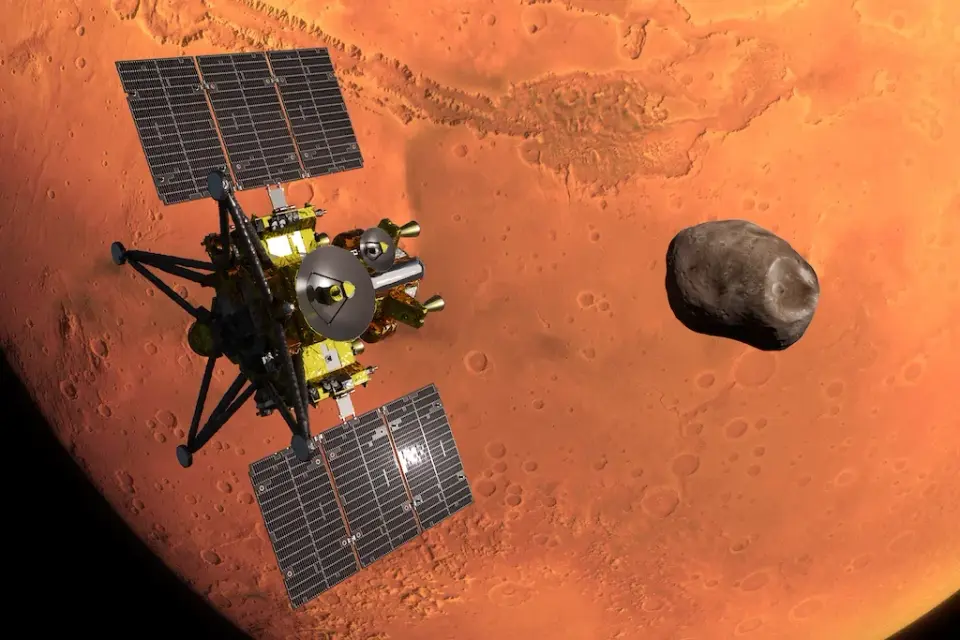
Japan’s JAXA is preparing to launch the Martian Moons eXploration (MMX) spacecraft to collect and return samples from Mars’s moon Phobos. The mission aims to land a rover and the main spacecraft on the moon, gather over 10 grams of material, and deliver a capsule to Australia in 2031. This would be the first deliberate sample return from the Martian system, helping resolve debates about the origin of Mars’s moons and the delivery of water to the inner solar system.
Key points
- JAXA plans to launch MMX on an H3 rocket from Tanegashima Space Center in late 2026, with European partners targeting October 2026.
- The spacecraft will reach Mars in 2027, spend three years in quasi-satellite orbits, and depart in 2030.
- MMX will deploy the 25-kilogram IDEFIX rover, developed by CNES and DLR, to traverse Phobos’s surface for approximately 100 days.
- The main spacecraft will perform a brief landing to collect samples using two systems: a coring tube and a pneumatic sampler.
- The return capsule is scheduled to land in South Australia in 2031, leveraging existing recovery infrastructure from previous JAXA asteroid missions.
- The mission seeks to determine if Phobos is a captured asteroid or formed from impact debris, with implications for understanding water delivery in the solar system.
Background
This mission follows JAXA’s successful Hayabusa and Hayabusa2 asteroid sample returns. It coincides with a broader trend in Mars exploration, including NASA’s revised Mars Sample Return plans and China’s Tianwen-3 mission, which also targets sample return around 2031. Recent observations, such as Earth’s occultation by Phobos captured by Perseverance, highlight the moon’s dynamic orbital characteristics.
How outlets are covering it
Space Daily provides detailed technical insights into the challenges of landing on Phobos, emphasizing the moon’s irregular shape and weak gravity, which complicates rover mobility and sampling. Universe Space Tech highlights the international collaboration and the broader scientific goals, including the origin of Mars’s moons and water delivery. UNN focuses on the geopolitical aspect, noting Japan’s aim to outpace China in Mars exploration. All sources agree on the 2031 return timeline and the 10-gram sample target, but Space Daily offers the most comprehensive technical breakdown of the mission’s phases and instruments.
Why it matters
The MMX mission represents a significant step in planetary science by attempting the first sample return from the Martian system. The results could resolve long-standing debates about the origin of Mars’s moons and provide insights into the distribution of water and organic materials in the solar system. Additionally, the mission’s success would demonstrate new technologies for landing and sampling in low-gravity environments, potentially informing future crewed missions to Mars.
What to watch
The next critical step is the launch of MMX on an H3 rocket, expected in late 2026. Following launch, the spacecraft will travel to Mars, arrive in 2027, and begin its three-year reconnaissance and sampling phase. The return capsule is scheduled to land in Australia in 2031, after which the samples will be transported to JAXA’s curation facilities for analysis.
- Japan is sending a spacecraft to land on Phobos, where gravity is about 1,700 times weaker than Earth’s. MMX will collect more than 10 grams of material and return it to Australia in 2031 — the first sample ever deliberately brought back to Earth from the Marti Space Daily
- JAXA Unveils Martian Moon Probe, Aiming to Be 1st to Take Home Samples The Japan News
- Japanese probe prepares to launch toward Phobos Universe Space Tech
- Japan will send a probe to a moon of Mars to investigate the origins of the Solar System Українські Національні Новини (УНН)
- JAXA Unveils Spacecraft for World's First Mission to Bring Back Sand from a Martian Moon finance.biggo.com
Want the full story? Read the original reporting
Read on Space Daily