
BepiColombo Detaches Propulsion Stage, Begins Final Push to Mercury Orbit
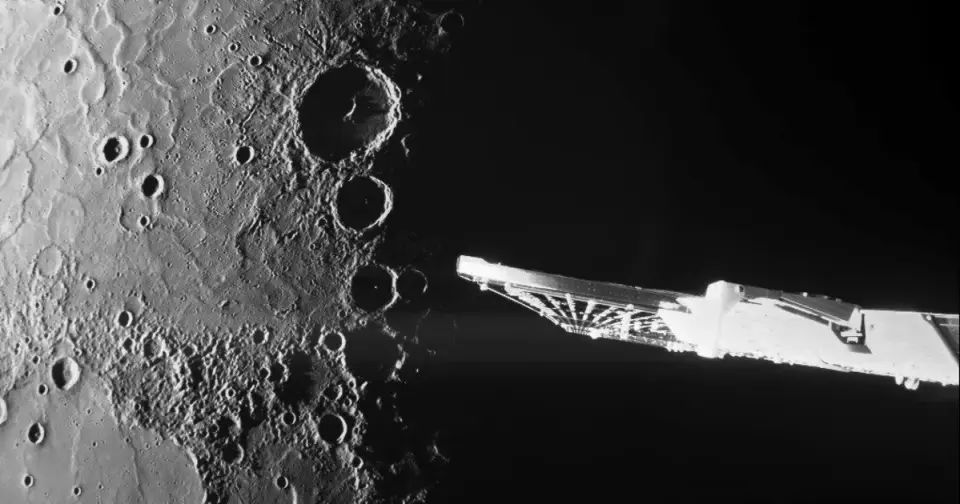
The ESA-JAXA BepiColombo mission successfully separated its Mercury Transfer Module on September 3, 2026, marking the start of a six-month arrival sequence. The twin orbiters will enter Mercury orbit in November and split in December, becoming the first dual-spacecraft mission to study the planet from different altitudes.
Key points
- On September 3, 2026, the Mercury Transfer Module (MTM) separated from the BepiColombo science stack after an eight-year voyage.
- The MTM will drift past Mercury in late October 2026 before entering a permanent solar orbit, while the science orbiters continue to Mercury.
- Orbital insertion around Mercury is scheduled for November 21, 2026, followed by the separation of the two orbiters on December 9-10, 2026.
- The mission has traveled over 6 billion miles (10 billion km), utilizing nine gravity assists from Earth, Venus, and Mercury to slow the spacecraft.
- Science operations are expected to begin in April 2027, with the Mercury Planetary Orbiter (MPO) mapping the surface and the Mercury Magnetospheric Orbiter (MIO) studying the magnetic field.
Background
BepiColombo, a joint European Space Agency (ESA) and Japan Aerospace Exploration Agency (JAXA) mission, launched in October 2018. Named after Italian mathematician Giuseppe 'Bepi' Colombo, it aims to study Mercury's dense interior, magnetic field, and surface features like 'hollows.' Previous coverage noted a 2024 solar panel issue that delayed the arrival from 2025 to 2026. This is the first mission to place two independent spacecraft in orbit around a planet simultaneously.
How outlets are covering it
HuffPost and CNN emphasize the technical success of the MTM separation and the 'nail-biting' nature of the operation, with CNN highlighting the risk of systems failing in the harsh solar environment. Sky & Telescope Magazine focuses on the visual documentation of the journey, releasing a compiled video of the eight-year voyage. Universe Today details the mechanical process of the separation, noting the use of pyrotechnics and springs, and confirms the successful deployment of solar arrays. All sources agree on the timeline for orbital insertion in November and the split in December, but differ in emphasis: CNN and HuffPost focus on the challenges and risks, while Sky & Telescope and Universe Today focus on the technical execution and visual data.
Why it matters
This mission will provide unprecedented data on Mercury's formation, density, and magnetic environment. The dual-orbiter approach allows for simultaneous mapping of the surface and the space environment, potentially solving mysteries about the planet's high density and the origin of surface 'hollows.' It represents a significant milestone in planetary exploration, being the first time two independent spacecraft will orbit a planet together.
What to watch
The next major milestone is the orbital insertion around Mercury on November 21, 2026. Following this, the two orbiters will separate on December 9-10, 2026. The MPO will reach its polar orbit by March 10, 2027, and science operations will officially begin in April 2027. The MTM will drift past Mercury in late October 2026 before entering a permanent orbit around the Sun.
- Two Spacecraft Get Closer To Mercury After Nearly Decade-Long Voyage HuffPost
- 10 billion km in 3 minutes! Epic video captures a spacecraft's 8-year odyssey to planet Mercury skyatnightmagazine.com
- Mercury’s enduring mysteries are ready for an unprecedented close-up CNN
- BepiColombo Successfully Begins Its Final Descent To Mercury Universe Today
- Mercury ready for its close-up as mission prepares to orbit planet newsnationnow.com
Want the full story? Read the original reporting
Read on HuffPost