
Solar Radiation May Intensify Martian Dust Storms, New Data Suggests
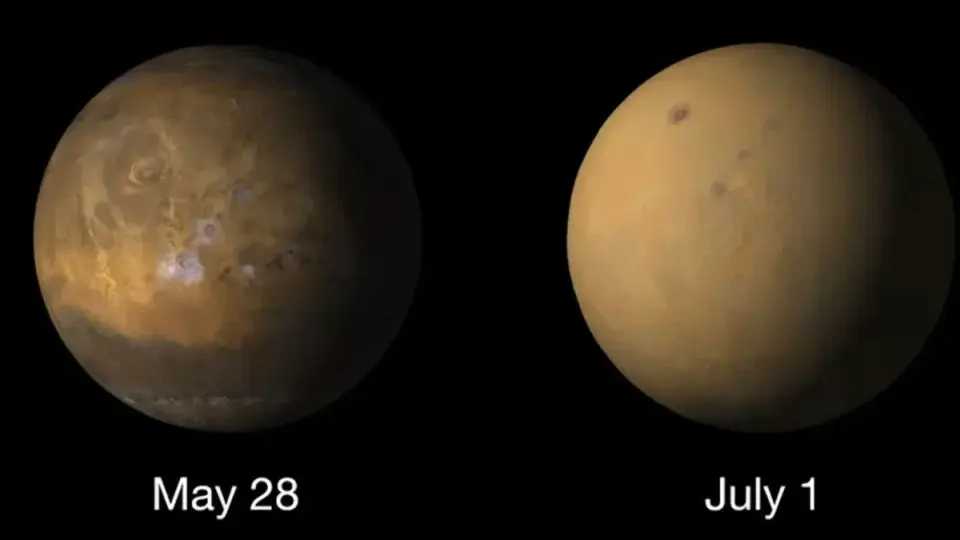
Researchers from Lancaster University and international partners have found evidence that solar energetic particle (SEP) events can synergistically heat Mars' lower atmosphere during global dust storms. Analyzing data from NASA's MAVEN and ESA's Trace Gas Orbiter, the team discovered that a June 2018 solar storm coincided with a massive dust event, causing a temperature spike of approximately 50 degrees Celsius at altitudes between 75 and 125 kilometers. This heating effect was not observed in four other SEP events without concurrent dust storms, suggesting that solar radiation and dust dynamics may interact to amplify weather severity. The finding implies that Mars' weak magnetosphere allows solar particles to penetrate and exacerbate atmospheric conditions, potentially explaining the prolonged silence of the Opportunity rover in 2018. While the researchers caution that two data points are insufficient for definitive proof, they plan to analyze further events, including a significant solar storm in May 2024, to confirm this interaction.
Key points
- A study presented at the Royal Astronomical Society’s National Astronomy Meeting indicates that solar energetic particle events can heat Mars' lower atmosphere when coinciding with global dust storms.
- Data from NASA's MAVEN and ESA's Trace Gas Orbiter showed a temperature increase of about 50 degrees Celsius at 75-125 km altitude during a June 2018 SEP event that overlapped with a planet-wide dust storm.
- Four other SEP events studied showed no clear heating effect, highlighting the unique synergy between solar radiation and dust storms in the 2018 event.
- The 2018 dust storm is linked to the loss of communication with NASA's Opportunity rover, which stopped transmitting on June 10, 2018, after being engulfed by the storm.
- Researchers acknowledge that current evidence is limited to two overlapping events (2018 and 2021) and requires further analysis, particularly of a strong solar storm in May 2024, to confirm the phenomenon.
Background
This discovery adds a new dimension to our understanding of Martian climate, which has previously been studied in isolation from solar activity. Recent archival coverage has focused on broader solar storm impacts, such as the proposed StormWall satellite shield to protect Earth's magnetosphere and the analysis of Carrington-class events using STEREO-A data. Additionally, discussions on Mars terraforming have explored methods to warm the planet, but this new research suggests that natural solar interactions may already play a significant role in Martian atmospheric dynamics. The lack of a strong global magnetic field on Mars, unlike Earth, makes its atmosphere more vulnerable to such solar influences, a factor that was not previously considered in the context of dust storm severity.
How outlets are covering it
Gizmodo emphasizes the unexpected nature of the discovery, noting that dust storms were not the original focus of the study, and highlights the specific temperature measurements recorded by ESA's Trace Gas Orbiter. It also points out the caution of the researchers, who state that further data is needed to confirm the phenomenon. Universe Today, on the other hand, frames the finding as a 'quietly thrilling' accidental discovery, stressing that the team was not looking for dust storm interactions but stumbled upon them. It underscores the importance of considering combined effects in Martian weather models, suggesting that future models may need to account for the Sun and dust working together rather than as separate phenomena. Both sources agree on the significance of the 2018 event but differ in their emphasis: Gizmodo focuses on the technical data and the need for more evidence, while Universe Today highlights the broader implications for understanding Martian atmospheric dynamics.
Why it matters
Understanding how solar storms interact with Martian dust storms could improve the accuracy of weather models for Mars, which is crucial for planning future missions and ensuring the safety of rovers and potential human explorers. The 2018 event that silenced the Opportunity rover serves as a stark reminder of the risks posed by unanticipated atmospheric conditions. If solar radiation can amplify dust storms, it could lead to more frequent and severe weather events, impacting the longevity of surface equipment and the feasibility of long-term habitation. This knowledge could also inform the design of future spacecraft and protective measures for astronauts, as well as contribute to the broader understanding of planetary atmospheres in the solar system.
What to watch
Researchers plan to analyze data from ESA's Trace Gas Orbiter collected from 2022 to the present to look for additional instances of solar-dust storm interactions. A particular focus will be on the May 2024 solar storm, which was strong enough to be captured on video by NASA's Curiosity rover. If further evidence supports the initial findings, it may lead to revised models of Martian atmospheric heating and weather patterns. Additionally, the study may prompt further investigation into the role of solar energetic particles in other planetary atmospheres, particularly those with weak magnetic fields.
Want the full story? Read the original reporting
Read on Gizmodo