
Simulations suggest Venus lost its moon to tidal forces, not a catastrophic event
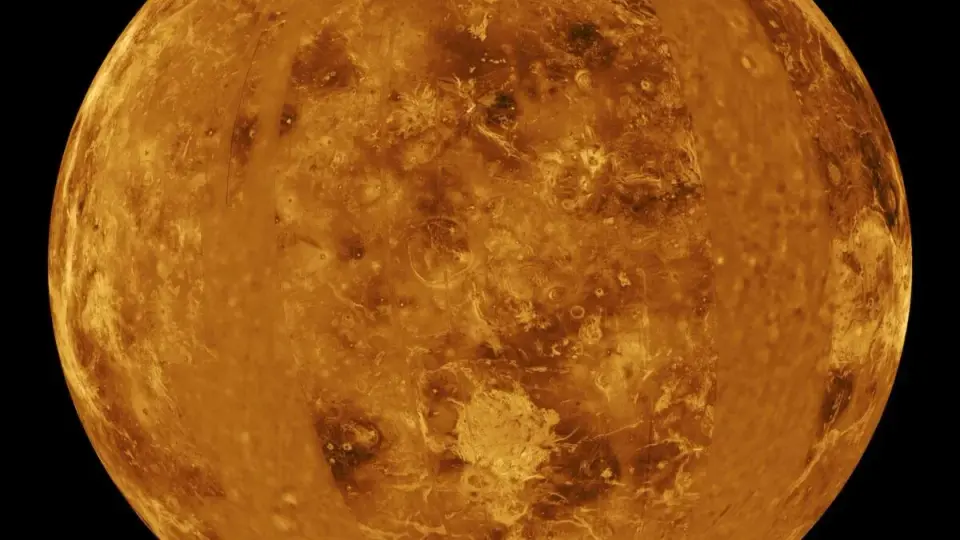
A new study by Stephen Kane and colleagues suggests Venus likely had a moon that was destroyed by tidal forces rather than a catastrophic impact. Simulations show that depending on Venus's early rotation speed and the moon's mass, the satellite would have either survived for billions of years or spiraled inward to be torn apart. The research indicates Venus's current moonless state is a predictable outcome of orbital mechanics, not a rare anomaly.
Key points
- A team led by Stephen Kane at UC Riverside published a preprint on arXiv modeling the tidal evolution of a hypothetical Venusian moon.
- Simulations show a moon with half Earth's Moon's mass could have survived for 1.7 billion years, while a heavier moon might have lasted only 30 million years.
- The study suggests Venus's moon was likely destroyed by crossing the Roche limit, where tidal forces tore it apart, rather than being stripped by a third body.
- The fate of the moon depended critically on Venus's initial rotation period after its last giant impact; a faster spin favored survival, while a slower spin led to destruction.
- The findings imply that Venus-like planets elsewhere in the universe may generally lack large moons due to similar tidal dynamics.
Background
Venus has long been called Earth's twin due to similar size and composition, but its lack of a moon has puzzled scientists. Previous theories suggested a giant impact might have stripped away a moon, but this new study offers a more nuanced explanation based on tidal evolution. Earlier archive coverage noted that future missions like NASA's DAVINCI could look for indirect signatures of a past moon-consumption event, such as debris rings or atmospheric anomalies.
How outlets are covering it
Gizmodo emphasizes the dramatic narrative of Venus 'eating' its moon, highlighting the Roche limit as the point of destruction. The Brighter Side of News focuses on the complexity of tidal models, noting that different assumptions about Venus's interior rheology lead to vastly different outcomes, from survival for 4.5 billion years to destruction in 30 million years. Tech Explorist stresses that the absence of a moon is a predictable outcome of celestial mechanics, not a chance event, and highlights the importance of Venus's post-impact spin period in determining the moon's fate. All sources agree that the study does not prove a moon existed but rather shows that if one did, its fate was likely sealed by tidal forces.
Why it matters
Understanding why Venus lacks a moon helps explain the planet's unique evolutionary path, including its slow retrograde rotation and potential past habitability. If Venus had retained a moon, its climate and rotational history might have been different, potentially influencing the development of life. The findings also have implications for exoplanet science, suggesting that Venus-like worlds may generally lack large moons due to similar tidal dynamics.
What to watch
Future missions like NASA's DAVINCI could look for indirect evidence of a past moon, such as debris rings or atmospheric anomalies. Further research into Venus's interior rheology and tidal dissipation will help refine models of moon evolution. The study also opens up questions about the habitability of Venus in its early history, when it may have had liquid water oceans.
- Venus May Have Had a Moon for Nearly 2 Billion Years—Before It Ate It Gizmodo
- Did Venus eat its own moon? Space
- Why doesn't Venus have a moon? A new study may have the answer Phys.org
- Tidal forces may have doomed an ancient moon around Venus The Brighter Side of News
- Why Venus has no moon: Scientists reveal the strange reason Tech Explorist
Want the full story? Read the original reporting
Read on Gizmodo