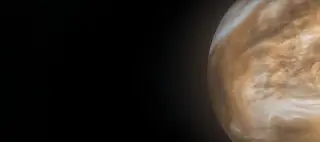
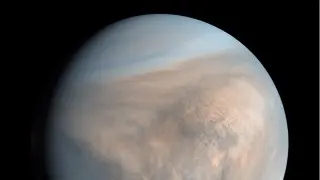
A new microphysical model explains that Venus's long-unexplained lower haze is formed by meteorite dust interacting with sulfuric acid, not volcanic ash. This process also clarifies how iron compounds absorb ultraviolet light in the planet's atmosphere.
Researchers at MIT have demonstrated that complex biological signaling molecules, specifically peptides, can maintain stable three-dimensional structures in environments mimicking Venus’s upper atmosphere. By testing three specific peptides in 98% sulfuric acid, the team found they remained intact for weeks, suggesting that Venus’s cloud layers may be chemically hospitable to certain forms of complex biochemistry despite their extreme acidity.
Three major astrology outlets predict a volatile week for zodiac signs from September 27 to October 3, 2026, driven by Mars entering Leo and Mercury moving into Scorpio. While Cosmopolitan’s content was inaccessible, The Cut and YourTango agree that relationships and communication will face scrutiny. The Cut advises readers to match provocative energy with assertiveness, whereas YourTango warns specific signs to avoid conflict and prioritize self-care. A Venus retrograde beginning in early October is expected to prompt a reassessment of personal values and romantic connections.
As the Sun brightens over roughly the next billion years, Earth’s climate will gradually lose atmospheric CO2, undermining C3 plants and triggering a moist greenhouse that erodes oceans by allowing hydrogen to escape to space. This slow process could render Earth uninhabitable long before the Sun becomes a red giant, gradually stripping away breathable air and water and pushing the planet toward a Venus-like state. The one‑billion-year timeline is uncertain and climate feedbacks like the carbonate-silicate thermostat can delay outcomes, but the overall arc points to a hostile, sterilized Earth long before the Sun’s ultimate evolution.
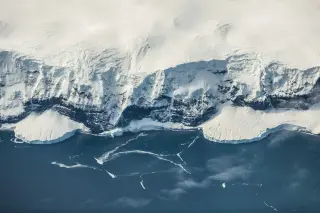
A digest of several studies: Venus may have swallowed a primordial moon due to tidal evolution, potentially shaping its harsh climate; evidence suggests Antarctica hides remnants of the Gondwana Supermountains and submarine fan systems linked to the Cambrian explosion; researchers demonstrate xenocortication by transplanting human brain organoids into mice, where the tissues develop similarly to human brain cells; and a six-page fragment of Nicholas Love’s Mirror of the Blessed Life of Jesus Christ was found tucked in John Gage’s belongings from the Dissolution period.
Venus will reach peak brightness on Friday (Sept. 18), shining at magnitude −4.8 and visible low in the western sky about 30–60 minutes after sunset; it can be seen with the naked eye, though a telescope or binoculars enhances the view. For best results, seek dark-sky locations away from light pollution and minimize screen use. No special eyewear is needed for this planetary display.
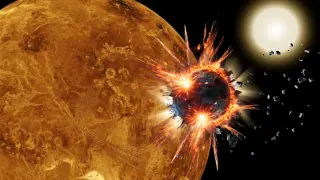
A new study shows Venus’s moonless state can arise from normal tidal evolution after a single giant impact, not a later catastrophe. Whether a moon could survive depends on Venus’s early spin: a fast spin (day <12 hours) could allow a moon to last billions of years; a slower spin would drag it inward and tear it apart within tens of millions to a few billion years. Different interior dissipation models converge for slow spins but differ for fast spins with massive moons. Debris disks from impacts tend to either fall back or place any moon at the tidal survival boundary. Thus Venus-like exoplanets may generally struggle to retain large moons, with climate implications.
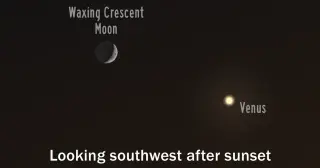
Look west just after sunset Monday to spot a slim crescent Moon near brilliantly bright Venus, which will reach its greatest brightness around Sept. 18 (about magnitude -4.8). In Raleigh, sunset is around 7:23 PM, so find a clear western horizon and enjoy the close pairing, though the objects are millions of miles apart in space (Moon ~240,000 miles from Earth; Venus tens of millions of miles away). Venus’ crescent phase (~25% illuminated) will be easier to see with a telescope or binoculars, and nearby guide stars Spica (to the right) and Antares (to the left) can help with orientation.
Venus ends up hotter than Mercury not because it’s closer to the Sun, but because its thick CO2 atmosphere and dense clouds trap heat so effectively that infrared energy is repeatedly absorbed and re-emitted, creating a strong greenhouse effect. Mercury, by contrast, has almost no atmosphere, so it heats during the day but cools dramatically at night. Even though Venus reflects a large portion of sunlight, the atmosphere’s heat-trapping blanket means the planet’s surface stays extremely hot, illustrating that distance from the Sun is only part of a planet’s climate story.
The European Space Agency will press ahead with the EnVision Venus orbiter using a European radar payload after NASA signaled it cannot deliver the originally planned US‑built radar; Europe has pushed the launch to 2032 to develop its own radar, while NASA’s budget pressures drive cuts to international partnerships, prompting ESA to cover the radar role domestically and explore other collaborations.
A new arXiv study suggests Venus could have harbored a moon for up to about 1.7 billion years (if the moon was roughly half the mass of Earth's), while a moon twice as massive would last only ~30 million years before Venus’ gravity drags it into the Roche limit and tears it apart, implying a brief, moon-influenced phase in Venus’s early history that could relate to its potential habitability.
A new simulation argues that a hypothetical moon around Venus would typically spiral inward and be torn apart by the planet, explaining why Venus has no moon. Survival would require a fast-spinning early Venus and a small moon, a combination likely not present in Venus's history. The study suggests Venus-like worlds elsewhere may generally lack large moons; direct evidence is hard to obtain, but future missions such as NASA’s DAVINCI could look for indirect signatures of a past moon-consumption event.
A 2025 Science Advances study proposes Venus’s Baltis Vallis—the Solar System’s longest channel at about 6,800 kilometers—was formed by unusually mobile carbonatite lava rather than water, with a low-viscosity melt potentially releasing enough CO2 to help drive Venus’s current greenhouse climate; models show carbonatite could travel far under Venusian conditions, but the idea depends on uncertain eruption volumes and gas fractions and remains unproven without direct samples; future missions VERITAS and Envision could test surface composition and channel morphology, though even a positive result would not confirm oceans, life, or a temperate Venus past.
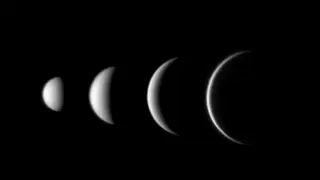
Venus is slipping toward inferior conjunction (Oct. 24), its disk shrinking from about 36% to 32% illuminated while its apparent size grows. The planet peaks in brightness in mid‑September (around magnitude -4.8 on Sept. 18) as the thin crescent becomes most conspicuous in small telescopes. After that, it fades into the sunset glare, so observers—especially in mid‑northern latitudes—should look low in the west-southwest just after sunset, using a telescope or binoculars to glimpse the phase. This is a classic demonstration of solar system geometry, echoing Galileo’s early observations that confirmed the heliocentric model; meanwhile, the August 15 greatest elongation (~46 degrees) precedes October’s closer approach to the Sun.
A 2025 reanalysis of data from NASA’s Pioneer Venus Large Probe’s 1978 descent suggests Venus’s cloud aerosols may be about 60% water by mass, largely bound in hydrated ferric sulphates (and possibly magnesium sulphates), with most water released only upon heating. This points to hydrated salts as part of cloud composition and does not overturn the sulfuric-acid model, but it does complicate the simple acid-water picture. The finding comes from a single historic descent and could reflect sampling artefacts, so confirming evidence from future dedicated missions (e.g., DAVINCI, Venus Life Finder) is needed across multiple cloud layers.