
1988 Green Bank Telescope Collapse: Structural Failure Ends Era of World's Largest Radio Dish
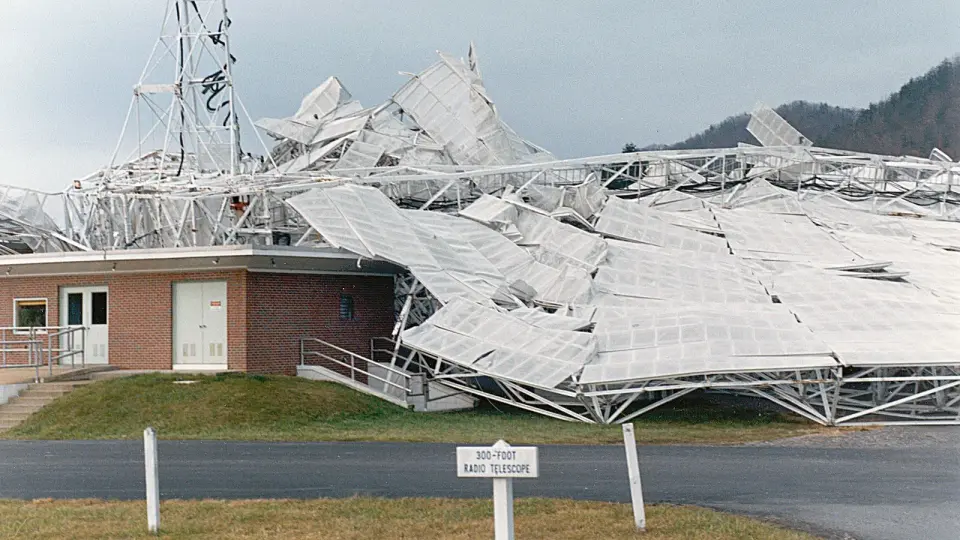
On November 15, 1988, the 300-foot radio telescope in West Virginia collapsed under its own weight due to a failed structural plate. The incident, which occurred without warning or high winds, left significant debris and ended the operation of the world's largest radio observatory at the time. A replacement facility began operations in 2001.
Key points
- The 300-foot telescope in Green Bank, West Virginia, collapsed at 9:46 p.m. on November 15, 1988, under clear skies and calm wind conditions.
- Investigators determined that a 'gusset plate,' one of four connectors holding the metal beams together, failed because it was not designed for the 26 years of service the telescope had endured.
- The collapse was attributed to unforeseeable stress factors rather than negligence, as the original structure had undergone significant upgrades, including a new aluminum surface in 1970.
- The telescope contributed to major scientific discoveries, including evidence for dark matter and the origin of pulsars from supernova explosions, before its failure.
- Construction of a larger and more sensitive replacement, the Green Bank Telescope, began three years after the collapse and began science operations in 2001.
Background
The 300-foot telescope was the largest radio observatory in the world when it debuted, though its rapid two-year construction led to later upgrades. It produced the Green Bank 6cm Survey, a catalog of radio objects that remains a primary reference for northern hemisphere radio astronomy. This event is distinct from other recent telescope failures, such as the 2020 collapse of the Arecibo Observatory, and serves as a historical marker for structural engineering challenges in large-scale astronomical infrastructure.
Why it matters
The collapse highlighted the long-term structural risks of rapid construction in large-scale scientific infrastructure. It demonstrated that even world-leading facilities require rigorous long-term maintenance and material stress testing. The subsequent replacement, the Green Bank Telescope, became a critical tool for modern radio astronomy, underscoring the resilience of the field despite significant hardware losses.
What to watch
The Green Bank Telescope, which replaced the collapsed structure, continues to operate as a leading facility for radio astronomy. It supports ongoing research into cosmic phenomena, building on the foundational data collected by its predecessor before the 1988 failure.
Want the full story? Read the original reporting
Read on Space