
Astronauts Complete Final ISS Solar Array Installation After Troubleshooting Power Glitch
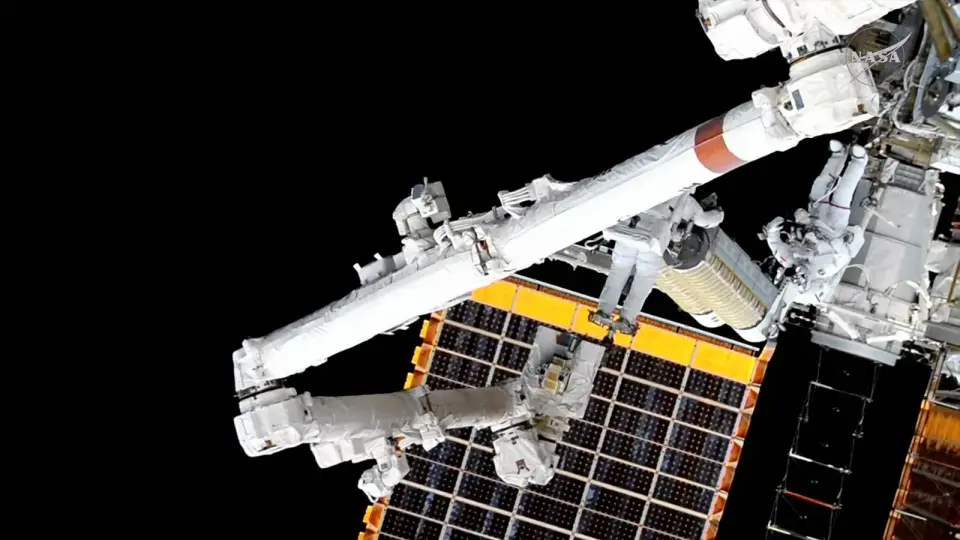
NASA astronaut Anil Menon and Canadian Space Agency astronaut Joshua Kutryk successfully installed the eighth and final Roll-Out Solar Array (iROSA) on the International Space Station on November 5, 2026. The 6-hour, 59-minute spacewalk concluded a five-year power upgrade project, boosting the station’s electricity capacity by up to 30% to support operations through its scheduled 2030 deorbit. The deployment faced a temporary halt when ground controllers detected lower-than-expected electrical current, requiring the crew to wait for Earth’s shadow to inspect and reseat connectors before the array could unfurl.
Key points
- The eighth and final iROSA was deployed on the 3B power channel of the station’s starboard truss, completing the installation of all eight new arrays.
- The spacewalk began at 8:36 a.m. EST and ended at 3:35 p.m. EST, lasting 6 hours and 59 minutes.
- Mission Control paused the deployment after detecting only half the expected shunt current, forcing the crew to wait for orbital night to safely inspect the live electrical connectors.
- The new arrays are half the size of the legacy wings but generate 40% more power, with each iROSA producing approximately 8 kilowatts.
- This was the 286th spacewalk in support of the ISS and the ninth of 2026, marking the end of a five-year power augmentation effort.
Background
The need for the iROSA upgrades arose as the station’s original solar arrays, installed between 2000 and 2009, exceeded their 15-year design life and showed degraded output. The first iROSA was deployed in June 2021, with the final pair delivered to the station via a SpaceX Dragon cargo spacecraft in October 2026. Previous coverage noted that the seventh array was installed on October 29, 2026, during the 100th U.S. spacewalk since the shuttle era ended. This final installation completes the power system upgrades necessary to sustain the ISS through its planned retirement and controlled deorbit in late 2030.
How outlets are covering it
All sources confirm the successful completion of the eighth iROSA installation by Menon and Kutryk. Space.com and Spaceflight Now highlight the technical challenge of the low current reading, which required the crew to wait for Earth’s shadow to inspect the connectors, a detail emphasized by Spaceflight Now as a critical safety measure. Global News focuses on the Canadian perspective, noting Kutryk’s status as the fifth Canadian to perform a spacewalk and his second outing in two weeks. NASA’s official report provides the logistical details of the spacewalk timing and crew roles. While Space.com notes the arrays will produce 30% more electricity overall, Spaceflight Now specifies that each individual iROSA generates 8 kilowatts compared to 19 kilowatts for the original wings when new. There is no disagreement on the outcome, but the emphasis varies between the technical troubleshooting process and the broader significance of the power upgrade for the station’s longevity.
Why it matters
The completion of the iROSA installation ensures the International Space Station has sufficient power to operate safely until its 2030 deorbit. This upgrade addresses the degradation of the original solar arrays and supports continued scientific research and crew operations. The successful resolution of the power connector issue demonstrates the adaptability of ground control and crew coordination during critical extravehicular activities. This milestone also marks the end of a five-year project that involved multiple spacewalks by different crews, ensuring the station’s power infrastructure remains viable for its final years in orbit.
What to watch
NASA’s next planned U.S. spacewalks are targeted for early January 2026 to upgrade the Alpha Magnetic Spectrometer, a cosmic-ray detector mounted on the station’s truss. Following this, the station will continue operations with the upgraded power system until its scheduled deorbit in late 2030. The crew will likely resume standard research and maintenance activities, with no further iROSA installations required as all eight arrays are now deployed.
- 'We got it done!' Spacewalking astronauts finish installing next-gen ISS solar arrays Space
- Spacewalk Begins to Install Last Roll-Out Solar Array NASA (.gov)
- Spacewalkers complete five-year effort to upgrade space station power supply Spaceflight Now
- Canadian astronaut Joshua Kutryk begins 2nd spacewalk Global News
- Spacewalkers install final add-on solar array, completing space station power upgrade CBS News
Want the full story? Read the original reporting
Read on Space