
Astronomers Identify First Candidate for a 'Microblazar' in the Milky Way
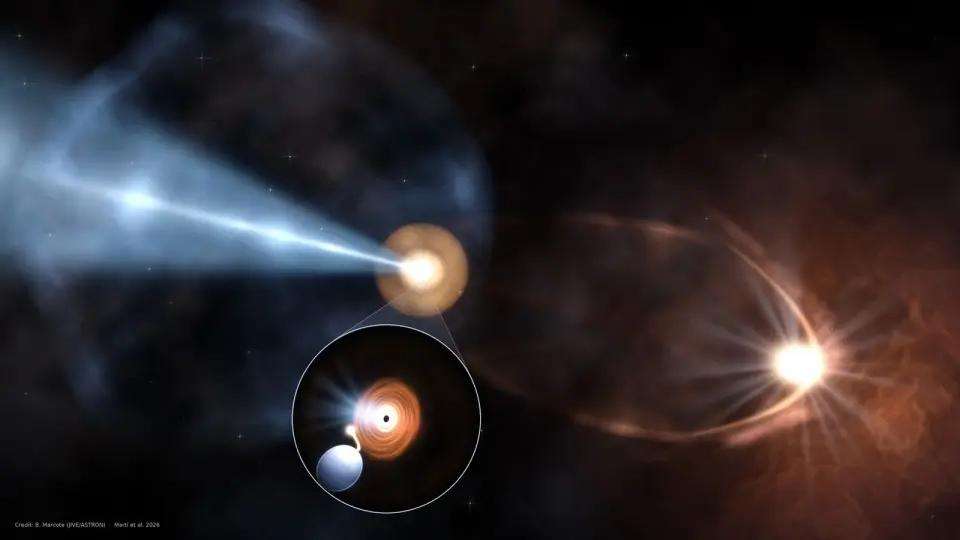
An international team of astronomers has identified IRAS 18293-0941 as the first strong candidate for a 'microblazar,' a long-theorized cosmic object. Located about 12,000 light-years from Earth in the Milky Way, this binary system features a black hole orbiting a giant star. The black hole ejects matter in powerful jets, one of which is pointed directly at Earth, offering a rare opportunity to study these energetic phenomena up close.
Key points
- IRAS 18293-0941 is a binary system consisting of a black hole and a hot giant star orbiting each other every 11 days.
- The object is located approximately 12,000 light-years from Earth and is obscured by a veil of dust.
- One of the black hole's relativistic jets is directed toward Earth, making it a 'blazar' candidate.
- The discovery was confirmed using data from the Calar Alto Observatory, the European Very Long Baseline Interferometry Network, the MeerKAT radio telescope, and the Very Large Array.
- The study was accepted for publication in the journal Astronomy and Astrophysics.
Background
Blazars are supermassive black holes that emit powerful jets of particles and radiation, with at least one jet pointed directly at Earth. While larger versions are common in distant galaxies, 'microblazars' involving stellar-mass black holes had only been theorized. Previous discoveries of 'microquasars' (smaller quasars) had led scientists to predict the existence of microblazars, but none had been confirmed until now. This discovery provides a closer, more accessible target for studying the physics of these extreme objects compared to distant galactic blazars.
How outlets are covering it
Live Science and Science News emphasize the significance of this being the first serious candidate for a microblazar, highlighting the potential to understand how these objects behave. BBC Sky at Night Magazine notes that the object was first detected in 1983 by the Infrared Astronomical Satellite (IRAS) and that the confirmation came after years of study. UA.NEWS points out a discrepancy: while the object shows signs of jets interacting with the environment, it lacks the rapid brightness variations typically expected from a microblazar. Lead author Josep Martí suggests that a surrounding gas cloud may smooth out these fluctuations. All sources agree that the object's proximity allows for detailed study of jet interactions with the interstellar medium, including the detection of a 'hotspot' caused by the opposite jet heating surrounding gas.
Why it matters
This discovery provides a unique laboratory for studying the physics of relativistic jets and accretion processes in stellar-mass black holes. By observing a microblazar in our own galaxy, astronomers can gain insights into how these objects form, evolve, and interact with their surroundings, which may help explain the origins of high-energy particles in the universe.
What to watch
Researchers are continuing to analyze the data to confirm the presence of the opposite jet and its interaction with the interstellar medium. They are also investigating why the object does not exhibit the expected rapid brightness variations, with hypotheses including the smoothing effect of a surrounding gas cloud. Further observations will aim to refine the understanding of microblazar behavior and their role in cosmic ray acceleration.
- Earth is in the firing line of a strange new type of cosmic object: a 'microblazar' Live Science
- Astronomers say they’ve spotted the first miniature quasar pointed at Earth Science News
- Astronomers describe candidate for first known microblazar — Live Science UA.NEWS
- First microblazar produces possibly the fastest particles in the Milky Way Technology Org
- There's an enormous black hole pointing its jet at Earth – and scientists only found it because of a strange flash in deep space BBC Sky at Night Magazine
Want the full story? Read the original reporting
Read on Live Science