
China Scraps Chang'e-7 Launch Amid Typhoon Delays and Lunar Race Tensions
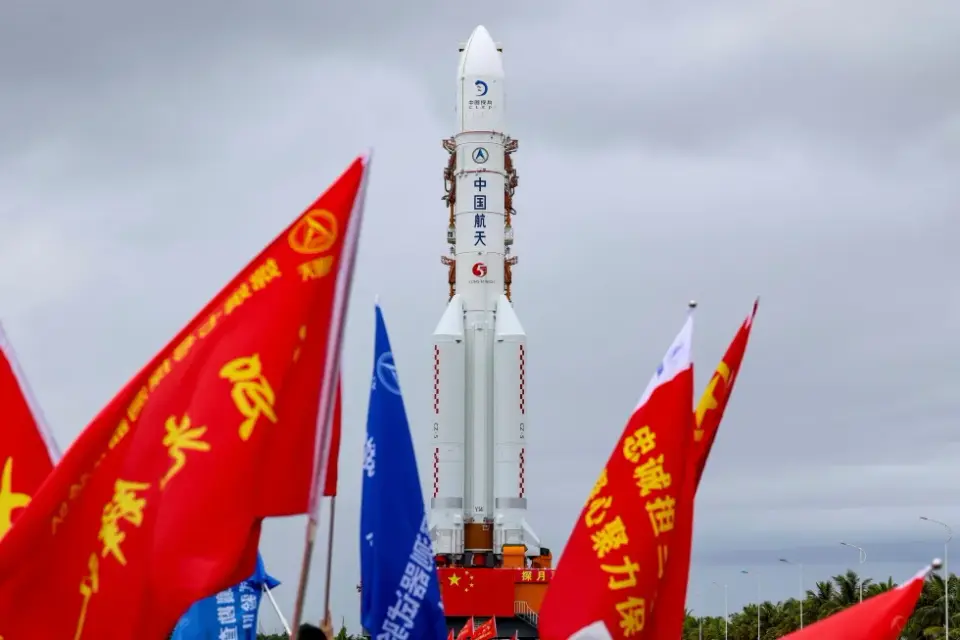
China’s Manned Space Agency abruptly postponed the Chang’e-7 lunar mission on August 23, 2026, citing a failure to meet launch conditions. The probe, intended to search for water ice near the Moon’s south pole, was scheduled to launch from Hainan Island but was held back by Typhoon Narra and strict reliability requirements. This delay intensifies the race with the United States, as NASA’s Blue Origin lander may now reach the lunar pole first in early 2027.
Key points
- China’s Manned Space Agency announced the postponement on August 23, 2026, stating the mission does not meet conditions for 'absolute success.'
- The Chang’e-7 probe, consisting of an orbiter, lander, rover, and hopping vehicle, was set to launch from Wenchang on a Long March 5 rocket.
- The delay is likely caused by Typhoon Narra, which is lingering near Hainan Island, and the closing of the current launch window for the lunar south pole.
- The mission aims to locate water ice in permanently shadowed craters near Shackleton Crater, a critical resource for future lunar settlements.
- The postponement may allow NASA’s Blue Origin Blue Moon lander to reach the lunar south pole first, potentially in early 2027.
Background
Chang’e-7 is the seventh in China’s lunar exploration series, following the 2024 Chang’e-6 sample return. Previous archive coverage noted the mission’s goal to assess water ice accessibility for a potential 2030 crewed landing and an international lunar research station. The mission was originally targeted for an August 24, 2026 launch, with a 90-day orbital reconnaissance phase before landing.
How outlets are covering it
AP News and CBS News reported the postponement as a sudden decision by Chinese authorities without detailed technical explanations, emphasizing the agency’s focus on 'prudence' and 'reliability.' Ars Technica provided a technical analysis, attributing the delay primarily to Typhoon Narra and the closing of the launch window, while noting a less likely possibility of engine issues related to the YF-100 engine shared with a recently failed Long March 7A. ABC News framed the delay within the broader 'new space race,' highlighting NASA Administrator Jared Isaacman’s comments on the competition for lunar resources and the strategic importance of reaching the south pole first. All sources agree on the mission’s scientific goals but differ on the primary cause of the delay, with Ars Technica offering the most specific meteorological context.
Why it matters
The delay shifts the timeline for the first robotic landing at the lunar south pole, potentially allowing the United States to claim the first presence in this resource-rich region. This could influence future international cooperation or competition for lunar resources, including water ice for fuel and life support, and may affect the schedule for China’s planned crewed lunar landing by 2030.
What to watch
China is expected to seek a new launch window in February or March 2027, according to social media chatter cited by Ars Technica. NASA’s Blue Origin Blue Moon lander is also targeting the first half of 2027 for its south pole mission. The outcome of these launches will determine which nation first establishes a robotic presence at the lunar south pole, with significant implications for future crewed missions and resource extraction.
- China abruptly postpones ambitious Chang’e-7 lunar mission launch AP News
- Due to need for ‘absolute success,’ China delays critical Moon launch to 2027 Ars Technica
- China's bid for lunar water launches Sunday as the new space race heats up ABC News - Breaking News, Latest News and Videos
- China postpones Chang'e-7 moon launch as mission fails to meet launch conditions, officials say CBS News
- China puts off Chang’e-7 mission to drill for ice near lunar south pole South China Morning Post
Want the full story? Read the original reporting
Read on AP News