
Newly Found Ocean World HD 176071 b Is Doomed to Be Devoured by Its Star
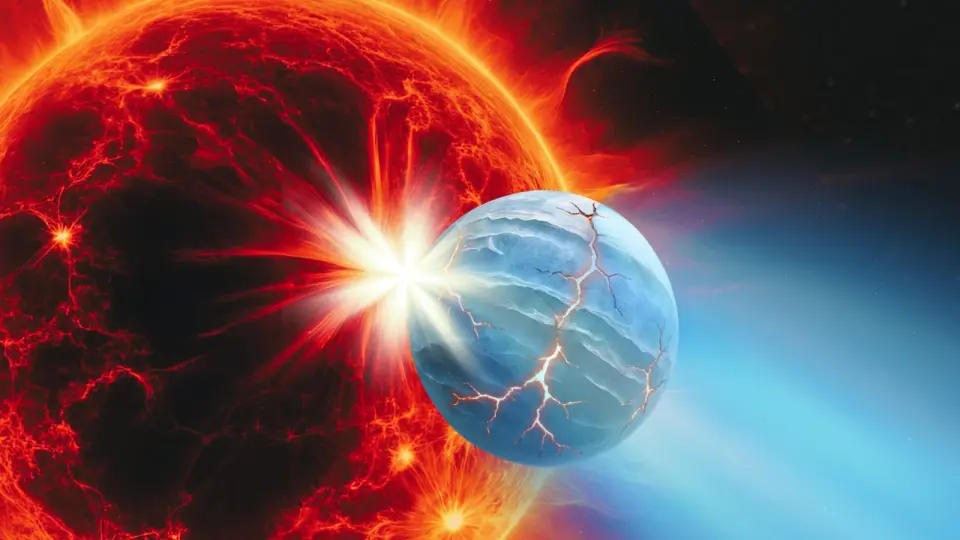
Astronomers have identified a new exoplanet, HD 176071 b, located 335 light-years away, which is composed of roughly 50% water. Orbiting extremely close to its host star with a 14-hour year, the planet is subject to intense tidal forces that will inevitably cause it to be swallowed by the star. This discovery is notable because the planet retains a dynamic atmosphere despite residing in the 'Neptunian Desert,' a region where such worlds typically lose their gaseous layers due to stellar radiation.
Key points
- HD 176071 b is approximately 2.5 times the size of Earth and 8.5 times its mass, indicating a composition that is about 50% water.
- The planet orbits its star at a distance of just under 1.5 million miles, resulting in an orbital period of only 14 hours.
- Extreme tidal forces from the star are driving the planet toward a rapid orbital decay, leading to its eventual destruction.
- The discovery was made by comparing historical data from the Kepler space telescope with recent observations from the TESS satellite, revealing an unexpected phase shift in reflected light.
- The planet defies the 'Neptunian Desert' phenomenon by maintaining a dynamic atmosphere, which is usually stripped away from close-orbiting planets by intense stellar radiation.
Background
Recent astronomical findings have increasingly focused on the fate of close-orbiting planets and the chemical history of water in exoplanet atmospheres. For instance, earlier studies using the James Webb Space Telescope analyzed semi-heavy water on WASP-39b to understand atmospheric escape, while other research has identified stars that may have already swallowed planets, such as TOI-5882. The discovery of HD 176071 b adds to this growing body of evidence regarding how stellar interactions and tidal forces shape the lifecycle of nearby worlds.
Why it matters
This discovery provides a rare observational example of a 'hot water world' that challenges existing models of atmospheric retention in extreme environments. By confirming that a water-rich planet can maintain an atmosphere in the 'Neptunian Desert,' scientists can better understand the mechanisms of planetary evolution and the limits of stellar radiation effects on exoplanet composition.
What to watch
Researchers will continue to monitor HD 176071 b to track its orbital decay and atmospheric changes as it moves closer to its host star. Further analysis of the phase shift in reflected light may provide additional insights into the planet's surface composition and the dynamics of its impending destruction.
Want the full story? Read the original reporting
Read on Space