
Crew-12 Returns to Earth After 237-Day ISS Mission, Setting European Spaceflight Record
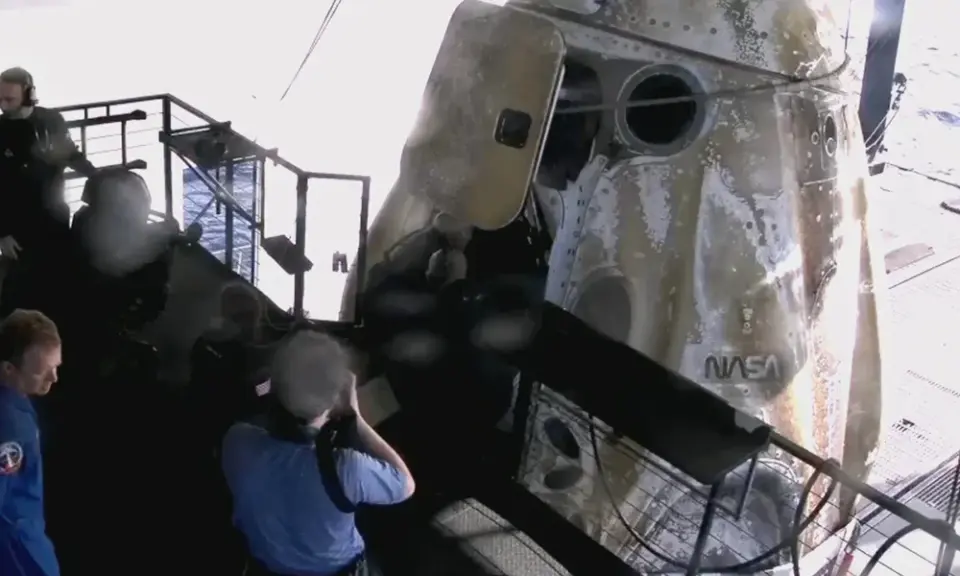
SpaceX successfully returned the Crew-12 astronauts to Earth on October 8, 2026, after a 237-day mission aboard the International Space Station. The crew, comprising NASA’s Jessica Meir and Jack Hathaway, ESA’s Sophie Adenot, and Roscosmos’ Andrey Fedyaev, splashed down in the Pacific Ocean off Los Angeles. The mission concluded a period of intensive scientific research and spacewalks, with Adenot setting a new European record for the longest single spaceflight. A post-flight briefing is scheduled for October 15 at NASA’s Johnson Space Center.
Key points
- Crew-12 splashed down in the Pacific Ocean off the coast of Los Angeles on October 8, 2026, at 8:34 a.m. PDT.
- The mission lasted 237 days, during which the crew traveled over 100 million miles and completed 3,792 orbits of Earth.
- Sophie Adenot set a new European record for the longest single spaceflight, exceeding the previous record by more than 35 days.
- Jessica Meir completed four spacewalks, bringing her career total to seven and placing her third all-time among women at NASA.
- A news conference to discuss the mission’s scientific achievements is scheduled for October 15 at NASA’s Johnson Space Center in Houston.
Background
The return of Crew-12 follows the arrival of Crew-13 on October 1, 2026, which set a record for the fastest transit to the ISS. The Crew-12 mission was originally launched in February 2026 to replace a crew that was sent home early due to a medical emergency, marking NASA’s first medical evacuation in 65 years. The successful return of Crew-12 and the arrival of Crew-13 ensure continuous human presence on the ISS, with seven astronauts currently aboard representing the US, Russia, and Canada.
How outlets are covering it
NASA and ESA emphasized the scientific achievements and the record-breaking nature of the mission, particularly highlighting Adenot’s European record and Meir’s spacewalk milestones. The Guardian focused on the human element, noting the crew’s eagerness to return home after eight months and the context of the earlier medical evacuation. All sources agreed on the successful and flawless nature of the return, with no discrepancies in the reported facts.
Why it matters
The successful return of Crew-12 demonstrates the reliability of SpaceX’s Crew Dragon spacecraft and the ongoing collaboration between NASA, ESA, and Roscosmos. The scientific research conducted during the mission, including studies on stem cell production and IV fluid generation, has implications for future human exploration of the Moon and Mars. The mission also highlights the importance of international cooperation in space exploration and the ability to respond to medical emergencies in orbit.
What to watch
A news conference is scheduled for October 15 at NASA’s Johnson Space Center to discuss the mission’s scientific achievements. Sophie Adenot will return to Europe and will not be available for the briefing. The crew will undergo post-flight medical screenings and return to their respective agencies. The ISS will continue to be occupied by Crew-13 and a third crew, ensuring continuous human presence in orbit.
- SpaceX brings four astronauts home after 8 months in space, and the return was flawless Teslarati
- NASA’s SpaceX Crew‑12 Splashes Down, Sets Briefing to Discuss Mission NASA (.gov)
- 4 people on NASA's Crew-12 mission return to Earth after 8 months in space NPR
- Four astronauts return to Earth from ISS after medical relief mission The Guardian
- Splashdown confirmed for Sophie Adenot European Space Agency (ESA)
Want the full story? Read the original reporting
Read on Teslarati