
Curivity Marks 1-Kilometer Elevation Milestone on Mount Sharp
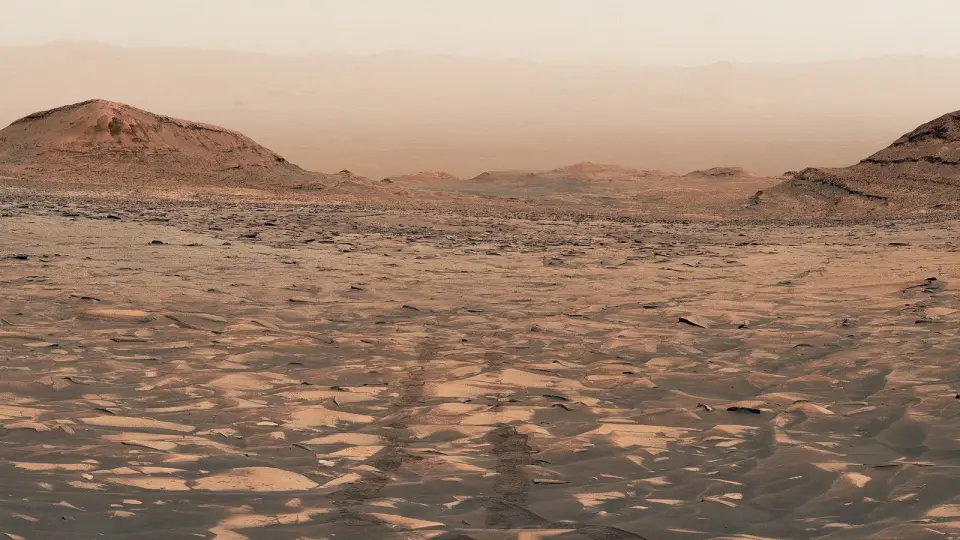
NASA's Curiosity rover has reached a total elevation gain of 1 kilometer (0.6 miles) during its 14-year mission on Mars. The milestone was marked on August 26, 2026, as the rover continues its ascent up Mount Sharp within Gale Crater. The achievement was documented by a panoramic image composed of 323 individual shots taken by the rover's Mastcam on August 1 and 2, 2026. The photo, taken from a valley nicknamed 'Valle Grande,' shows the rover's tracks leading back toward the crater floor. This progress is part of a broader scientific effort to analyze sedimentary layers that record Mars' environmental history, with the rover having traveled over 37 kilometers and climbed more than 1.35 kilometers in total elevation since landing in 2012.
Key points
- Curiosity achieved a 1-kilometer elevation gain on August 26, 2026, marking a significant milestone in its 14-year mission.
- The milestone was captured via a 323-image panorama taken on August 1 and 2, 2026, from the 'Valle Grande' valley on Mount Sharp.
- The rover has traveled over 37 kilometers and climbed more than 1.35 kilometers in total elevation since its 2012 landing.
- Recent operations include investigating geological features like 'Los Toldos' and monitoring atmospheric dust levels as Mars transitions into fall.
- The climb through Mount Sharp's sedimentary layers allows scientists to study how Mars' environment evolved over billions of years.
Background
Curiosity landed in Gale Crater on August 5, 2012, and began climbing Mount Sharp in 2014. The mountain is approximately 5 kilometers tall and contains sedimentary rock layers that preserve evidence of Mars' changing environmental conditions. Previous coverage noted that Curiosity has discovered signs of ancient lakes and streams, as well as clay-rich mudstones and organic molecules suggesting habitable conditions. Recent images have also sparked public debate, such as a 'jellyfish' artifact attributed to cosmic rays, and revealed ancient sandstorm wreckage, highlighting the rover's ongoing role in both scientific discovery and public engagement.
How outlets are covering it
NASA and Space.com emphasize the milestone as a 'pinnacle' of the mission, highlighting the visual achievement of the 1-kilometer elevation gain and the panoramic view of Mount Sharp. Hindustan Times focuses on the atmospheric context, noting that the images provide a glimpse of Martian summer and the dusty conditions that affect rover operations. Mirage News provides a technical perspective, detailing recent operational challenges, such as navigating steep slopes and loose rocks, and the specific scientific activities like ChemCam spectroscopy and dust storm monitoring. While all sources agree on the milestone, they differ in emphasis: NASA and Space.com focus on the visual and historical significance, Hindustan Times on the environmental conditions, and Mirage News on the operational and scientific details of the rover's recent activities.
Why it matters
The 1-kilometer elevation gain represents a significant achievement in planetary exploration, demonstrating the rover's ability to navigate complex terrain and continue its long-term scientific mission. The data collected from Mount Sharp's sedimentary layers provides crucial insights into Mars' past environment and potential habitability, contributing to our understanding of how planetary environments evolve over time. This milestone also highlights the resilience and capability of robotic exploration in extreme environments, setting the stage for future missions and continued scientific discovery on Mars.
What to watch
Curiosity will continue its climb up Mount Sharp, with planned drives of 150 feet (47 meters) to new locations. The rover will engage in further contact science, remote sensing, and environmental monitoring, including dust storm observations as Mars transitions into fall. Scientists will continue to analyze the geological features and atmospheric data collected, aiming to understand the planet's history and potential for past life. Future missions may build on Curiosity's findings, potentially including the return of rock samples to Earth for definitive analysis.
- Curiosity climbs to new heights on Mars photo of the day for Aug. 28, 2026 Space
- Curiosity Reaches 1-Kilometer Elevation Gain NASA Science (.gov)
- What does a Martian summer look like? NASA’s Curiosity captures stunning views Hindustan Times
- Curiosity Blog: Back to Regular Programming Mirage News
- Curiosity climbs to new heights on Mars | Space photo of the day for Aug. 28, 2026 Yahoo
Want the full story? Read the original reporting
Read on Space