
Curiosity’s Morse Code Wheel Marks Serve as Critical Navigation Tools
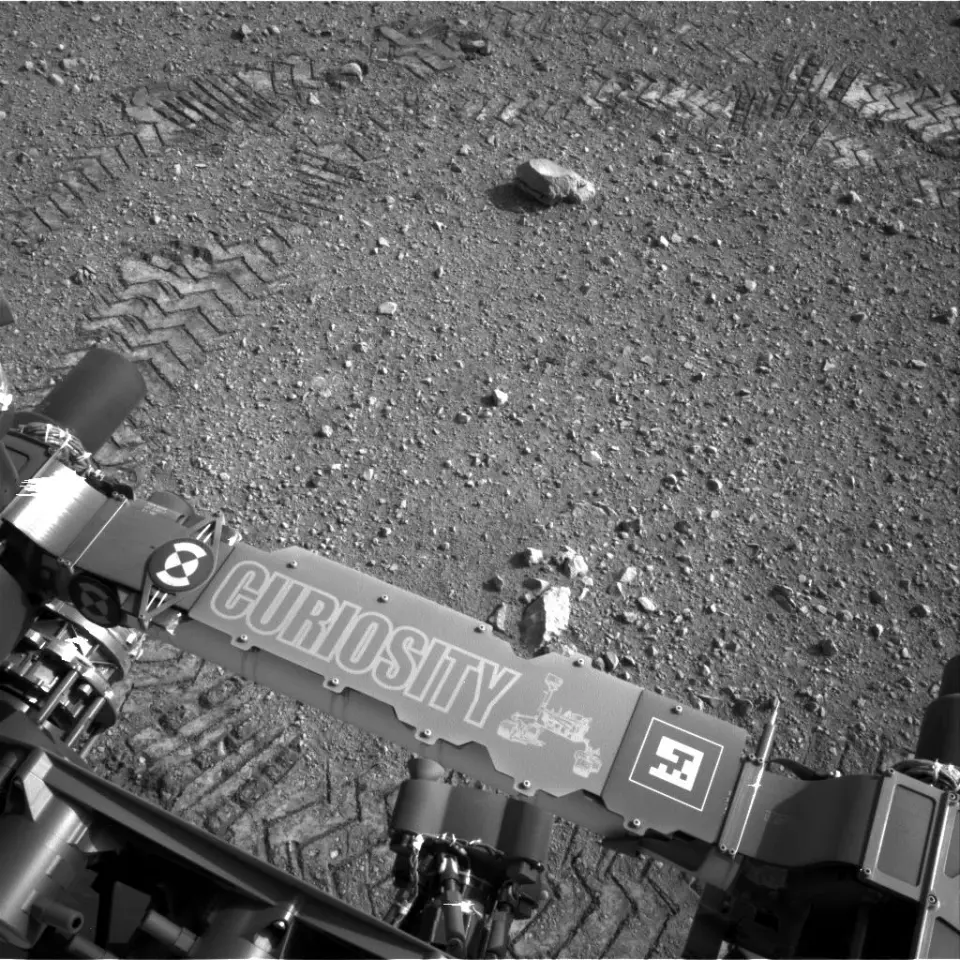
Curiosity’s six aluminum wheels feature cut-outs spelling 'JPL' in Morse code, a design that doubles as a visual odometry reference to measure wheel slip on Mars. This engineering solution helps the rover verify its actual movement against commanded rotation, especially on featureless terrain where traditional navigation cues are scarce. The marks have been visible since the rover's first test drive in 2012 and remain functional despite significant wheel wear from nearly 14 years of operation.
Key points
- Each of Curiosity’s six wheels contains cut-outs forming the Morse code for 'JPL', serving as a visual reference for navigation.
- The rover uses these marks to compare commanded wheel rotation with actual movement, detecting slip on sand or rock.
- Visual odometry combines wheel data with gyroscope and accelerometer inputs to estimate movement in six degrees of freedom.
- The wheels are 50 centimeters in diameter with aluminum skin only 0.75 millimeters thick, designed under strict mass limits.
- The Morse code pattern provides a known geometric feature on smooth ground where natural landmarks are scarce.
Background
Curiosity has been operating on Mars since 2012, logging over 32 kilometers of travel. Recent images from July 2026 show significant wheel wear, including holes and cracks, yet the rover continues to function effectively in Gale Crater. The rover has also recently observed honeycomb-patterned polygons in Martian soil, highlighting the diverse terrain it navigates. JPL’s ERNEST rover prototype, tested in 2026, aims to improve future planetary mobility with autonomous navigation, building on lessons from Curiosity’s long-term operation.
Why it matters
The integration of a simple signature into a critical navigation system demonstrates efficient engineering under strict mass and power constraints. By using the Morse code marks as visual odometry references, Curiosity can accurately measure slip on difficult terrain, preventing navigation errors that could worsen its position on steep or sandy ground. This approach ensures reliable movement despite the rover’s thin, damaged wheels, extending its operational life and scientific mission.
What to watch
Curiosity will continue to use its visual odometry system to navigate Gale Crater, relying on the Morse code marks and other terrain features to verify its movement. The rover’s wheel wear will be monitored as it accumulates more travel, with route planning adjusted to avoid further damage. Future rovers, such as JPL’s ERNEST prototype, may incorporate similar or improved navigation techniques to enhance mobility on Mars and the Moon.
Want the full story? Read the original reporting
Read on Space Daily