
Euclid Telescope Spots Record-Breaking Quasar 630 Million Years After Big Bang
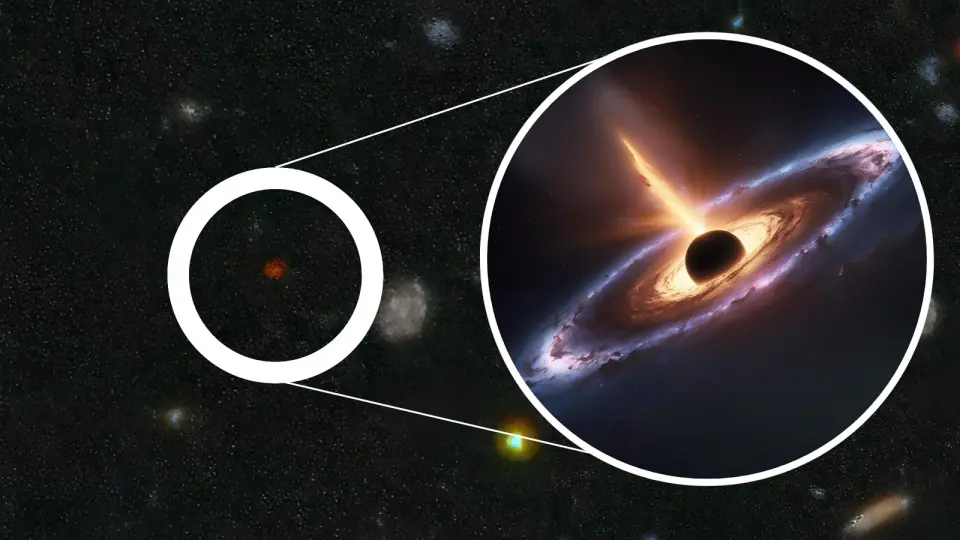
Astronomers have identified the most distant and ancient quasar ever observed, nicknamed Dun Aonghasa, which existed just 630 million years after the Big Bang. Powered by a supermassive black hole with 360 million times the mass of the sun, the discovery challenges existing models of how such massive objects formed so early in cosmic history.
Key points
- The quasar, designated J1504+6252, was discovered in 18 months of data from the European Space Agency's Euclid telescope.
- It is the first quasar found with a redshift beyond 8, specifically at 8.13, making it 40 million years older than the previous record holder.
- The black hole powering the quasar has a mass equivalent to 360 million suns, a size that puzzles scientists given the early time of its existence.
- The object appears to be feeding slowly, suggesting a previous period of rapid growth or a pause in its accretion phase.
- The findings were corroborated by the James Webb Space Telescope, Hubble Space Telescope, and ground-based observatories like W.M. Keck.
- The research was published in the journal Astronomy & Astrophysics on Nov. 24, 2026.
Background
In November 2026, the Euclid telescope identified 31 ancient quasars, including two that set records for the earliest cosmic beacons. This new discovery, Dun Aonghasa, surpasses those previous records by 40 million years. Earlier in November, gravitational-wave limits on early black hole binaries were established, providing additional context for understanding black hole growth in the early universe.
How outlets are covering it
All three sources agree on the core facts: the discovery of Dun Aonghasa, its age (630 million years after the Big Bang), and the mass of its black hole (360 million suns). Space.com emphasizes the mystery of how the black hole grew so massive so quickly, noting that it is currently feeding slowly. Live Science highlights the redshift of 8.13 and the implications for black hole growth models. CBS News focuses on the record-breaking nature of the discovery and the personal connection of the lead researcher, Julien Wolf, to the name Dun Aonghasa. There are no significant disagreements among the sources.
Why it matters
This discovery pushes the boundaries of our understanding of the early universe and challenges existing models of how supermassive black holes formed. It provides a new 'deadline' for the growth of black holes in the early cosmos and may help explain how such massive objects existed so soon after the Big Bang.
What to watch
Future observations from Euclid and JWST will test the hypothesis that Dun Aonghasa's black hole went through a massive growth spurt followed by slower growth. The record could potentially be broken again in the coming months or years as more data is analyzed.
- Astronomers discover the most distant and ancient supermassive black hole-powered quasar in the universe Space
- Astronomers spot record-setting quasar in the early universe Reuters
- Earliest monster black hole in the universe discovered just 630 million years after Big Bang Live Science
- Newly found farthest quasar from Earth is also record-setting oldest, scientists say CBS News
- New quasar record tightens constraints on black hole formation scenarios Phys.org
Want the full story? Read the original reporting
Read on Space