
Hubble Reveals N44 Nebula's Cycle of Stellar Destruction and Birth
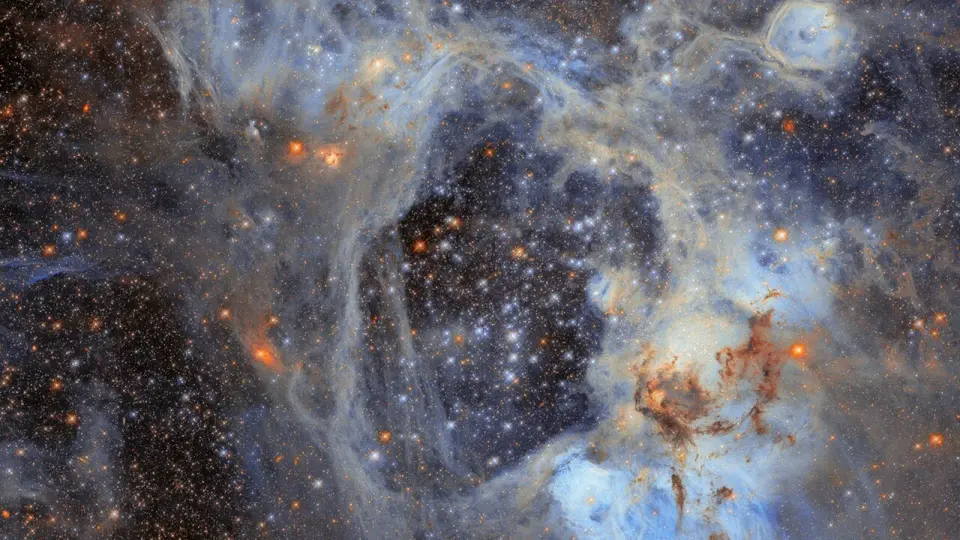
A new Hubble image of the N44 nebula in the Large Magellanic Cloud reveals a 210 by 140 light-year cavity carved by massive stars, which simultaneously destroy their birth gas and trigger the formation of 30,000 new stars in the surrounding shell.
Key points
- The image, released September 3, 2026, shows LHA 120-N44, a nebula 160,000 light-years away in the constellation Dorado.
- The central void, known as a superbubble, was created by stellar winds and supernovae from massive stars that expelled the gas they formed from.
- The compressed gas in the surrounding shell is now collapsing to form approximately 30,000 young protostars that have not yet fused hydrogen.
- The image contains nearly half a million stars, providing astronomers with a rare opportunity to study the timeline of star formation in a low-metallicity environment.
Background
This observation follows earlier Hubble coverage of the N44 superbubble in September 2026 and aligns with recent multi-telescope efforts to map stellar lifecycles, as noted in August 2026 archive entries regarding Hubble and James Webb Space Telescope composites.
How outlets are covering it
Live Science emphasizes the 'cosmic cycle' of destruction and creation, highlighting the 30,000 newborn stars. NASA focuses on the physical mechanism of the superbubble's creation via stellar winds. TechEBlog provides technical details, noting the image was taken through V and I filters and mentions the smaller N44F bubble. Inshorts offers a brief summary of the void's dimensions and location.
Why it matters
The N44 nebula serves as a nearby laboratory for studying star formation processes, offering insights into how massive stars influence their environment and how long it takes for protostars to become main-sequence stars.
What to watch
Astronomers will continue analyzing the 30,000 pre-main-sequence objects in the N44 shell to determine the timescale of star formation and the impact of stellar feedback on gas dynamics.
- Haunting Hubble 'bubble' image captures cosmic cycle of destruction and creation Live Science
- Superbubble in the Large Magellanic Cloud NASA (.gov)
- N44 Superbubble, Hubble’s Monthly Image of a Star-Carved Void TechEBlog -
- NASA's Hubble telescope captures picture of 'superbubble' | LMC largest of small galaxies orbiting Milky Way | Inshorts Inshorts
Want the full story? Read the original reporting
Read on Live Science