
Hubble Reveals Hidden 'Cat's Tail' in Beta Pictoris Debris Disk
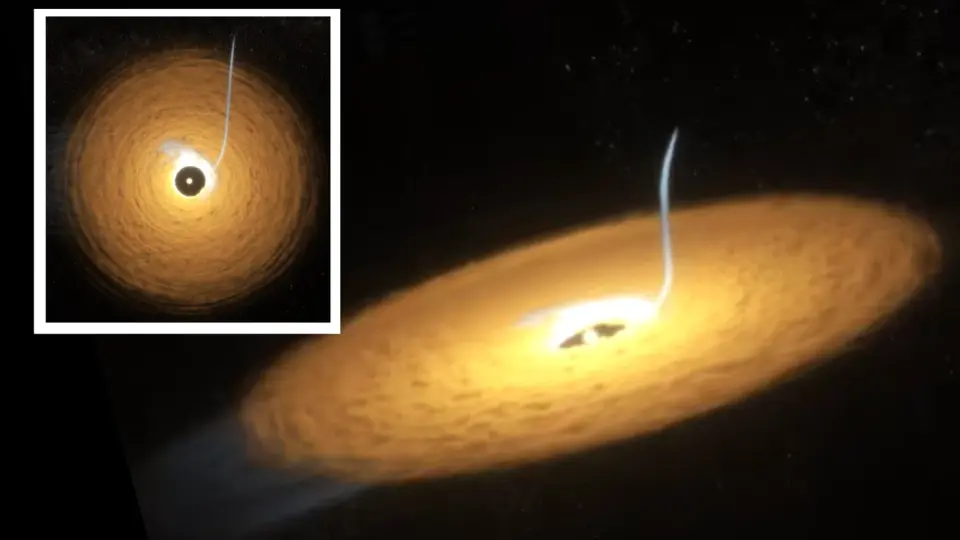
Astronomers using the Hubble Space Telescope have detected the 'Cat's Tail' feature in the Beta Pictoris system, a structure previously visible only in infrared light. The tail, extending up to 1,000 astronomical units, is likely the result of a collision between two Pluto-sized bodies. Its composition of porous, carbon-rich organic material explains why it was invisible to visible-light telescopes until now.
Key points
- The 'Cat's Tail' in the Beta Pictoris system, located 63 light-years away, was detected in visible light for the first time using Hubble data spanning 14 years.
- The feature extends up to 1,000 astronomical units (about 93 billion miles) and is composed of highly porous, carbon-based organic refractory material that absorbs visible light.
- Researchers believe the tail formed from a collision between two bodies with masses similar to Ceres or dwarf planets, resulting in the vaporization and recondensation of carbon grains.
- Hubble observations revealed a warp in the dust halo, likely caused by the gravitational influence of the gas giant Beta Pictoris b, which is approximately 10 times the mass of Jupiter.
- The study, published in The Astrophysical Journal Letters, provides insights into early solar system dynamics by observing a young planetary system that is only about 20 to 23 million years old.
Background
The Beta Pictoris system has been a subject of intense study due to its youth and resolved debris disk, offering a window into the chaotic early stages of planetary formation. Previous observations by the James Webb Space Telescope in 2024 identified the 'Cat's Tail' in infrared light, but its absence in visible light puzzled astronomers. This new Hubble study resolves that mystery by analyzing the composition and geometry of the dust, complementing earlier findings about the system's dynamic environment.
How outlets are covering it
While all sources agree on the basic discovery, they differ in emphasis. Space.com highlights the tail's immense length, comparing it to 200 trillion house cats. SciTechDaily focuses on the technical reason for its invisibility, noting the carbon-based material absorbs visible light. Universe Today provides the most detailed scientific analysis, estimating the mass and radius of the colliding bodies and linking the porous dust to high-velocity impacts. UA.News offers a concise summary of the findings, emphasizing the role of the giant planet Beta Pictoris b in warping the dust halo. The primary source and SciTechDaily both note the tail's apparent length may be shorter in 3D space than previously thought, depending on the viewing angle.
Why it matters
This discovery helps astronomers understand the violent processes that shaped our own solar system. By studying the Beta Pictoris system, which is much younger than our solar system, scientists can observe collisions and gravitational interactions in real-time, providing insights into how planets and debris disks evolve over time.
What to watch
Future observations with next-generation telescopes like the Extremely Large Telescope and the Giant Magellan Telescope may provide deeper insights into the Cat's Tail's composition and the dynamics of the Beta Pictoris system. Continued study of the porous dust grains could reveal more about the conditions under which they formed.
- Hubble Telescope sees cosmic 'cat's tail' that could wrap around Earth and the sun 500 times Space
- Hubble Uncovers a Mysterious 93-Billion-Mile Structure Hiding in a Nearby Star System SciTechDaily
- Hubble studies Cat's Tail in Beta Pictoris system UA.NEWS
- Colliding Dwarf Planets Created a 'Cat's Tail' 1,000 Astronomical Units Long Universe Today
- An enormous 'Cat's Tail' tells of cosmic collision 63 light-years away University of Arizona News
Want the full story? Read the original reporting
Read on Space