
Juno’s Microwave Radiometer Reveals Steep Heat Gradient Beneath Io’s Volcanic Crust
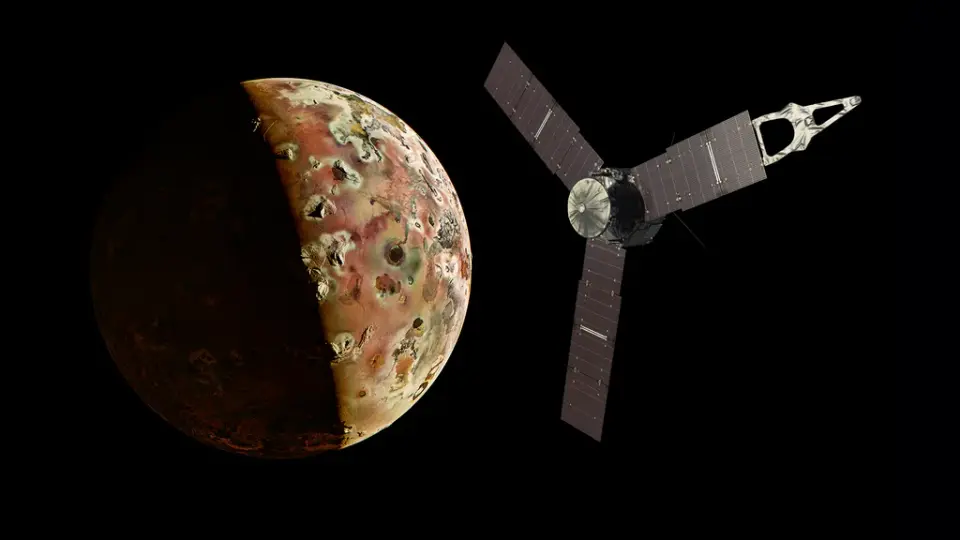
NASA’s Juno spacecraft has provided the first direct measurements of temperatures beneath the surface of Jupiter’s moon Io. Using its Microwave Radiometer, the mission detected a steep temperature increase of over 40 degrees Fahrenheit within just a few feet of the surface. These findings, published in the Journal of Geophysical Research: Planets, suggest that heat from tidal forces moves through Io’s crust via conduction or cooling lava flows. The discovery also revealed that Io’s surface is composed of low-density, porous materials like volcanic ash, offering new insights into volcanism on Earth and subsurface oceans on other moons.
Key points
- Juno’s Microwave Radiometer measured subsurface temperatures during two close flybys of Io in December 2023 and February 2024.
- Temperatures rose by more than 40 degrees Fahrenheit within a few feet of the surface, a gradient far steeper than solar heating alone could explain.
- The surface material was found to be low-density and porous, resembling volcanic ash or pumice rather than solid rock.
- Researchers propose two mechanisms for heat transfer: steady conduction through the crust or cooling lava flows buried beneath solidified crust.
- The technique offers a new tool for studying subsurface heat on rocky and icy worlds, including potential applications for monitoring volcanoes on Earth.
Background
Previous observations of Io relied on infrared instruments, which could only measure surface temperatures or detect lava fountains hotter than 1,400 kelvins. These methods reached only millimeters or centimeters below the ground. Juno’s Microwave Radiometer, originally designed to probe Jupiter’s cloud tops, was repurposed during its extended mission to examine the moons Ganymede, Europa, and Io. The instrument uses six microwave frequencies between 0.6 and 22 gigahertz, each penetrating to different depths, from inches to tens of feet. This allowed scientists to look beneath the surface of a rocky moon for the first time, a capability that was unexpected and has implications for studying Earth’s volcanoes and subsurface oceans on other moons.
How outlets are covering it
The Brighter Side of News and EarthSky emphasize the surprise of seeing below Io’s rocky surface and the implications for studying Earth’s volcanoes. Earth.com highlights the two possible mechanisms for heat transfer: conduction through the crust and cooling lava flows. Texas Public Radio focuses on the broader implications for understanding how moons and asteroids form and cool, and the potential for using similar instruments to monitor volcanic activity on Earth. All sources agree on the significance of the findings but differ in their emphasis on the specific mechanisms and applications.
Why it matters
The discovery provides a new tool for studying heat below the surfaces of rocky and icy worlds. It offers insights into how tidal heating works throughout the cosmos, a fundamental process that provides energy and heat to worlds far from their parent star. The findings could help researchers investigate tidal heating on ocean worlds, such as Europa and Enceladus, and may also help scientists better understand volcanic systems on Earth. The ability to measure subsurface temperatures could lead to better predictions and monitoring of volcanic activity, which is crucial for public safety.
What to watch
Future observations could map where heat escapes and test whether conduction or cooling lava dominates in different regions of Io. Higher-resolution instruments with more frequencies and dual polarization could sharpen these comparisons. The technique may also be applied to other moons and planets to study subsurface heat and tidal heating. Researchers hope that these discoveries will lead to better understanding and monitoring of volcanic activity on Earth, potentially improving predictions and safety measures.
- NASA’s Juno spacecraft finds temperatures surging just below Io’s volcanic surface thebrighterside.news
- Juno measures fiery Io’s subsurface temperature for 1st time EarthSky
- NASA measures the fiery heat inside Jupiter's volcanic moon Io Earth.com
- SwRI scientist announces first direct temperature measurements beneath Io’s surface Texas Public Radio | TPR
- APOD: 2001 July 15 - Io in True Color NASA Science (.gov)
Want the full story? Read the original reporting
Read on thebrighterside.news