
JWST spots salt-cloud haze in the Pink Planet's cold atmosphere
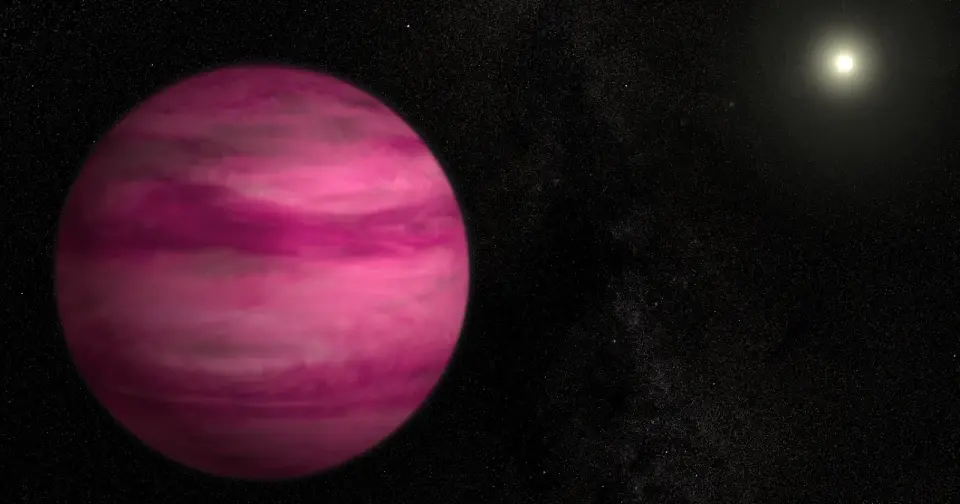
The James Webb Space Telescope has for the first time obtained a spectrum of GJ 504 b, the so-called Pink Planet, showing its light is best explained by a hazy atmosphere with salt clouds. The analysis detects water vapor, CO, methane, CO2, ammonia and hydrogen sulfide, plus signs of metal enrichment and disequilibrium chemistry, suggesting a dynamic, cloud-forming atmosphere. The planet is extremely cold for a directly imaged world (about 564 K) and sits near the planetary-mass/brown-dwarf boundary; the salt-cloud model is the key to fitting the spectrum, though the object's exact nature remains unsettled. The result demonstrates JWST’s ability to study faint, cold exoplanets and tests cloud-formation theories long discussed in theoretical work.
- For a decade the Pink Planet was too faint for any ground telescope to study — and when James Webb finally caught its spectrum, the best fit to the light was an atmosphere hazed with salt clouds Space Daily
- "Pink Planet" is surrounded by salty clouds, researchers using Webb telescope find CBS News
- James Webb Space Telescope finds a salty surprise on famous 'Pink Planet' Space
- Webb telescope finds possible salt clouds on a pink alien world Mashable
- JWST-TST High Contrast: First Direct Spectroscopy of GJ 504 b Reveals Clouds And Possible Metal Enrichment astrobiology.com
Want the full story? Read the original reporting
Read on Space Daily