
NASA Confirms SpaceX Rocket Crater on Moon After Year-Long Orbit
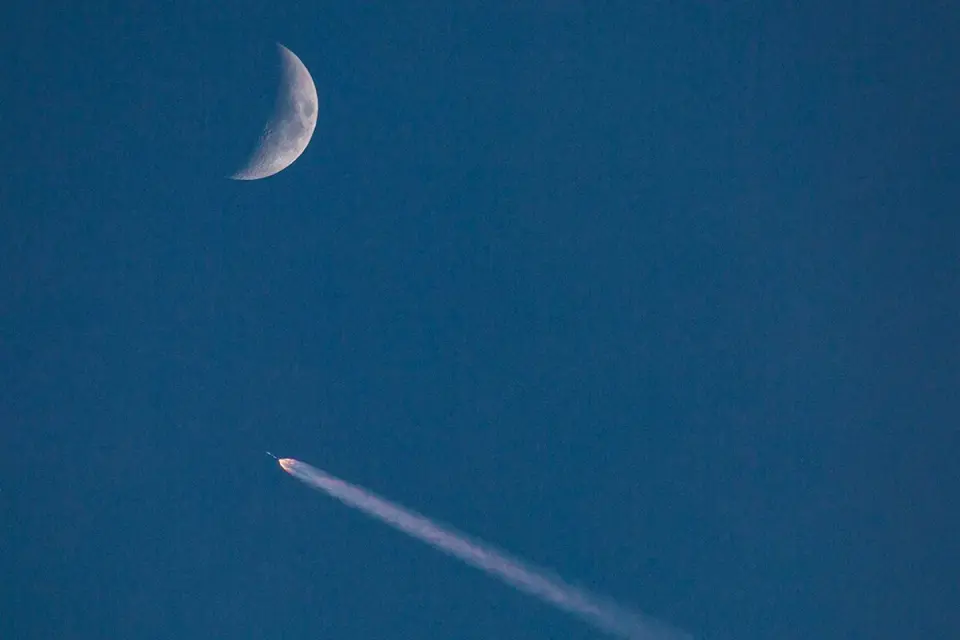
NASA’s Lunar Reconnaissance Orbiter has captured images of a new crater on the Moon caused by a SpaceX Falcon 9 upper stage impact on August 5, 2026. The debris, which had been in an unstable orbit since a January 2025 launch, struck the lunar surface at approximately 5,400 mph. The resulting crater is 18 meters wide and less than 3 meters deep. This event highlights the growing challenge of tracking space debris and the precision required to predict impacts on celestial bodies.
Key points
- The Falcon 9 upper stage, launched in January 2025 to deliver lunar landers, failed to re-enter Earth's atmosphere and entered an unstable orbit.
- The stage impacted the Moon on August 5, 2026, creating a crater near Einstein crater.
- NASA’s LRO captured images between August 11 and 12, 2026, from an altitude of 100 km.
- The crater measures 18 meters in width and less than 3 meters in depth.
- The impact location was predicted with high accuracy by NASA’s Center for Near Earth Object Studies and confirmed by the Korean Danuri orbiter.
Background
This incident follows earlier predictions in August 2026 that a SpaceX Falcon 9 upper stage from a January 2025 mission would impact the Moon. Previous coverage noted the potential for a 20-30 meter crater and the kinetic energy equivalent to three tons of TNT. The event was anticipated to provide a rare opportunity to study lunar impacts and debris risks as space junk increases.
How outlets are covering it
BBC Sky at Night Magazine emphasizes the technical achievement of predicting the impact site and the visual details of the crater, including bright and dark rays. NASA Science focuses on the coordination between experts and hobbyists, highlighting the use of open data and the validation of planetary defense tools. The Washington Post notes that lunar-surface impacts are an 'accepted and safe' method of disposing of hardware, while CNN’s coverage was largely obscured by technical errors in the provided source. All sources agree on the basic facts but differ in emphasis, with NASA stressing the scientific value and BBC highlighting the imaging process.
Why it matters
This event underscores the growing problem of space debris and the need for precise tracking and impact prediction. It also demonstrates the capability of current technology to monitor and document such events, which is crucial for the safety of future space missions and the protection of celestial bodies.
What to watch
NASA and other agencies will continue to analyze the images to understand the impact dynamics and the composition of the excavated material. The success of this prediction may lead to improved tools and techniques for tracking other potential impactors, both natural and artificial.
- They've done it. NASA's lunar probe has photographed the crater caused by a SpaceX rocket smashing into the Moon BBC Sky at Night Magazine
- NASA’s LRO Images Falcon 9 Crater on Moon, Learns New Details NASA Science (.gov)
- New images reveal what happened when a SpaceX rocket slammed into the moon CNN
- Before-and-after images show where SpaceX rocket crashed into the moon The Washington Post
- SpaceX Rocket Hits the Moon: Space Debris and What’s Next for SpaceX Stock Barron's
Want the full story? Read the original reporting
Read on BBC Sky at Night Magazine