
NASA Launches PSRA Initiative to Reassess Mars Sample Return Strategy
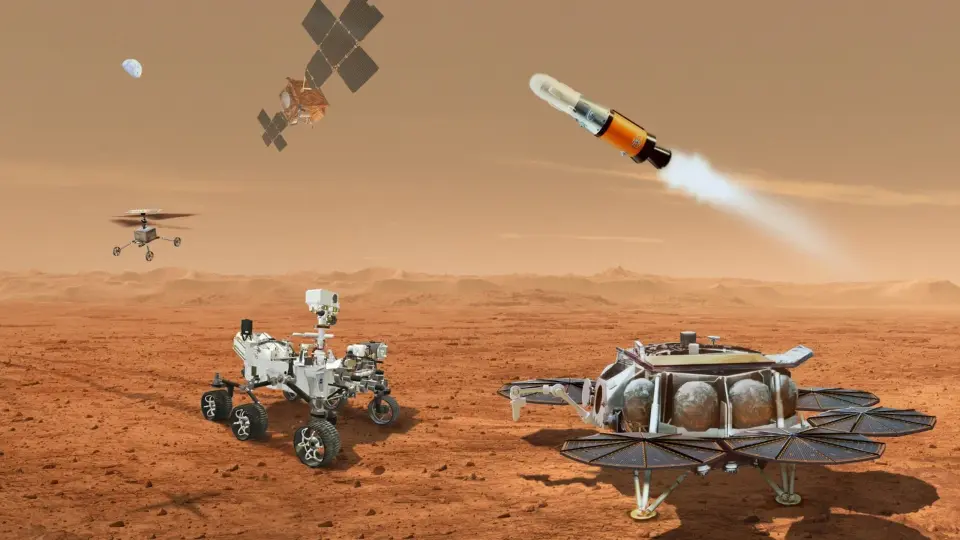
NASA has initiated the Perseverance Sample Retrieval Architecture (PSRA) to develop a new strategy for returning Martian samples to Earth. The initiative aims to address previous cost overruns and timeline delays, with a final report expected in winter 2027-2028. This move occurs as China advances its own sample-return mission and scientists emphasize the need to assess hazardous Martian dust before human exploration.
Key points
- NASA Mars Exploration Program Director Tiffany Morgan announced the PSRA initiative on Nov. 9 during a virtual meeting of the Mars Exploration Program Analysis Group.
- The PSRA strategy team will kick off in January 2027, with a final report due in winter 2027-2028, focusing on impartial recommendations for retrieving Perseverance rover samples.
- Previous independent reviews estimated the cost of Mars Sample Return at $11 billion for a 2040 return, which NASA deemed too costly, while another assessment suggested an $8 billion cost for a 2035 return.
- Perseverance, which landed in Jezero Crater in February 2021, has been collecting and sealing samples on the Martian surface and inside the rover, potentially containing signs of past life.
- Bruce Jakosky of the University of Colorado Boulder emphasized that returning samples is crucial for assessing hazardous chemicals like perchlorates and fine dust to ensure astronaut safety in future human missions.
- China’s Tianwen-3 mission is on track to launch in 2028 using two Long March-5 rockets, aiming to return approximately 500 grams of Martian samples to Earth by 2031.
Background
NASA previously canceled its Mars Sample Return program in October 2026 due to an $11 billion budget and lack of political support, leaving Perseverance’s samples stranded on Mars. Meanwhile, Japan’s MMX mission launched in October 2026 to return samples from Mars’ moon Phobos by 2031, and a 4.1-billion-year-old Martian meteorite found in the Sahara was confirmed in October 2026, highlighting the scientific value of Martian samples.
How outlets are covering it
Space.com and UA.NEWS report on the PSRA initiative as a fresh strategy to address cost and timeline issues, with Space.com providing more detail on the PSRA team’s objectives and Jakosky’s emphasis on planetary protection. Inside Outer Space briefly mentions the initiative but directs readers to Space.com for details. All sources agree on the PSRA timeline and the cost estimates from previous reviews, but Space.com and UA.NEWS provide more comprehensive coverage of the scientific and geopolitical context, including China’s Tianwen-3 mission.
Why it matters
The PSRA initiative is critical for determining whether NASA can retrieve Martian samples within a feasible budget and timeline, especially as China advances its own sample-return mission. The samples could provide insights into past life on Mars and help assess hazardous conditions for future human missions, making the outcome of PSRA significant for both scientific and exploratory goals.
What to watch
The PSRA strategy team will kick off in January 2027, with a final report due in winter 2027-2028. China’s Tianwen-3 mission is expected to launch in 2028, with samples returning to Earth by 2031. NASA’s decision on the PSRA strategy will determine the future of its Mars Sample Return program and its ability to compete with China in this scientific milestone.
- NASA kick-starts a fresh push to bring Mars samples home Space
- NASA Kick-starting New Look at Mars Sample Return Inside Outer Space
- NASA launches initiative to return samples from Mars — Space.com UA.NEWS
- NASA unveils PSRA plan to return Perseverance samples from Mars NewsBytes
- NASA’s New Mars Sample Return Effort Detailed Inside Outer Space
Want the full story? Read the original reporting
Read on Space