
NASA seeks commercial bids to save Hubble from 2033 reentry
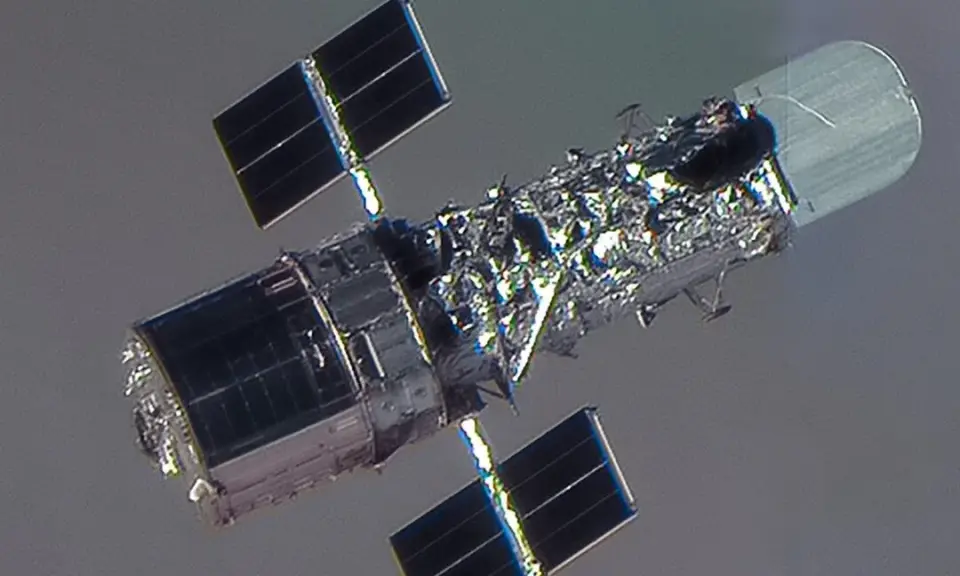
NASA has issued a Request for Information (RFI) to commercial firms for proposals to reboost, service, or control the reentry of the Hubble Space Telescope. Responses are due November 30, 2026. The agency aims to extend Hubble's life or ensure a safe disposal before its predicted uncontrolled reentry in 2033-2034. No funding is currently allocated, but NASA seeks to assess capabilities and costs for a mission by 2032.
Key points
- NASA released an RFI on Oct 29, 2026, seeking commercial ideas to reboost Hubble to at least 600 km, service it, or guide a controlled reentry.
- Responses are due by Nov 30, 2026; NASA is not committing to purchase a mission but wants to gauge feasibility and cost.
- Hubble’s orbit has decayed from 583 km in 2002 to 470 km today; a reboost to 600 km could extend its life by 25+ years.
- Previous 2022 RFI yielded eight responses, including a joint Astroscale/Momentus proposal and a SpaceX Dragon concept from Jared Isaacman, which were deemed 'notional' in 2024.
- The Swift telescope rescue attempt in 2025 demonstrated that commercial servicing is possible but technically challenging; Hubble is a higher-value asset requiring more resources.
Background
Hubble has operated for 36 years, last serviced by the Space Shuttle in 2009. Its orbit is decaying due to atmospheric drag, with no onboard propulsion. NASA’s newer telescopes (Webb, Roman) observe in infrared, leaving a gap in visible/UV coverage until the Habitable Worlds Observatory in the 2040s. Recent archive coverage highlights Hubble’s ongoing scientific value, including new galaxy surveys and solar system observations, underscoring the desire to extend its mission.
How outlets are covering it
Ars Technica emphasizes the maturity of commercial servicing, citing Northrop Grumman’s robotic satellite and startups like Astroscale, and notes Isaacman’s shift from proposing a crewed mission to expecting robotic interest. The Register highlights the risk of uncontrolled reentry and the 10% chance of reentry by Sept 2032, stressing the need for a controlled disposal option. NASA’s official statement focuses on the scientific imperative and the lack of a direct replacement for Hubble’s visible/UV capabilities. UA.NEWS provides a neutral summary of the RFI details and previous attempts.
Why it matters
Hubble remains a critical tool for visible and ultraviolet astronomy, with no direct replacement until the 2040s. A successful reboost or servicing mission could extend its life by decades, preserving unique scientific capabilities. Conversely, failure to act could result in an uncontrolled reentry, posing risks and ending a 36-year legacy of discovery. The RFI signals NASA’s willingness to leverage commercial innovation to extend the life of a national icon.
What to watch
NASA will review responses by Nov 30, 2026, to assess feasibility and cost. If promising proposals emerge, the agency may allocate funding for a mission by 2032. The outcome will depend on commercial capabilities, budget constraints, and technical challenges of capturing and boosting a large, aging spacecraft.
- Think you can save the Hubble Space Telescope? NASA wants to know. Ars Technica
- NASA Explores Potential Commercial Servicing for Hubble Telescope NASA Science (.gov)
- NASA ponders a Hubble servicing mission or a controlled deorbit The Register
- NASA seeks companies to raise Hubble telescope’s orbit — Ars Technica UA.NEWS
- NASA seeks ideas for Hubble servicing mission SpaceNews
Want the full story? Read the original reporting
Read on Ars Technica