
Norwegian amateurs trigger first orbital voice command, launching Doom on ESA satellite
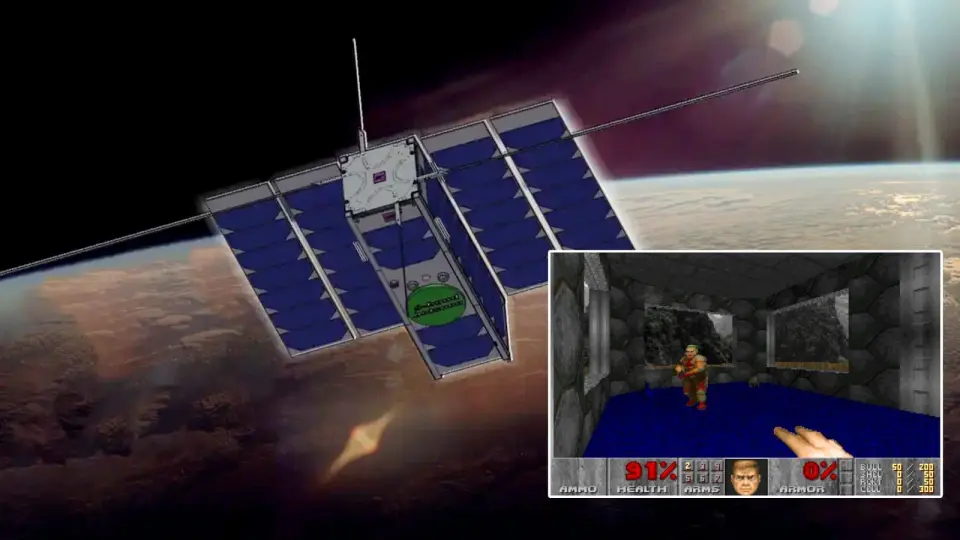
Norwegian radio amateurs successfully sent a voice command to an ESA satellite, triggering the game Doom in orbit. This marks the first time a spacecraft has autonomously recognized and executed a spoken instruction from Earth, demonstrating new potential for remote communication and emergency alerts.
Key points
- The OPS-SAT PRETTY cubesat, managed by ESA, executed the command 'PRETTY play Doom Doom Doom' on July 27, 2026.
- The signal was transmitted from a rooftop in Oslo by Jon Bergli Heier after six previous failed attempts between April and July.
- The satellite used onboard AI, specifically Sherpa-ONNX for speech recognition and GNU Radio for signal processing, to decode the voice and launch the 1993 game.
- The team spent 59 days and approximately $775 (7,200 NOK) to narrow the receiver channel and fix signal issues that initially made the voice unrecognizable.
- Tanagra Space, which supplied the software, suggests this technology could eventually allow satellites to detect 'mayday' calls from remote areas and alert rescue services.
Background
This achievement builds on a 2025 milestone where an Icelandic developer first got Doom to run on the same ESA satellite. While that earlier instance proved the hardware could run the game, the 2026 experiment is the first to demonstrate autonomous voice control via radio transmission, moving beyond manual or pre-programmed triggers.
How outlets are covering it
Space.com and UA.NEWS emphasize the technical struggle, noting the six failed attempts and the specific engineering fix required to narrow the receiver channel. VICE highlights the novelty of the stunt, contrasting the 'irresponsible' nature of playing games in space with the serious potential for detecting astronomical phenomena or emergency signals. The Verge focuses on the software update by Tanagra Space as the primary enabler, clarifying that while playing Doom is not new, the voice command capability is the historic first.
Why it matters
This experiment validates the feasibility of natural language processing in low Earth orbit. By proving that satellites can interpret spoken commands through noisy radio channels, it opens pathways for autonomous emergency response systems, where stranded individuals could trigger aid without complex digital interfaces, and for deep-space signal analysis where AI filters relevant data from cosmic noise.
What to watch
Tanagra Space and ESA are likely to explore further applications of onboard AI for audio pattern recognition, potentially testing the system for detecting distress signals or analyzing radio frequencies for astronomical events. The success of this amateur-led project may also encourage other non-traditional entities to contribute to satellite software development and testing.
- Yes, it runs 'Doom': Satellite plays iconic game in world's 1st demonstration of orbital voice control Space
- An ESA satellite obeyed voice commands to play Doom. The Verge
- In Norway, Doom launched on a satellite by voice command — Space.com UA.NEWS
- Someone Just Told a Satellite in Space to Play ‘Doom,’ and It Actually Worked VICE
- Satellite on orbit responded to voice command in experimental first SpaceNews
Want the full story? Read the original reporting
Read on Space