
Perseverance Captures Mars Solar Transit Days After Earth’s Eclipse
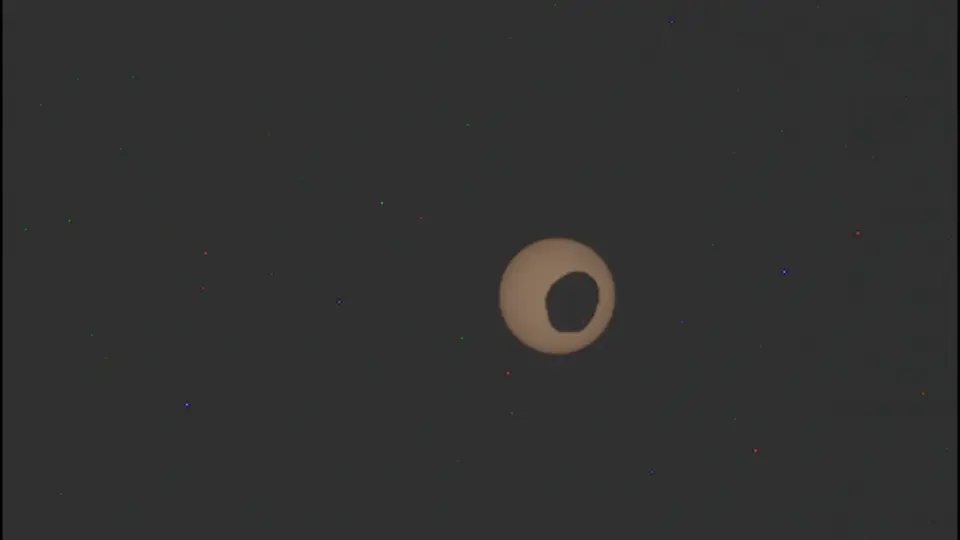
NASA’s Perseverance rover captured a partial solar eclipse on Mars on August 13, 2026, one day after Earth’s total solar eclipse. The image, taken by the rover’s Mastcam-Z camera, shows the moon Phobos partially obscuring the sun. Unlike Earth, Mars’s moons are too small to cause total eclipses, resulting in partial transits. This event highlights how robotic explorers provide unique vantage points for observing celestial phenomena across the solar system.
Key points
- Perseverance captured a partial solar eclipse on Mars on August 13, 2026, using its Mastcam-Z camera.
- The eclipse was caused by Phobos, Mars’s larger moon, partially blocking the sun.
- Mars’s moons are too small to cause total solar eclipses, resulting in partial transits.
- The event occurred one day after Earth’s total solar eclipse on August 12, 2026.
- Robotic explorers like Perseverance provide unique vantage points for observing celestial phenomena across the solar system.
Background
This event follows the August 12, 2026 total solar eclipse on Earth, which was widely covered by media and citizen scientists. Mars has previously experienced solar transits, such as one captured by Perseverance in 2024, which helped scientists track Phobos’s orbital decay. The August 13, 2026 event adds to the growing body of data on Martian celestial mechanics and atmospheric observations.
How outlets are covering it
Space.com emphasizes the unique vantage point provided by Perseverance, highlighting the contrast between Earth’s total eclipse and Mars’s partial transit. Futura focuses on the scientific utility of eclipses, noting how they help measure orbital decay and atmospheric properties. Mashable India provides a broader context of solar eclipses across the solar system, including Jupiter’s moons, and emphasizes the educational value of these events for future human exploration.
Why it matters
The Perseverance rover’s capture of a Martian solar eclipse underscores the importance of robotic exploration in understanding celestial mechanics across the solar system. These observations help scientists track orbital decay, study atmospheric properties, and prepare for future human missions to Mars. The event also highlights the unique perspectives that robotic explorers provide, which are not possible from Earth or human-occupied locations.
What to watch
NASA will continue to use Perseverance to capture more celestial events on Mars, contributing to the understanding of Martian orbital mechanics and atmospheric properties. Future human missions to Mars may also observe these events, providing new insights into the Martian environment. Additionally, scientists will continue to analyze data from Perseverance to track Phobos’s orbital decay and its potential impact on Mars.
- Perseverance rover watchs alien solar eclipse on Mars photo of the day for Aug. 19, 2026 space.com
- What really happens on planets where the Sun suddenly vanishes from view Futura, le média qui explore le monde
- NASA'S Perseverance rover captures rare Martian solar eclipse Yahoo News UK
- Other Planets Got Total Solar Eclipses Too? NASA Shares Surya Grahan From Jupiter and Mars [WATCH] Mashable India
- Perseverance rover watches alien solar eclipse on Mars | Space photo of the day for Aug. 19, 2026 Yahoo
Want the full story? Read the original reporting
Read on space.com