
17-Spacecraft Network Reveals Hidden Asymmetry in December 2024 Solar Eruption
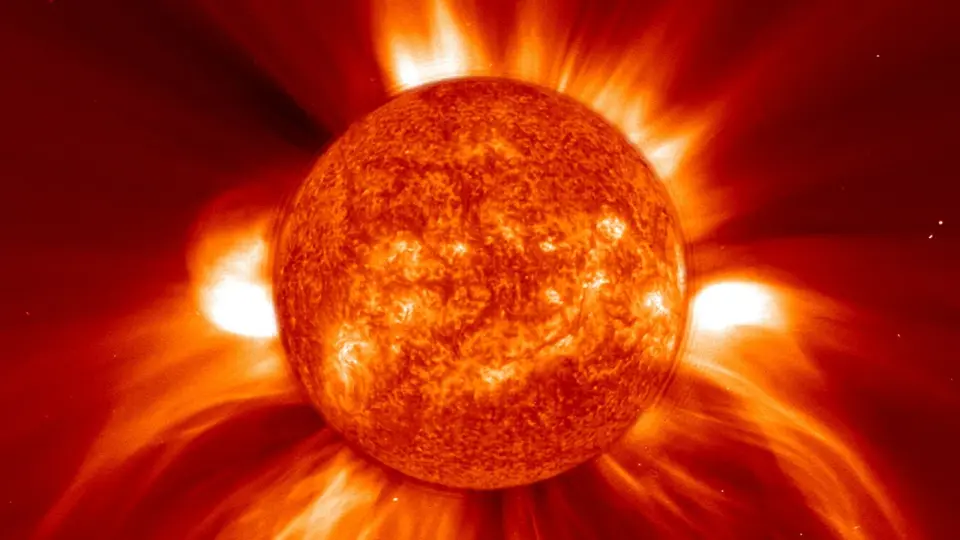
A record-breaking network of 17 spacecraft tracked a complex, asymmetric coronal mass ejection (CME) from the Sun on December 15, 2024, revealing a hidden component that threatened Earth and Mars. Led by Adrienn Luspay-Kuti of Johns Hopkins University Applied Physics Laboratory, the study used data from missions like Europa Clipper, MAVEN, and STEREO-A to map the CME’s irregular shape, which previous single-line observations missed. The findings, published in Science Advances, highlight critical blind spots in space-weather forecasting that could endanger future crewed missions.
Key points
- The CME erupted at 00:48 UT on December 15, 2024, and was tracked by 17 spacecraft, breaking the previous record of 10.
- The ejection had two distinct parts: a faster component (840 km/s) heading toward Earth and Mars, and a slower component (534 km/s) moving away from Earth.
- Europa Clipper detected the fast component during a routine instrument check on December 19, 2024, at 1.19 astronomical units from the Sun.
- The asymmetric structure was invisible from Earth’s vantage point, revealing a gap in current space-weather forecasting models.
- The study emphasizes the need for out-of-ecliptic observations to protect future crewed missions from solar radiation.
Background
This story builds on our August 2026 coverage of the same event, which highlighted how Europa Clipper’s detection of an unusual solar wind exposed gaps in space-weather forecasts. The current briefing expands on the full 17-spacecraft network and the specific asymmetric structure of the CME, providing a more comprehensive view of the event’s impact on forecasting models.
How outlets are covering it
Space.com emphasizes the record number of spacecraft and the detailed view of the CME’s evolution, while UA.NEWS focuses on the two-part asymmetric structure and the specific speeds of the components. Gizmodo highlights the blind spot in space-weather forecasting and the potential risks to future crewed missions, noting that the fast component was invisible from Earth’s view. All sources agree on the significance of the 17-spacecraft network but differ in their emphasis on the technical details versus the broader implications for space safety.
Why it matters
The discovery of a hidden, asymmetric CME component underscores the limitations of current space-weather forecasting models, which rely heavily on observations from the Sun-Earth line. This gap could endanger future crewed missions, as fast CMEs can create shock waves that accelerate high-energy particles, posing a serious radiation hazard to astronauts outside Earth’s magnetic field. The study highlights the need for a more comprehensive network of spacecraft to monitor solar activity and protect space travelers.
What to watch
Researchers plan to investigate whether strongly distorted CMEs are rare or simply overlooked due to insufficient observation points. They also aim to test if current forecasting models can reproduce this type of CME behavior, which could improve the accuracy of space-weather predictions and enhance the safety of future missions.
- How a huge fleet of 17 spacecraft discovered something surprising about solar eruptions Space
- Interplanetary spacecraft capture a coronal mass ejection component hidden from Earth Phys.org
- 17 spacecraft detect an asymmetric plasma ejection from the Sun UA.NEWS
- A ‘Hidden’ Solar Outburst Just Exposed a Blind Spot in Space-Weather Forecasting Gizmodo
Want the full story? Read the original reporting
Read on Space