
SMILE Satellite Begins Science Ops, Capturing Daytime Auroras in First UV Images
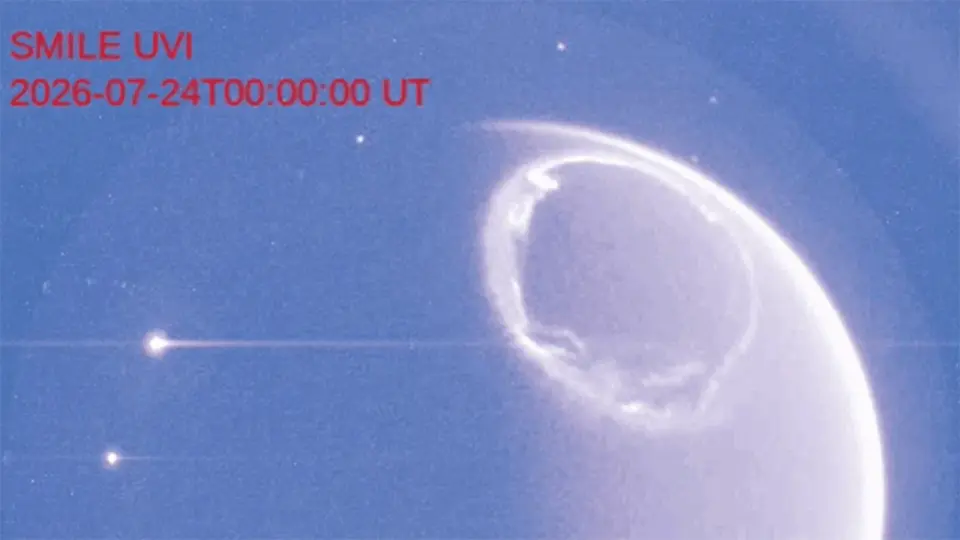
The joint European-Chinese SMILE satellite officially began science operations on September 23, 2026, after a successful commissioning phase. Its first ultraviolet images, captured on July 24, reveal auroras visible in broad daylight over the North Pole. The mission aims to study solar wind interactions with Earth's magnetic field, with its X-ray imager currently undergoing calibration to reduce stray light before targeting the magnetopause in mid-October.
Key points
- SMILE launched on May 19, 2026, and reached its target elliptical orbit on June 20, 2026.
- Science operations began on September 23, 2026, following a commissioning period that resolved technical issues.
- The first ultraviolet aurora imager (UVI) images were taken on July 24, 2026, showing a full ring of auroras over the North Pole.
- The satellite orbits approximately 75,000 miles (121,000 km) above the North Pole, allowing 45-hour continuous observations.
- The soft X-ray imager (SXI) is currently experiencing stray light issues, with calibration expected to improve by mid-October 2026.
Background
SMILE (Solar wind Magnetosphere Ionosphere Link Explorer) is a collaboration between the European Space Agency (ESA) and the Chinese Academy of Sciences (CAS). It is part of ESA's Cosmic Vision programme, designed to answer how the Solar System works by studying space weather. The mission follows a two-year development period, with a documentary series 'Let's Smile' covering its assembly and launch from French Guiana.
How outlets are covering it
Live Science and Space.com emphasize the visual novelty of seeing auroras in daylight, describing the images as 'eerie' and 'ghostly.' Scientific American highlights the scientific significance of the 'auroral substorm' and the interaction of solar wind with Earth's magnetic field. ESA provides the technical context, noting that while the UVI is working well, the SXI requires software updates to reduce stray light, with optimal conditions expected in mid-October as the satellite moves farther from Earth and northern winter approaches. All sources agree on the mission's start date and the July 24 capture date, but differ in focus: media outlets highlight the imagery, while ESA details the instrument calibration challenges.
Why it matters
SMILE's ability to observe auroras in daylight and for extended periods (45 hours) provides unprecedented data on solar storms and geomagnetic activity. This improves understanding of space weather, which can impact electronic infrastructure on Earth. The mission's success marks a milestone in international space collaboration and advances the study of Earth's magnetic field interactions with solar wind.
What to watch
SMILE will continue its three-year mission, with the SXI expected to capture its first clear images of the magnetopause or northern polar cusp by mid-October 2026. The satellite will monitor solar activity and auroras, providing data to scientists worldwide. ESA and CAS teams will continue to refine instrument settings to optimize data collection.
- Auroras appear in broad daylight in Smile spacecraft's eerie first images of Earth — Space photo of the week livescience.com
- Earth's hidden daytime auroras revealed from space | Space photo of the day for Oct. 2, 2026 Space
- Satellite images reveal ethereal auroral storm raging above the North Pole Scientific American
- Science begins for Smile European Space Agency (ESA)
- SMILE Spacecraft’s Ultraviolet Imager Captures Indelible Views of Earth’s Auroras freeyork
Want the full story? Read the original reporting
Read on livescience.com