
SMILE Satellite Captures First Full View of Earth’s Daytime Auroras
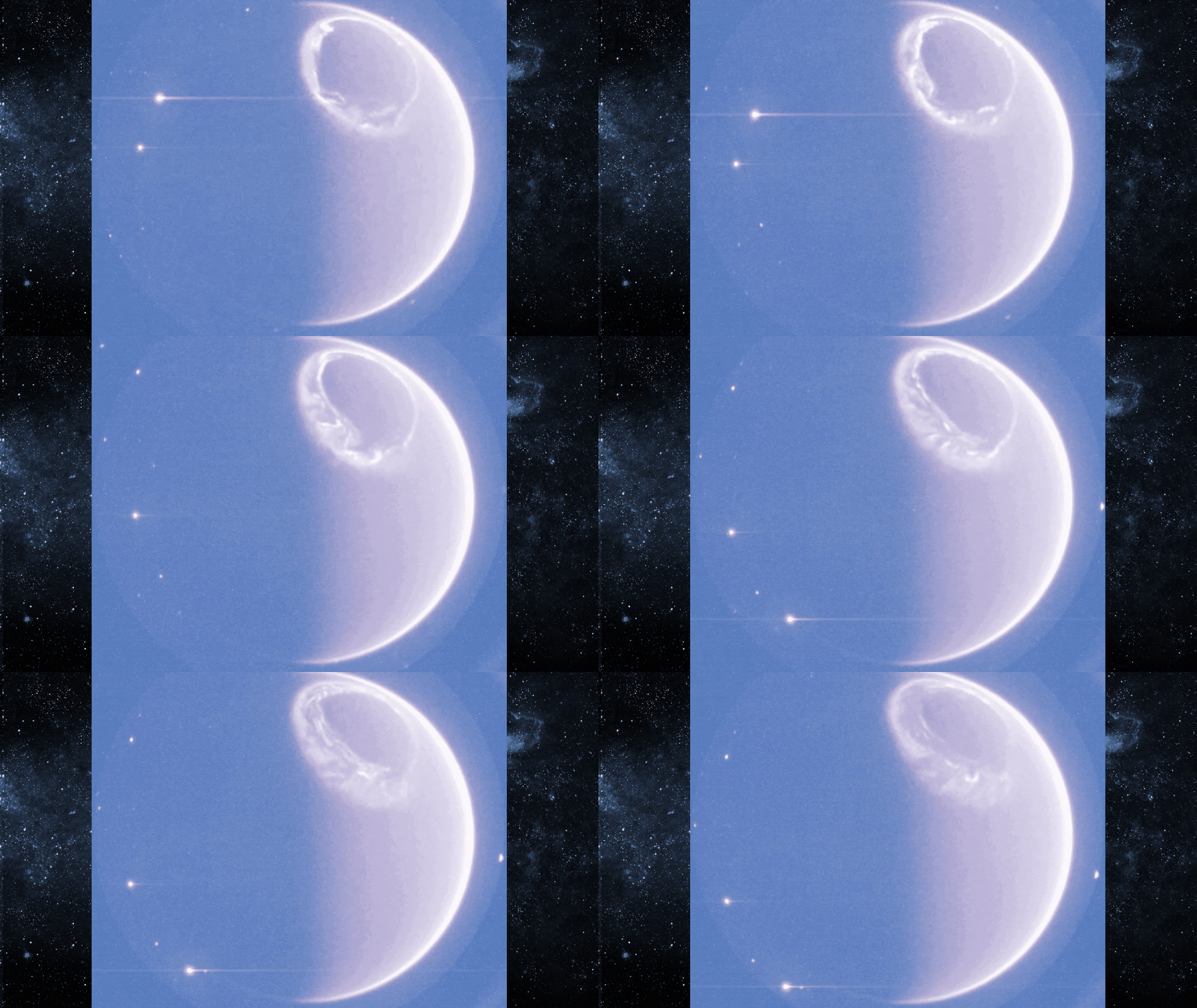
The Solar Wind Magnetosphere Ionosphere Link Explorer (SMILE) has released its first ultraviolet images, revealing the full ring of northern lights encircling Earth’s North Pole. Captured on July 24, 2026, the footage shows auroral activity on both the day and night sides of the planet, a capability not seen since 2008. This marks the start of science operations for the joint European-Chinese mission, which aims to improve understanding of solar storms and space weather.
Key points
- SMILE’s ultraviolet imager (UVI) captured the first full view of the northern auroral oval since NASA’s Polar mission ended in 2008.
- The images, taken on July 24, 2026, show auroras on Earth’s dayside, which are usually obscured by sunlight.
- SMILE is a joint mission between the European Space Agency (ESA) and the Chinese Academy of Sciences (CAS), launched in May 2026.
- The spacecraft carries four instruments, including a soft X-ray imager (SXI) that has begun testing with images of supernova remnants.
- SMILE will record auroras for 45 hours at a time, helping scientists link solar wind interactions with geomagnetic storms.
Background
SMILE was launched on May 19, 2026, and reached its target orbit on June 20. The mission is part of ESA’s Cosmic Vision programme and aims to answer how the Solar System works by studying Earth’s response to solar wind. Prior to this, the last spacecraft to image the full northern auroral oval in ultraviolet light was NASA’s Polar, which ended its mission in 2008.
How outlets are covering it
Space.com emphasizes the visual novelty of seeing daytime auroras, highlighting the UVI’s capability to capture the full ring of northern lights. ESA focuses on the technical milestone of declaring the mission ready for science operations after a busy commissioning period, noting issues with stray light in the X-ray imager that are being addressed. Scientific American highlights the scientific significance of the auroral substorm images, noting that ultraviolet imaging avoids interference from daytime sunlight and that SMILE will record auroras for 45 hours at a time. All three sources agree on the date of the images (July 24, 2026) and the joint nature of the mission, but differ in emphasis: Space.com on the visual, ESA on the operational milestone, and Scientific American on the scientific implications.
Why it matters
SMILE’s ability to image the full auroral oval in ultraviolet light provides a new tool for understanding how solar wind interacts with Earth’s magnetosphere. This data can help predict geomagnetic storms, which can affect electronic infrastructure and space weather. The mission’s success marks a significant step in international space collaboration and advances our understanding of Earth’s space environment.
What to watch
SMILE’s X-ray imager (SXI) is expected to take its first good image of the magnetopause or northern polar cusp in mid-October 2026, as stray light reduces. The mission will continue to collect data on solar storms and geomagnetic storms, with the goal of improving space weather forecasting and understanding Earth’s magnetic field.
- Earth's hidden daytime auroras revealed from space | Space photo of the day for Oct. 2, 2026 Space
- Science begins for Smile European Space Agency (ESA)
- Satellite images reveal ethereal auroral storm raging above the North Pole Scientific American
- First Full Ultraviolet View Of Northern Lights Marks Early Success For European-Chinese Mission IFLScience
- New spacecraft captures burst of northern lights around North Pole Community Newspaper Group
Want the full story? Read the original reporting
Read on Space