
Tiangong Station Offers Rare Bright Passes Over US East Coast
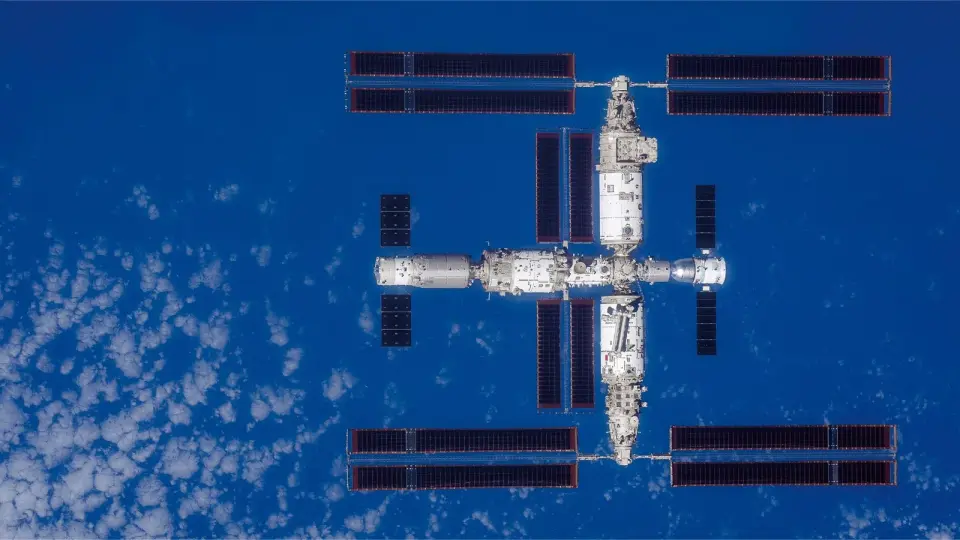
China's Tiangong space station is currently visible from parts of the eastern United States, offering bright, high-altitude passes that rival the brightness of Jupiter. This visibility coincides with a recent 5.5-hour spacewalk by three taikonauts to repair a solar array. While not as bright as the International Space Station, Tiangong reaches magnitude -2, making it easily observable with the naked eye under clear skies. The best viewing opportunities occur shortly after sunset or before sunrise, particularly for observers in New York City, which lies near the northern limit of Tiangong's 41.5-degree inclined orbit.
Key points
- Tiangong is visible from the US East Coast this week, with peak brightness reaching magnitude -2, similar to Jupiter.
- Three taikonauts recently completed a 5.5-hour spacewalk to repair a solar array on the station.
- New York City offers exceptional viewing opportunities due to its location near the northern limit of Tiangong's orbit, allowing for passes at 84 and 88 degrees altitude.
- Optimal viewing times are one to two hours after sunset or before sunrise, when the station is illuminated by the sun while the ground is dark.
- Tiangong's orbit has a 41.5-degree inclination, limiting high-altitude passes to specific latitudes, including parts of the US East Coast.
Background
The International Space Station (ISS) is nearing the end of its operational life, with a planned retirement around 2030. NASA is currently transitioning toward commercial low-Earth orbit destinations, including partnerships with companies like Nanoracks, Blue Origin, and Northrop Grumman, to replace the ISS. Meanwhile, China's Tiangong station continues to expand its capabilities, with plans to double its size. Recent ISS activities, such as the sixth all-female spacewalk and antenna repairs, highlight the ongoing maintenance efforts required to keep the current station operational until its decommissioning.
Why it matters
The visibility of Tiangong from the US highlights the growing presence of non-Western space infrastructure in low Earth orbit. As the ISS approaches its end-of-life, Tiangong's continued operations and expansion underscore China's commitment to maintaining a permanent human presence in space. For observers, these passes offer a unique opportunity to witness a different space station, providing a tangible connection to international space exploration efforts beyond the traditional ISS.
What to watch
Observers in the US East Coast should monitor local sky conditions and use tracking tools like Heavens Above to identify specific pass times. Future visibility will depend on Tiangong's orbital path and solar illumination. Long-term, the expansion of Tiangong and the retirement of the ISS will reshape the landscape of human spaceflight, with commercial stations expected to fill the gap left by the ISS.
Want the full story? Read the original reporting
Read on Space