
Tiny Asteroid CERNQ52 Detected and Hits Indian Ocean Within Seven Hours
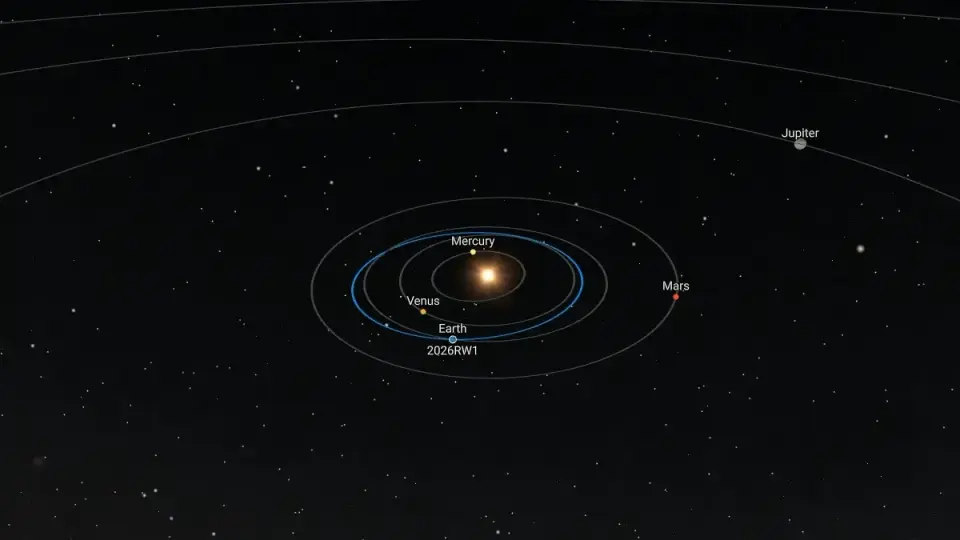
Asteroid CERNQ52, roughly one meter wide, was detected by the Mount Lemmon Observatory and impacted Earth’s atmosphere over the Indian Ocean near northwest Australia on September 6, 2026. This event marks the 13th confirmed asteroid impact detected before collision. The object burned up harmlessly, creating a bright meteor visible to observers in the region.
Key points
- CERNQ52 was discovered by the Mount Lemmon Observatory, part of the Catalina Sky Survey, approximately seven hours before impact.
- The asteroid had a diameter estimated between 0.6 and 1.2 meters, with some sources citing approximately 0.8 to 1 meter.
- Impact occurred at 16:07 UTC (11:07 a.m. CDT) over the Indian Ocean near northwest Australia.
- The object is classified as an Aten asteroid, meaning its orbit lies inside Earth’s orbit (less than 1 AU).
- This is the 13th known instance of an asteroid being detected before impacting Earth.
- No damage or injuries were reported; the object burned up in the atmosphere as a bright meteor.
Background
Recent advancements in planetary defense have increased the frequency of pre-impact detections. In August 2026, an 11-year-old Indian student, Atharv Sood, contributed to asteroid detection efforts through the All-India Asteroid Search Campaign, highlighting growing global participation in monitoring near-Earth objects. Separately, research published in September 2026 suggested that Mars’ moon Deimos was shaped by a large ancient asteroid impact, underscoring the historical significance of such events in the solar system.
How outlets are covering it
The Watchers and EarthSky both confirm the impact occurred near northwest Australia over the Indian Ocean, with EarthSky specifying the time as 16:07 UTC. Inside Outer Space, citing ESA’s Planetary Defense Office, lists the nominal impact time as 16:12 UTC and notes a diameter range of 0.6 to 1.2 meters, while EarthSky cites a diameter of approximately 1 meter. EarthSky highlights that this is the first known Aten asteroid impact, a classification not emphasized by other sources. The Watchers notes the impact occurred about seven hours after discovery, a detail not explicitly quantified in the other sources. All sources agree the event was harmless and resulted in a bright meteor.
Why it matters
This event demonstrates the effectiveness of current planetary defense systems in detecting small, fast-approaching asteroids. While the impact caused no harm, it underscores the importance of continuous monitoring and rapid response capabilities. The ability to detect such objects with only hours of warning highlights the need for improved early-warning systems to mitigate potential risks from larger objects in the future.
What to watch
No further action is required for CERNQ52, as it has already impacted and burned up. However, this event may prompt further analysis of the detection methods used by the Catalina Sky Survey and ESA’s Meerkat system. Researchers may also study the atmospheric entry data to improve models of small asteroid impacts. Public reporting of the meteor through the International Meteor Organization may provide additional observational data.
- Asteroid 2026 RW1 impacts Earth over Indian Ocean about 7 hours after discovery, becomes 13th known asteroid detected before impact The Watchers - Watching the world evolve and transform
- Small asteroid impact today over the ocean near Australia EarthSky
- NASA issues statement as 'object' hits Earth near Australia manchestereveningnews.co.uk
- Imminent Earth Impactor: CERNQ52 Inside Outer Space
- The object will 'test our planets defence capabilities' facebook.com
Want the full story? Read the original reporting
Read on The Watchers - Watching the world evolve and transform