Tag

Near Earth Object

All articles tagged with #near earth object

Apophis 2029 Flyby Could Be Obscured by Space Debris, Scientists Warn
science24 days ago

Apophis 2029 Flyby Could Be Obscured by Space Debris, Scientists Warn

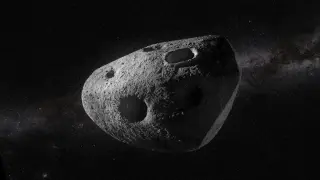
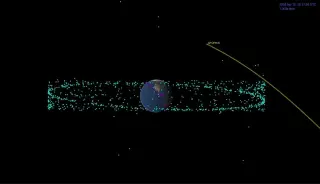
Asteroid 99942 Apophis (about 370 meters long) will pass within ~32,000 kilometers of Earth in April 2029. New simulations indicate a collision with high-Earth-orbit space debris could occur, which would not significantly alter Apophis's orbit but could complicate interpreting gravity-driven changes during the flyby. The possibility underscores gaps in debris surveys and could spur improved monitoring ahead of the encounter, with ESA's RAMSES and NASA–ESA OSIRIS-APEX observations planned.

Apophis 2029 Flyby: Billions Could Witness a Close Naked-Eye Earth Pass
science28 days ago

Apophis 2029 Flyby: Billions Could Witness a Close Naked-Eye Earth Pass

On 13 April 2029, asteroid 99942 Apophis will pass about 32,000 km from Earth—closer than geostationary satellites—offering a rare, world-spanning viewing event, though NASA says there is no impact risk for at least a century. New visibility maps suggest as many as 7.6 billion people could see it with the naked eye during roughly seven hours, depending on darkness and sky conditions. Scientists will study the encounter to learn about asteroid structure and gravity effects, while three spacecraft programs—ESA’s Ramses, JAXA’s DESTINY+, and NASA’s OSIRIS-APEX—will observe Apophis before, during and after the flyby as a planetary-defense rehearsal.

Near-Earth Object Rewrites Its Identity: A Hidden Comet Behind the Asteroid Label
science1 month ago

Near-Earth Object Rewrites Its Identity: A Hidden Comet Behind the Asteroid Label

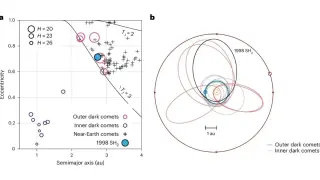
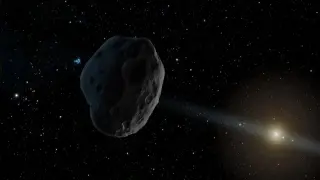
Astronomers confirmed that the near-Earth object 1998 SH2, once labeled an asteroid, exhibits cometary activity (a faint coma and tail) driven by ice sublimation. Its non-gravitational motion predicted this activity before direct observation, making it the first case where orbital perturbations pointed to a comet. If dark comets are more common, they could influence Earth impact risk assessments and help explain how water may have been delivered to early Earth, with broader implications for planetary defense and interpreting objects like ‘Oumuamua.

28-Year Identity Swap: 1998 SH2 Is a Comet, Not an Asteroid
space1 month ago

28-Year Identity Swap: 1998 SH2 Is a Comet, Not an Asteroid

A near-Earth object long tracked as a possible asteroid (1998 SH2) was shown to be a comet after nongravitational forces from outgassing altered its path; subsequent observations with large telescopes detected a faint tail, and the object was redesignated as P/1998 SH2, highlighting the existence of dark comets and the importance of continuous tracking for planetary defense.

Apophis 2029: a global naked-eye sky show with a safe flyby
space1 month ago

Apophis 2029: a global naked-eye sky show with a safe flyby

Astronomers predict the near‑Earth asteroid 99942 Apophis will pass by Earth on April 13, 2029, and be visible to the naked eye for about seven hours as it travels from Australia to the North Atlantic; at closest approach it will be roughly 19,700 miles above Earth and should be brightest near Cameroon. NASA says there is no impact risk for 2029 or the next century, making this a safe, rare opportunity to study how Earth's gravity affects an asteroid—potentially triggering landslides or exposing pristine material, though the exact outcome is unknown. Visibility depends on weather and light pollution, but estimates suggest billions could see it in principle.

Skyscraper-sized asteroid to skim Earth in two online livestreams
space2 months ago

Skyscraper-sized asteroid to skim Earth in two online livestreams

A giant asteroid about 440 meters across (152637 1997 NC1) will pass Earth at roughly 1.59 million miles away on June 27, with closest approach around 7:16 a.m. EDT (1116 GMT) and traveling about 19,879 mph. NASA classifies it as a potentially hazardous asteroid, though this flyby poses no risk. The Virtual Telescope Project will host two YouTube livestreams starting at 7 p.m. EDT on June 26 and 27 to show the asteroid using robotic telescopes in Manciano, Italy, weather permitting, offering skywatchers with small telescopes a chance to spot the object as it moves through the constellation Ophiuchus.

Canada to spot a 1.65-km asteroid during its closest approach since the 1600s
canada-science2 months ago

Canada to spot a 1.65-km asteroid during its closest approach since the 1600s

A roughly 1.65-kilometre asteroid (1997 NC1) will pass Earth on June 27 at about 2.5–2.6 million kilometres away—the closest approach since the 1600s—and may be visible from parts of Canada with a small telescope. The CSA says the flyby poses no risk; such events offer scientists a chance to study the asteroid’s size, shape and orbit, with NASA noting the next close approach isn’t until 2133.

Kilometer-Sized Asteroid to Pass Safely by Earth This Weekend
space2 months ago

Kilometer-Sized Asteroid to Pass Safely by Earth This Weekend

A near-Earth object roughly a kilometer across, officially designated 1997 NC1 (also named 152637), will pass by Earth on June 27 in what scientists describe as a safe, close approach. While headlines may suggest danger, current calculations show no impact risk for at least the next century, and such passes help researchers refine asteroid tracking and defense techniques.

67-meter asteroid LN6 set to skim past Earth on the Lubavitcher Rebbe’s yahrzeit
space2 months ago

67-meter asteroid LN6 set to skim past Earth on the Lubavitcher Rebbe’s yahrzeit

NASA’s asteroid tracker says 2003 LN6, about 67 meters in diameter, will pass Earth at a distance of a little over 1.4 million kilometers on June 18, 2026—the yahrzeit of Rabbi Menachem Mendel Schneerson. It’s a monitored near‑Earth object posing no danger, with planetary-defense context (including the DART mission) noted to illustrate how scientists protect the planet.

Near-Earth Rock Slips Through Detection Door Before Close Flyby
science3 months ago

Near-Earth Rock Slips Through Detection Door Before Close Flyby

An asteroid the size of a blue whale will pass about 56,500 miles from Earth tonight (roughly 24% of the Earth–Moon distance), but it wasn’t discovered until roughly a week ago because key radar facilities are down after Arecibo’s collapse and ongoing Goldstone repairs; only about 1% of Earth-skimming asteroids this size get flagged, even as surveys like Vera Rubin Observatory discover thousands of new objects, highlighting gaps in our planetary defense.

Basketball-court-sized asteroid to skim Earth tonight, watch via livestream
space3 months ago

Basketball-court-sized asteroid to skim Earth tonight, watch via livestream

An asteroid the size of a basketball court, designated 2026 JH2, will pass closer to Earth than the Moon this evening and will be visible with small telescopes from the Northern Hemisphere, though it’ll be low in the sky after sunset; there’s no danger, and the Virtual Telescope Project will stream the closest approach starting at 19:45 UTC.

62-foot asteroid to skim Earth closer than the Moon
space3 months ago

62-foot asteroid to skim Earth closer than the Moon

An approximately 62-foot asteroid named 2026 JH2 will pass about 57,000 miles from Earth—closer than the Moon—around 6 p.m. ET Monday. It was discovered May 10 by the Mount Lemmon Survey and may be visible with small telescopes, but it poses no threat to Earth. NASA/ESA are tracking the flyby, and the Virtual Telescope Project will stream it online. The article also notes a much larger asteroid, Apophis, approaching Earth in 2029 and mentions the OSIRIS-APEX mission and potential budget cuts affecting NASA’s plans.

Apophis to zip by Earth in 2029, a near-light-speed shift in its orbit
science3 months ago

Apophis to zip by Earth in 2029, a near-light-speed shift in its orbit

NASA says the Eiffel Tower–sized asteroid Apophis, categorized as potentially hazardous, will pass Earth in April 2029 at about 20,000 miles away—closer than many geosynchronous satellites—nudging its orbit and rotation but posing no immediate risk. Discovered in 2004, Apophis is a remnant from the solar system’s formation; its name comes from the Egyptian god of chaos. Astronomers plan close-up observations, aided by missions like OSIRIS‑REx and Ramses to study the encounter.