
NASA’s 'Big Bang' Power Swap Extends Voyager 2’s Interstellar Mission by a Year
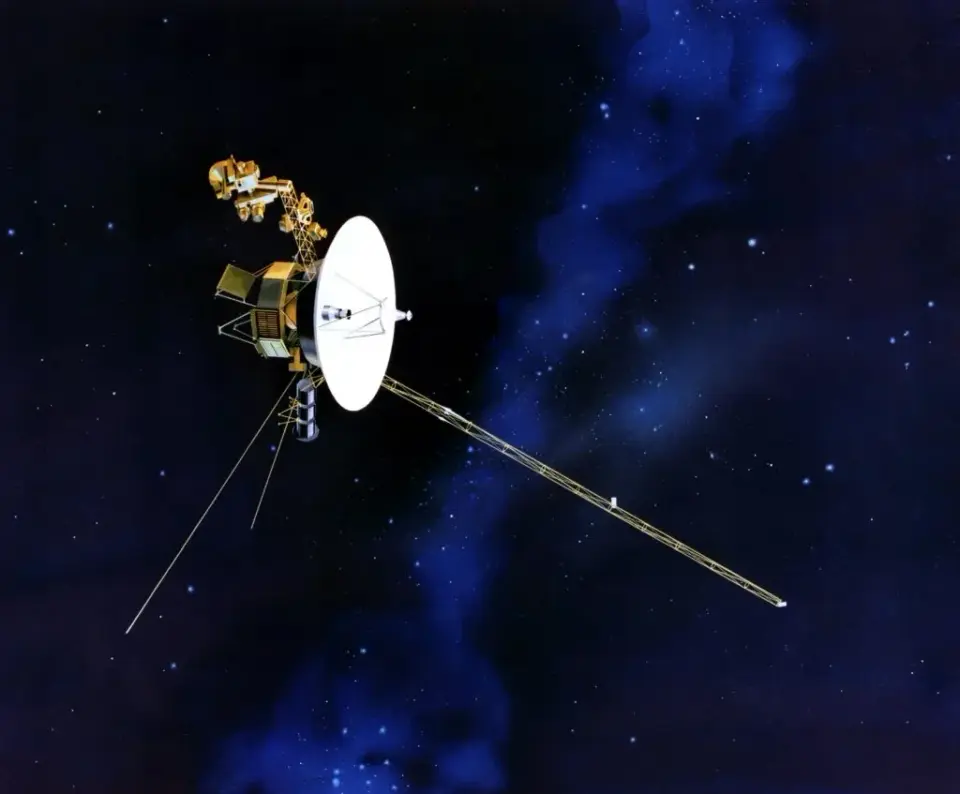
NASA engineers at the Jet Propulsion Laboratory successfully executed a coordinated power-saving maneuver nicknamed the 'Big Bang' on Voyager 2, extending its operational life by at least one year. By simultaneously shutting down nonessential devices and activating lower-power alternatives, the team preserved enough electricity to keep the probe’s three remaining science instruments active. This move prevents the immediate shutdown of additional instruments, allowing the spacecraft to continue transmitting unique data from interstellar space despite its declining power supply.
Key points
- JPL engineers completed the 'Big Bang' operation in August 2026, a simultaneous swap of powered devices to reduce energy consumption.
- The maneuver allows Voyager 2’s three active instruments—the Cosmic Ray Subsystem, Magnetometer, and Plasma Wave Subsystem—to operate for at least another year.
- Voyager 2 loses approximately four watts of usable power annually due to the decay of its plutonium-238 radioisotope thermoelectric generators.
- A similar power-saving strategy is planned for Voyager 1 in the coming months to extend its mission as well.
- Communication with Voyager 2 takes roughly 39 hours round-trip, requiring engineers to pre-plan commands without live troubleshooting.
Background
Voyager 2, launched in 1977, has long outlasted its original five-year mission plan. Since 2024, the mission has already disabled two science instruments on each Voyager probe to conserve power. Previous adjustments, such as a 2023 voltage-protection system tweak, also bought time. The probes are the only functioning spacecraft to have crossed the heliopause, making their continued operation scientifically valuable despite aging hardware.
How outlets are covering it
Space Daily emphasizes the logistical challenges of remote engineering, noting that the 39-hour communication delay forces engineers to rely on pre-planned sequences and onboard autonomy rather than live troubleshooting. Mashable highlights the historical significance of the mission, noting that Voyager 2 has explored four planets and 48 moons, and that the 'Big Bang' is the latest in a series of power-saving measures. Both sources agree that the extension is a temporary measure, not a permanent fix, as the power supply continues to decline. Space Daily clarifies that the 'nearly 24 hours' communication delay often cited applies more to Voyager 1, while Voyager 2’s one-way light time is about 19.5 hours.
Why it matters
The extension of Voyager 2’s mission preserves a unique data stream from interstellar space, a region no other spacecraft can currently access. As the probes move farther from the Sun, their data becomes increasingly valuable for understanding the environment beyond the solar system. The success of the 'Big Bang' maneuver demonstrates NASA’s ability to extend the life of aging spacecraft through innovative power management, potentially delaying the end of these historic missions until approximately 2036.
What to watch
NASA plans to implement a similar power-saving strategy on Voyager 1 in the coming months. If successful, both spacecraft will continue to operate for at least an additional year. The long-term viability of the missions depends on the continued decline of their power supply, with engineers expected to make further instrument shutdown decisions as power margins shrink.
- NASA engineers working to extend the Voyager missions cannot physically touch the spacecraft, cannot send a replacement part, and must wait nearly 24 hours for every command to arrive — and another 24 hours for the reply — yet they just bought Voyager Space Daily
- NASA figured out how to keep its 48-year-old Voyager 2 probe running for yet another year Space
- NASA Engineers Help Prolong Voyager 2’s Science Mission NASA Science (.gov)
- NASA gives Voyager 2 a new lease on life nearly 48 years after launch scrippsnews.com
- How NASA is powering the Voyager 2 probe from a galaxy away Mashable
Want the full story? Read the original reporting
Read on Space Daily