
Chinese AI System Executes 11,382-Step DNA Experiment in 203 Hours
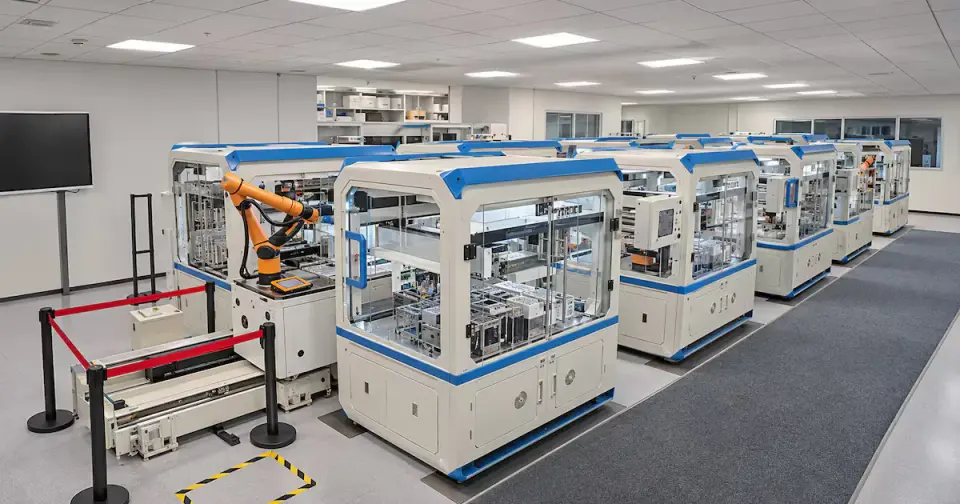
Researchers at Shanghai Jiao Tong University have developed AutoDNA, an AI-driven autonomous laboratory system capable of designing and executing complex life science experiments. Published in Nature on November 5, the study details how the system, built on Google Gemini 2.5 Pro, coordinated over 20 pieces of equipment and robotic arms to perform DNA synthesis and sequencing. In a notable test, the AI stored and retrieved an English sentence encoded in DNA, completing 11,382 steps over 203 hours. While humans handled material replenishment and equipment maintenance, the AI managed planning, execution, and analysis, achieving a 97.8% success rate in DNA base connection and a 3.2-fold increase in efficiency compared to manual methods.
Key points
- AutoDNA uses multiple AI agents to plan and execute experiments from a single natural language prompt.
- The system achieved a 97.8% success rate in enzymatic DNA synthesis, matching expert human performance.
- The AI reduced sequential DNA synthesis time from 1,433 minutes to 454 minutes through parallel processing.
- In a data storage test, the AI synthesized 78 DNA strands to store and accurately retrieve a specific English sentence.
- The system required human intervention for 6 out of 14 equipment errors, indicating it is not yet fully autonomous.
- South Korea is developing a similar 'AI scientist' initiative under the K-Moonshot project, aiming for completion by 2035.
Background
This development follows a broader trend in Chinese scientific innovation, including recent breakthroughs in plasma physics and gene editing. It also contrasts with ongoing legal disputes between US and Chinese biotech firms regarding intellectual property, highlighting the competitive landscape in advanced life sciences. South Korea’s parallel efforts to develop autonomous AI labs reflect a regional race to integrate artificial intelligence into core research processes.
How outlets are covering it
The Chosun Daily emphasizes the system's efficiency gains and its potential to bridge the gap between AI planning and physical execution, citing praise from Stanford professor James Zhou. Crypto Briefing highlights the practical implications of the system's ability to detect clinically significant mutations, such as KRAS G13D, while noting that the technology remains far from regulated clinical use. Both sources agree that while the AI handles complex decision-making, humans are still required for physical maintenance and error resolution, with the Chosun Daily noting that 6 of 14 errors required human intervention.
Why it matters
AutoDNA represents a significant step toward fully autonomous scientific research, potentially accelerating drug discovery and genetic testing. By reducing experiment times and improving success rates, such systems could lower the cost and time required for life science research. However, the need for human oversight in error correction and the lack of independent replication raise questions about reliability and safety in high-stakes biological applications.
What to watch
The scientific community will focus on replicating AutoDNA's results in independent labs to verify its performance. Researchers will also work on enhancing equipment safety and control mechanisms for risky biological experiments. South Korea’s K-Moonshot project will continue its development of AI-driven research systems, with the goal of achieving full autonomy by 2035.
Want the full story? Read the original reporting
Read on 조선일보