
UN Declares 2026 El Niño a 'Behemoth' Threatening Global Stability
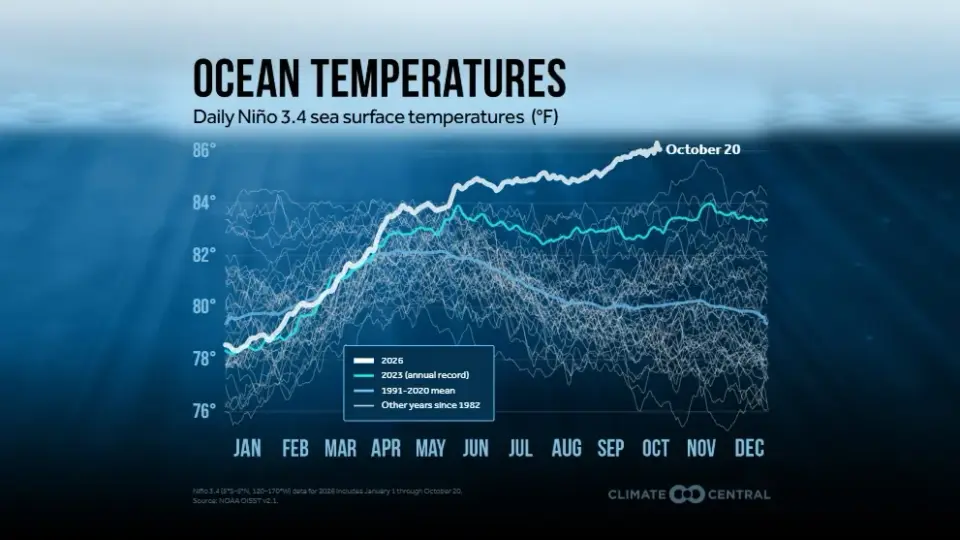
The World Meteorological Organization (WMO) has labeled the 2026 El Niño a 'behemoth' and 'wrecking ball,' warning that it will cause unprecedented global weather disruptions. Central Pacific temperatures are projected to rise 3.8°C above normal by December, exceeding all records since the 1950s. The event is expected to trigger extreme heat, droughts, and floods across Latin America, Africa, and Asia, potentially affecting 50 million people with hunger. In the US, NOAA forecasts wetter, warmer winters for the East and South, while California faces severe coastal flooding risks. Experts note this natural event is amplifying human-caused climate change, creating a 'preview' of future warming scenarios.
Key points
- WMO Secretary Celeste Saulo described the event as 'unprecedented in strength,' with central Pacific temperatures rising 3.8°C above normal between November and January, peaking in December.
- UN humanitarian coordinator Tom Fletcher warned the El Niño will 'tear through' Latin America, Africa, and Asia, potentially causing 50 million people to face increased hunger.
- NOAA predicts a 40-60% chance of above-average temperatures and wetter conditions for the US East Coast and South during the 2026-2027 winter.
- California Governor Gavin Newsom declared a state of emergency, citing risks of flash floods and mudslides on dry soil, while UC Davis researchers warn of vulnerable coastal infrastructure.
- Climate scientist Michael Mann noted that while El Niño is natural, it is converging with human-caused warming, setting new global temperature records and acting as a glimpse of future climate conditions.
Background
This event follows a series of record-breaking weather anomalies in 2026, including a hyperactive Pacific hurricane season and severe coastal flooding in California earlier in the year. Previous archive coverage noted that sea surface anomalies reached 3.8°C in the Niño 3 region by September, months before the typical peak. Additionally, concerns about reduced weather satellite capabilities due to budget cuts may impact long-term forecasting accuracy, though current seasonal outlooks remain high-confidence.
How outlets are covering it
While all sources agree on the severity of the event, they emphasize different impacts. The WMO and UN focus on global humanitarian consequences, such as hunger and infrastructure failure in the Global South. US-focused outlets like NOAA and Cape Cod Times highlight regional weather shifts, specifically warmer and wetter winters for the East Coast. UC San Diego experts provide a detailed local perspective, warning of specific coastal hazards like record-high sea levels, kelp forest die-offs, and marine ecosystem shifts. There is a consensus that while El Niño is a natural cycle, its current intensity is amplified by the baseline warming from human-caused climate change, though scientists debate whether human warming is increasing the frequency of such extreme events.
Why it matters
The 2026 El Niño represents a critical stress test for global climate resilience. Its unprecedented strength threatens to disrupt food supplies, water availability, and infrastructure across multiple continents. For the US, it signals a shift in seasonal weather patterns that could impact agriculture, energy demand, and coastal safety. The event also serves as a tangible demonstration of how natural climate cycles interact with long-term anthropogenic warming, potentially setting new benchmarks for global temperature records and extreme weather frequency.
What to watch
Forecasters expect the El Niño to peak in December 2026, with impacts lasting through early 2027. NOAA will update monthly seasonal outlooks, while the WMO will monitor the event's progression. In the US, attention will focus on winter storm impacts, coastal flooding, and potential drought relief in the South. Global monitoring will track the event's effects on agriculture, water supplies, and humanitarian needs, particularly in Africa and Asia. Scientists will continue to analyze the event's contribution to global temperature records and its long-term implications for climate models.
- 'Behemoth' El Niño to upend global weather, UN warns USA Today
- Could history repeat itself? How past Super El Niño winters offer clues about what's ahead FOX Weather
- El Niño breaks warming records in the Pacific Ocean, foreshadowing more extreme weather to come, UN says CBC
- 10 Things to Know About This Very Strong El Niño UC San Diego Today
- NOAA winter weather forecast for Cape Cod predicts wet, warm(er) Cape Cod Times
Want the full story? Read the original reporting
Read on USA Today