Tag

Global Weather

All articles tagged with #global weather

El Niño reaches 'very strong' status with 60% chance of becoming historic
climate8 days ago

El Niño reaches 'very strong' status with 60% chance of becoming historic

NOAA’s Climate Prediction Center has classified the current El Niño as 'very strong,' the highest intensity level, matching only three previous events since 1950. There is a 60% probability it will exceed those historic benchmarks. The event is expected to peak in late 2026 or early 2027, potentially driving global temperatures to near-record levels and causing extreme weather through spring 2027. While a transition to La Niña is possible by mid-2027, El Niño will dominate U.S. weather patterns for the next several months, influencing storm tracks and precipitation across the country.

UN Declares 2026 El Niño a 'Behemoth' Threatening Global Stability
climate1 month ago

UN Declares 2026 El Niño a 'Behemoth' Threatening Global Stability

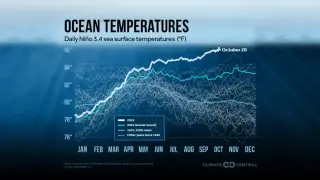
The World Meteorological Organization (WMO) has labeled the 2026 El Niño a 'behemoth' and 'wrecking ball,' warning that it will cause unprecedented global weather disruptions. Central Pacific temperatures are projected to rise 3.8°C above normal by December, exceeding all records since the 1950s. The event is expected to trigger extreme heat, droughts, and floods across Latin America, Africa, and Asia, potentially affecting 50 million people with hunger. In the US, NOAA forecasts wetter, warmer winters for the East and South, while California faces severe coastal flooding risks. Experts note this natural event is amplifying human-caused climate change, creating a 'preview' of future warming scenarios.

UN Warns Record-Breaking El Nino Will Supercharge Global Climate Crisis
climate-crisis3 months ago

UN Warns Record-Breaking El Nino Will Supercharge Global Climate Crisis

The World Meteorological Organization (WMO) has issued a stark warning that a rapidly intensifying El Nino event is set to dominate global weather patterns through 2026 and into 2027. Central Pacific sea-surface temperatures are projected to exceed 2.9 degrees Celsius above normal, a level that scientists describe as historically unprecedented for this stage of the cycle. UN Secretary-General Antonio Guterres characterized the event as 'inside the house and turning up the heat,' arguing that it is amplifying existing climate change impacts. The WMO forecasts severe consequences, including heatwaves, droughts, and floods, across Africa, Europe, Asia, and the Americas. While the phenomenon is natural, its interaction with human-induced warming is creating 'uncharted territory' for global weather systems, prompting urgent calls for immediate action on fossil fuel expansion and enhanced early-warning systems to protect vulnerable populations.

El Niño Arrives with Odds for a Historic Super Event
weather5 months ago

El Niño Arrives with Odds for a Historic Super Event

El Niño has officially begun and forecasters assign a 63% chance it could intensify into a “Super” El Niño, potentially one of the largest on record. NOAA says it could strengthen through fall and winter, warming global temperatures and triggering broad weather shifts—from heat and heavy rainfall in some regions to drought in others—while influencing Pacific hurricane activity. The event comes as the world is already warmer due to climate change, raising the likelihood that 2027 could become the warmest year on record.

"Warning: Atlantic Ocean Current System Nearing Catastrophic Collapse, Study Finds"
environment2 years ago

"Warning: Atlantic Ocean Current System Nearing Catastrophic Collapse, Study Finds"

Scientists have detected early warning signs of the collapse of the crucial Atlantic Meridional Overturning Circulation (AMOC), a system of ocean currents that plays a vital role in regulating global weather and sea levels. The collapse could lead to dramatic temperature changes in different regions, with some parts of Europe potentially experiencing a 30-degree Celsius plunge in temperatures over a century, while countries in the Southern Hemisphere could see increased warming. The study, using complex climate models, suggests that the AMOC could collapse due to freshwater entering the ocean, potentially causing a surge in sea levels by around 1 meter. While uncertainties remain, the findings add to the growing concern about the potential collapse of the AMOC and its catastrophic impacts on the climate system and humanity.