
Deep Partial Lunar Eclipse and Geomagnetic Storms Coincide for Rare Sky Event
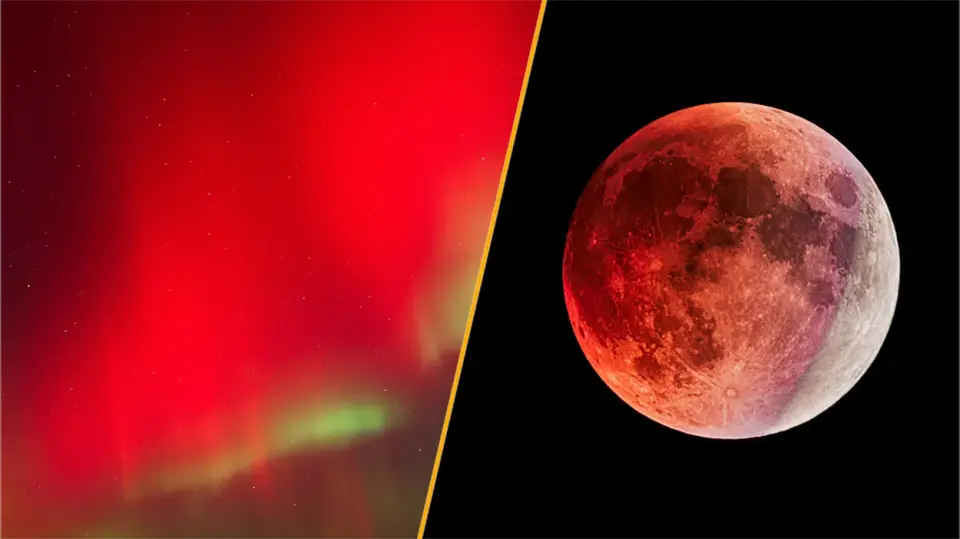
A deep partial lunar eclipse on August 27-28, 2026, will cover 96% of the Moon with Earth's shadow, creating a red hue visible to billions. Simultaneously, a G2 geomagnetic storm may produce northern lights across northern U.S. states and Canada, offering a rare dual celestial display.
Key points
- The partial lunar eclipse reaches maximum depth at 12:13 a.m. EDT, with 96% of the Moon's surface obscured by Earth's umbra.
- NOAA issued a G2 geomagnetic storm warning for 9:03 p.m. EDT, just 20 minutes before the eclipse begins.
- Auroras may be visible from New York to Idaho, with the best combined views of the red Moon and northern lights in Canada and Alaska.
- The event is visible across the Americas, Africa, Europe, and western Asia, with over 3 billion people positioned to see at least part of it.
- A powerful M-class solar flare and coronal mass ejection on August 25 triggered the geomagnetic storm conditions.
Background
This eclipse is part of an 'eclipse season' following the total solar eclipse of August 12, 2026. It is the deepest partial lunar eclipse visible until June 2029, with the next total lunar eclipse occurring on New Year's Eve 2027. Previous coverage noted the 96% obscuration figure refers to surface area, not diameter, and that the Moon will not fully enter totality.
How outlets are covering it
Live Science emphasizes the rare coincidence of red auroras and the red Moon, citing NOAA's G2 storm warning and astronomer Tom Kerss on viewing locations. Sky & Telescope provides detailed timing and visual descriptions, noting a pale turquoise band may appear between the bright sliver and reddened disk due to ozone filtering. MPR News highlights the global audience, noting visibility from the International Space Station and China's orbiting outpost, and frames the event as the second act of a celestial pair. Time Magazine focuses on the 'blood moon' phenomenon, explaining the atmospheric scattering of light and the 5.5-hour duration of the full event.
Why it matters
This event offers a unique opportunity to observe two distinct celestial phenomena simultaneously, combining the atmospheric effects of a deep lunar eclipse with the solar wind-driven auroras. It underscores the dynamic interactions between solar activity and Earth's magnetic field, providing a rare educational and observational moment for skywatchers worldwide.
What to watch
Skywatchers in northern U.S. states and Canada should monitor the night sky on August 27-28 for both the reddened Moon and potential auroras. The next total lunar eclipse will not occur until December 31, 2027, making this a significant event for the coming years.
- Rare red northern lights may be visible alongside red moon during tomorrow night's partial lunar eclipse Live Science
- Next Up! A Deep Partial Lunar Eclipse on Aug. 27–28 Sky & Telescope
- Near-total lunar eclipse is coming up with the Americas in prime position MPR News
- Summer Is Ending With a 'Blood Moon' Lunar Eclipse. Here's What To Know. Time Magazine
- Partial lunar eclipse will turn the moon red in New Mexico KOAT
Want the full story? Read the original reporting
Read on Live Science