Tag

Aurora

All articles tagged with #aurora

Saturn's Spin Mystery Solved: Webb Uncovers a Planetary Heat Pump
space12 days ago

Saturn's Spin Mystery Solved: Webb Uncovers a Planetary Heat Pump

Astronomers using the James Webb Space Telescope show Saturn’s apparent, inconsistent rotation is an illusion created by a self-sustaining loop between auroral heating and the planet’s upper atmosphere. By tracking the infrared glow of the H3+ molecule across Saturn’s northern aurora for a full Saturnian day, researchers mapped temperature and winds, revealing that auroral heating drives winds which power currents that sustain the aurora—effectively a planetary heat pump. This two-way coupling between atmosphere and magnetosphere could change how scientists interpret signals from gas giants and exoplanets.

Aurora Echoes: Snowmobiles, Frozen Cameras, and a Century of Arctic Science
science1 month ago

Aurora Echoes: Snowmobiles, Frozen Cameras, and a Century of Arctic Science

A New York Times science feature follows a reporter and a photojournalist as they retrace the century-old pursuit of auroral science, traveling above the Arctic Circle to Alta, Norway, to revisit the first aurora observatory (established in 1899) and reflect on the challenges and evolution of remote-field research in documenting the Northern Lights.

Solar Max Sparks Southern UK Auroras
science2 months ago

Solar Max Sparks Southern UK Auroras

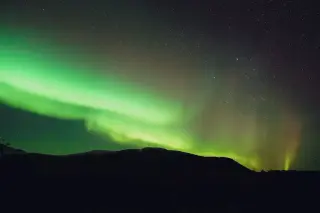
Auroras lit up the South West of the UK (Devon, Cornwall and the Channel Islands) due to coronal mass ejections from the Sun at the height of solar cycle 25. Experts say 2025–2026 is the likely peak, with some forecasts suggesting the next maximum could be as late as 2037. Strong geomagnetic storms push auroras farther south, but visibility depends on dark skies and viewing conditions. To see them, monitor Met Office Space Weather alerts and head to dark-sky sites away from light pollution, using long-exposure photography; the article notes several South West dark-sky locations.

Severe Solar Storm Sparks Auroras at Unusual Latitudes
science2 months ago

Severe Solar Storm Sparks Auroras at Unusual Latitudes

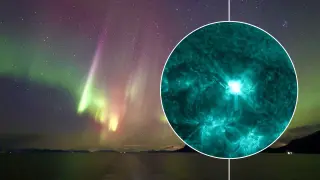
Earth is under a severe geomagnetic storm (G4, potentially reaching G5) triggered by a large coronal mass ejection and fast solar wind after an X1.9 flare, fueling strong auroras that could appear at unusually low latitudes; a radiation storm (S4, now subsiding to S2) also poses risks to spacecraft, aviation, and satellites, while power grids and communications may be affected as Earth's magnetic field responds to ongoing solar wind.

Rare southern auroras possible as strong geomagnetic storm hits
science2 months ago

Rare southern auroras possible as strong geomagnetic storm hits

A major geomagnetic disturbance could light up the sky with auroras across Canada and much of the northern US on Monday night, possibly stretching farther south; NOAA's space weather center warns the storm is among the strongest in more than two decades and could disrupt satellites and GPS, with activity expected to persist into Tuesday, following November events that brought auroras as far south as Kansas, Colorado, and Texas.

Auroras on the Move: Lights Reach Far South Tonight
science2 months ago

Auroras on the Move: Lights Reach Far South Tonight

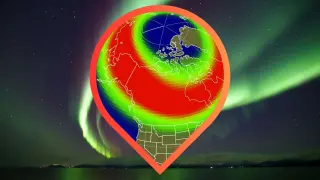
A powerful X-class solar flare and a fast coronal mass ejection could spark auroral displays much farther south than usual tonight—potentially visible from parts of California, the central Plains, and the Mid-Atlantic, with even deeper-south areas possible. NOAA has issued a rare G4 geomagnetic storm potential, though whether the CME hits Earth head-on remains uncertain. For best viewing, find a dark, clear sky along the northern horizon after sunset.

Earth-ward CME from X-class flare could spark auroras within 24 hours
space2 months ago

Earth-ward CME from X-class flare could spark auroras within 24 hours

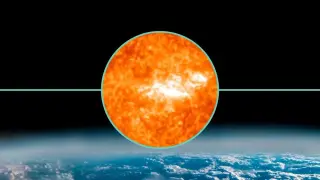
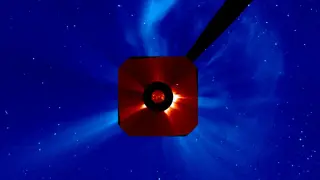
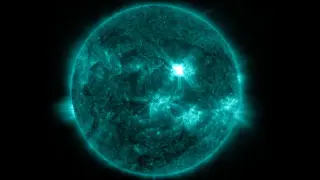
An X1.9 solar flare from the Sun triggered a fast Earth-directed coronal mass ejection (CME) forecast to reach Earth within about 24 hours. If the CME’s magnetic orientation (Bz) is southward, it could couple with Earth’s magnetosphere and drive strong (G3) to severe (G4) geomagnetic storm conditions, potentially lighting up auroras as far south as parts of the U.S. (e.g., Northern California to Alabama). Forecasters caution that CME arrivals are hard to pin down and depend on magnetic orientation; disruptions to satellites, GPS, and radio signals and increased atmospheric drag on spacecraft are possible alongside spectacular auroral displays depending on the event’s exact geometry and timing.