Tag

Geomagnetic Storm

All articles tagged with #geomagnetic storm

X1.4 Solar Flare Knocks Out Radio Ahead of Artemis 2 Moon Mission
space12 days ago

X1.4 Solar Flare Knocks Out Radio Ahead of Artemis 2 Moon Mission

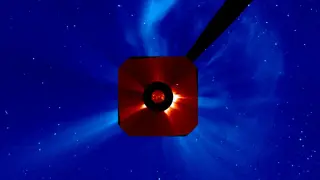
A powerful X1.4 solar flare from sunspot region 4405 caused radio blackouts on Earth’s sunlit side and launched a fast CME, with NOAA warning of a possible Earth-directed component and a moderate G2 geomagnetic storm watch. NASA’s Artemis 2 moon mission is planned no earlier than April 1, but space weather could disrupt launch communications and early maneuvers; if the CME impacts Earth, auroras could appear at unusually low latitudes in the United States.

Midwest and beyond could see northern lights as solar storm approaches this weekend
space24 days ago

Midwest and beyond could see northern lights as solar storm approaches this weekend

NOAA’s Space Weather Prediction Center warns of a G2 geomagnetic storm on March 19 (UTC) as multiple coronal mass ejections head toward Earth. The activity could push the auroral oval far south, with potential sightings in mid-latitudes including Illinois and New York, depending on CME timing and local conditions. Impacts could begin as early as 11 p.m. ET on March 18, with strongest activity 2–8 a.m. ET on March 19 and possibly lingering into March 20, and a wider window increases the chance for aurora displays given clear skies and favorable magnetic orientation.

Nine U.S. States Could See the Northern Lights Tonight
stargazing28 days ago

Nine U.S. States Could See the Northern Lights Tonight

Space.com reports that a fast solar wind is expected to sweep past Earth tonight (March 13), potentially triggering a minor geomagnetic storm and making the northern lights visible across nine U.S. states (Alaska, North Dakota, Minnesota, Montana, South Dakota, Wisconsin, Idaho, Washington, and Maine) if skies are clear. Best viewing is tonight into Saturday, with auroras possibly reaching farther south if conditions strengthen, per NOAA's Space Weather Prediction Center.

Northern Lights Could Dazzle U.S. This Weekend, NOAA Forecasts Geomagnetic Activity
science1 month ago

Northern Lights Could Dazzle U.S. This Weekend, NOAA Forecasts Geomagnetic Activity

A NOAA‑issued G1 geomagnetic storm watch due to a high‑speed solar wind could bring the Northern Lights as far south as the U.S. border this weekend, with the best displays in northern states and parts of Canada. For optimal viewing, seek dark, north‑facing spots away from city lights between 10 p.m. and 2 a.m.; the near‑90% illuminated moon may wash out faint auroras, so long‑exposure photography can help capture them.

Northern Lights Hit Ten States Tonight Amid Solar Storm Watch
science1 month ago

Northern Lights Hit Ten States Tonight Amid Solar Storm Watch

A NOAA geomagnetic storm watch due to a high-speed solar wind stream could bring the aurora borealis to ten U.S. states tonight through the weekend, visible between 10 p.m. and 2 a.m. local time if skies are clear. Best viewing is away from city lights; monitor live forecasts, and use Night Mode/Pro Mode on iPhones (preferably main lens, RAW if possible) for photos.

Solar Max Sparks Southern UK Auroras
science2 months ago

Solar Max Sparks Southern UK Auroras

Auroras lit up the South West of the UK (Devon, Cornwall and the Channel Islands) due to coronal mass ejections from the Sun at the height of solar cycle 25. Experts say 2025–2026 is the likely peak, with some forecasts suggesting the next maximum could be as late as 2037. Strong geomagnetic storms push auroras farther south, but visibility depends on dark skies and viewing conditions. To see them, monitor Met Office Space Weather alerts and head to dark-sky sites away from light pollution, using long-exposure photography; the article notes several South West dark-sky locations.

Solar storm lights up auroras from Europe to Southern California, 23-year radiation record broken
space2 months ago

Solar storm lights up auroras from Europe to Southern California, 23-year radiation record broken

A powerful solar radiation storm triggered by an X-class solar flare and a CME struck Earth, producing widespread auroras across Europe and parts of North America, with sightings as far south as Southern California. The storm peaked at G4 (severe) on the geomagnetic scale per NOAA’s SWPC. While dramatic, it wasn’t the strongest in two decades (the 2024 Mother’s Day event held that distinction), but it did set a 23-year record for solar-radiation storms.

Earth Faces a 20-Year-High Solar Storm: What This Powerful Space Weather Means
astronomy2 months ago

Earth Faces a 20-Year-High Solar Storm: What This Powerful Space Weather Means

Earth has been hit by the strongest solar radiation storm in more than two decades, driven by activity from the Sun. The resulting geomagnetic disturbance could affect radio communications, satellite operations, and power/stability of certain technologies, while also lighting up spectacular auroras at lower latitudes. Space weather agencies are monitoring the event and the potential cascading effects over the coming hours to days, offering updates and guidance for affected systems.

Severe Solar Storm Sparks Auroras at Unusual Latitudes
science2 months ago

Severe Solar Storm Sparks Auroras at Unusual Latitudes

Earth is under a severe geomagnetic storm (G4, potentially reaching G5) triggered by a large coronal mass ejection and fast solar wind after an X1.9 flare, fueling strong auroras that could appear at unusually low latitudes; a radiation storm (S4, now subsiding to S2) also poses risks to spacecraft, aviation, and satellites, while power grids and communications may be affected as Earth's magnetic field responds to ongoing solar wind.

Rare aurora could glow over north Georgia as space storm hits
weather2 months ago

Rare aurora could glow over north Georgia as space storm hits

A strong G4 geomagnetic storm triggered by a solar flare and coronal mass ejection could produce faint northern lights visible in north Georgia tonight, depending on a KP index of 8–9. Observers should seek dark skies away from city lights, and a visible aurora may be hard to see with the naked eye. Solar storms can also affect GPS, satellites, and power grids.

Rare southern auroras possible as strong geomagnetic storm hits
science2 months ago

Rare southern auroras possible as strong geomagnetic storm hits

A major geomagnetic disturbance could light up the sky with auroras across Canada and much of the northern US on Monday night, possibly stretching farther south; NOAA's space weather center warns the storm is among the strongest in more than two decades and could disrupt satellites and GPS, with activity expected to persist into Tuesday, following November events that brought auroras as far south as Kansas, Colorado, and Texas.

science2 months ago

CME Arrival Triggers G4 Geomagnetic Storm Watch for Jan 20

NOAA’s Space Weather Prediction Center has issued a G4 (Severe) Geomagnetic Storm Watch for January 20 due to a coronal mass ejection released January 18 in association with an energetic solar flare; the CME is expected to reach Earth from late January 19 to early January 20, with storm levels potentially ranging from G1 to G3 upon arrival and the passage likely continuing through January 20, with residual effects possible on January 21. Forecasters have a fair degree of confidence in the timing and will provide updates as conditions evolve.