
BepiColombo Enters Mercury Orbit Despite Thruster Glitch
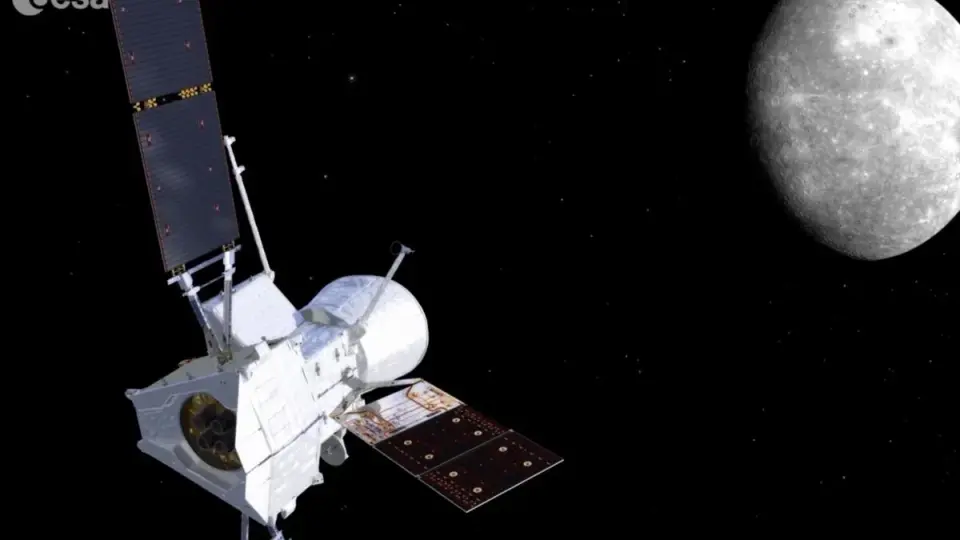
The joint European-Japanese BepiColombo mission successfully entered orbit around Mercury on November 21, 2026, after an eight-year journey. However, a software glitch caused a premature thruster shutdown during the orbital insertion burn, potentially leaving the spacecraft in a higher, less stable orbit. ESA confirmed the spacecraft is safe, but the issue must be resolved before the two probes can separate in December to begin science operations in April 2027.
Key points
- BepiColombo entered Mercury orbit on November 21, 2026, concluding an eight-year voyage that began in October 2018.
- A software glitch caused the thrusters to cut off early during the orbital insertion burn, as reported by ESA on November 22.
- The premature shutdown may have left the spacecraft in a higher and more unstable orbit than planned, complicating upcoming maneuvers.
- The mission consists of two conjoined probes: ESA’s Mercury Planetary Orbiter (MPO) and JAXA’s Mercury Magnetosphere Orbiter (Mio).
- The probes are scheduled to separate between December 9 and 10, 2026, with MPO entering its final orbit by March 10, 2027.
- Science operations are expected to begin in April 2027, but the thruster glitch must be fixed first to ensure mission success.
Background
BepiColombo launched in October 2018 to study Mercury’s surface, interior, and magnetic field. It is the second mission to orbit Mercury, after NASA’s MESSENGER probe operated from 2011 to 2015. The mission involves two conjoined probes: ESA’s Mercury Planetary Orbiter (MPO) and JAXA’s Mercury Magnetosphere Orbiter (Mio), carried by ESA’s Mercury Transfer Module (MTM). The MTM separated in early September 2026, allowing MPO’s thrusters to take over steering. The mission aims to resolve long-standing questions about Mercury’s unusually large iron core, magnetic field, and dense composition, which previous models have struggled to explain.
How outlets are covering it
Gizmodo emphasizes the technical risk posed by the thruster glitch, noting that a premature shutdown could leave the spacecraft in a higher, less stable orbit and jeopardize the complex sequence of maneuvers required for probe separation. The Guardian highlights the scientific significance of the mission, describing it as the best hope yet for understanding Mercury’s formation, magnetic field, and frozen ice in permanently shadowed craters. National Geographic focuses on the broader scientific mystery, noting that Mercury’s dense core and magnetic field defy conventional planetary formation models, and that BepiColombo’s data could settle debates about whether the planet lost its outer layers to a giant impact or formed with an unusually large core. SpaceNews reported on the glitch but did not provide additional details beyond confirming the issue.
Why it matters
The BepiColombo mission is critical for resolving fundamental questions about planetary formation, particularly why Mercury has such a large iron core and a magnetic field despite its small size. The thruster glitch poses a risk to the mission’s timeline and objectives, as the complex maneuvers required for probe separation and orbit adjustment must be executed precisely. If the glitch is not resolved, it could jeopardize the entire science campaign, which is expected to begin in April 2027. The mission’s success will also provide insights relevant to understanding exoplanets that orbit close to their stars, as Mercury serves as a solar system analogue for such worlds.
What to watch
ESA teams at the European Space Operations Centre are investigating the software glitch to determine its cause and impact on the mission. The next critical step is the separation of the two probes between December 9 and 10, 2026, followed by MPO’s descent to its final orbit by March 10, 2027. Science operations are scheduled to begin in April 2027, but any failure in the upcoming maneuvers could jeopardize the mission’s objectives. ESA is expected to provide more details on the glitch and the plan to address it soon.
- BepiColombo Reaches Mercury, Suffers Thruster Glitch Gizmodo
- Spacecraft reaches Mercury on second-ever mission to enter its orbit The Guardian
- Thruster glitch clouds BepiColombo arrival at Mercury SpaceNews
- A New Mission Arrives at Mercury, the Solar System's Most Mysterious Planet National Geographic
- BepiColombo safely in Mercury orbit despite unexpected challenge ESA
Want the full story? Read the original reporting
Read on Gizmodo