
Chemical Analysis Confirms Heme in 115-Million-Year-Old Dinosaur Bone
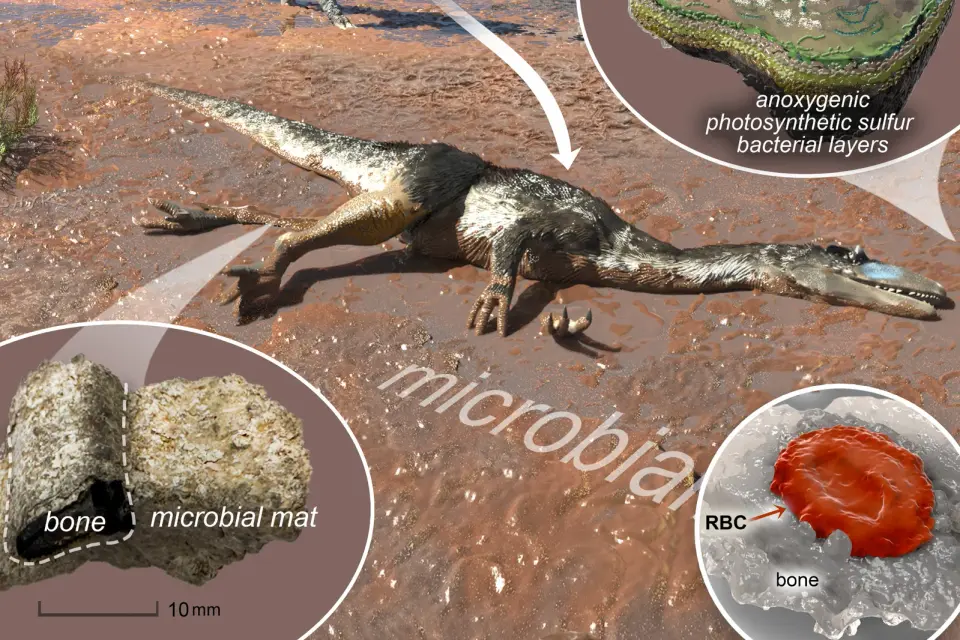
A study published in the Proceedings of the National Academy of Sciences reports the first chemical confirmation of heme, a key component of hemoglobin, within the fossilized vascular canals of a 115-million-year-old dinosaur. Researchers from Curtin University analyzed a juvenile Aratasaurus museunacionali leg bone recovered from Brazil in 2008. The findings suggest that specific mineralization processes, particularly involving manganese oxide, may have preserved delicate cellular structures and biomolecules for over a hundred million years, challenging previous assumptions about the limits of molecular preservation in fossils.
Key points
- Researchers identified oval-shaped structures in the vascular canals of an Aratasaurus museunacionali fossil that resemble red blood cells.
- Chemical analysis detected heme B and a derivative, 3,8-diethyl heme B, within these structures, marking the first in-situ detection of this molecule in a dinosaur fossil.
- The preservation is attributed to rapid burial in a low-oxygen, microbe-rich environment, with hausmannite (a manganese oxide) stabilizing the cellular structures.
- The fossil belongs to a juvenile theropod estimated to be 10 feet long and 75 pounds, though it likely grew larger.
- The discovery opens new avenues for studying ancient physiology and potentially searching for similar biological traces in extraterrestrial environments.
Background
Previous studies in the late 1990s reported structures resembling red blood cells in reptile fossils, but their validity was heavily debated due to a lack of chemical confirmation. This new research builds on those earlier observations by providing molecular evidence. The Romualdo Formation in Brazil, where the fossil was found, is already known for exceptional fossil preservation due to stagnant waters that limited oxygen and slowed decomposition. This discovery follows other recent paleontological findings, such as the identification of preserved tissue in a large T. rex, which has also challenged assumptions about soft-tissue longevity.
How outlets are covering it
While the New York Post and Popular Science framed the discovery as a 'landmark' that could advance the search for extraterrestrial life, CNN and Sci.News emphasized the scientific rigor and the specific chemical evidence of heme. There is notable disagreement among experts regarding the interpretation of the findings. Mary Schweitzer, a professor at North Carolina State University, argued that the structures do not meet established standards for identifying fossilized blood cells and questioned the significance of hausmannite, which is not found in living red blood cells. In contrast, lead author Kliti Grice maintained that hausmannite formed during fossilization and aided preservation. Timothy Cleland of the Smithsonian noted that while the finding is significant, it does not imply that DNA has survived, as heme and DNA fossilize differently. The primary sources agree that the combination of microscopic imaging and chemical analysis provides the strongest evidence to date, but they differ on the immediate implications for de-extinction and astrobiology.
Why it matters
This discovery challenges the long-held belief that complex biomolecules like hemoglobin cannot survive deep time. If confirmed in other specimens, it could allow scientists to investigate the physiology, metabolism, and activity levels of extinct animals. Furthermore, the finding suggests that delicate biological traces may persist in extreme environments, potentially guiding the search for life on other planets. It also raises questions about whether similar molecular information exists in other museum collections that have not been analyzed with these new techniques.
What to watch
The research team plans to expand their analysis to other fossils from different species, geological periods, and environments to determine how widespread this type of preservation is. Future studies may investigate how red blood cells change after death and whether the structures found in Aratasaurus retain their original shape. Additionally, scientists will explore whether the presence of heme in one fossil implies the survival of other molecules, such as DNA, in different contexts.
- ‘Landmark discovery:’ Dinosaur blood found in fossils for the first time — and it could advance search for life in the cosmos New York Post
- Scientists say they’ve found the strongest evidence yet of red blood cells in a dinosaur bone CNN
- Dinosaur blood found in fossils for the first time Popular Science
- Evidence of red blood cells seen in dinosaur fossil from Brazil Reuters
- 115-Million-Year-Old Dinosaur Bones Preserve Chemical Traces of Red Blood Cells Sci.News
Want the full story? Read the original reporting
Read on New York Post