
JWST Reveals 'Black Hole Star' MoM-BH*-1, Solving Cosmic Dawn Mystery
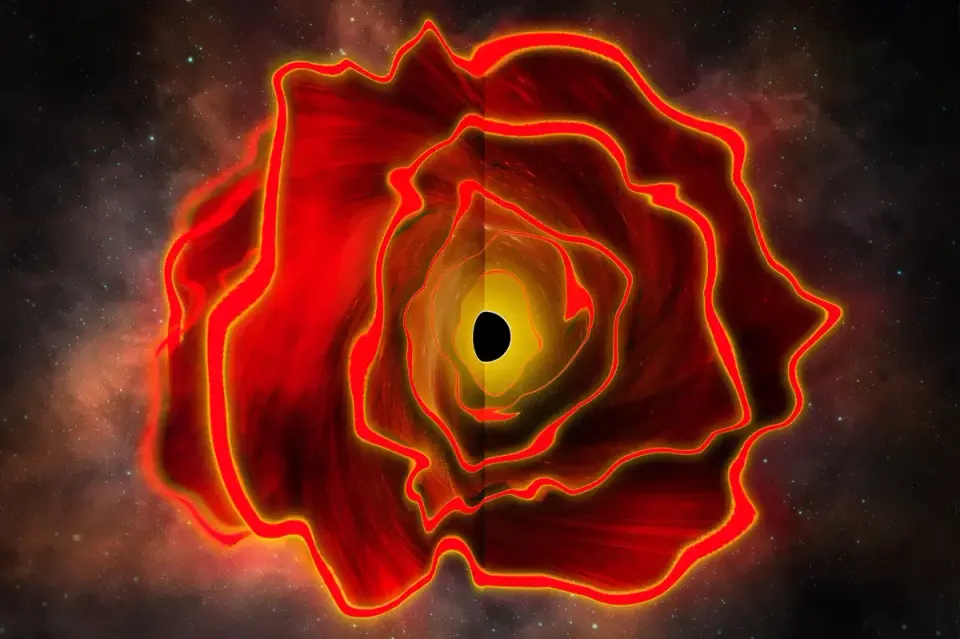
Astronomers have identified MoM-BH*-1, a unique celestial object in the early universe that functions as a hybrid between a star and a black hole. Discovered via the James Webb Space Telescope (JWST), this object is roughly the size of our solar system but emits 100 billion times more energy than a typical star. It is believed to be a supermassive black hole enshrouded in dense, dust-free gas, which explains its intense red color. This discovery offers a potential solution to the 'little red dots' mystery, suggesting these objects are common precursors to modern supermassive black holes.
Key points
- MoM-BH*-1 was discovered accidentally during the 'Mirage or Miracle' (MoM) survey, which aimed to find the earliest galaxies in the universe.
- The object is located in the constellation Cetus, approximately 30 billion light-years from Earth, and dates back to 660 million years after the Big Bang.
- It exhibits a massive 'Balmer break,' where light abruptly disappears below certain wavelengths, a feature previously unseen in any known object.
- The central black hole is estimated to be 100,000 times the mass of the sun, surrounded by a gas envelope with densities exceeding 10^9 cm^-3.
- Researchers plan to use JWST starting in December 2026 to further analyze the object's size and atmospheric composition.
Background
This discovery builds on recent efforts to understand the rapid formation of supermassive black holes in the early universe. Previous studies, such as those using the Euclid telescope, have identified ancient quasars that challenge existing models of black hole growth. The 'little red dots' observed by JWST have been a subject of intense debate, with theories ranging from supermassive stars to dust-shrouded black holes. The identification of MoM-BH*-1 as a 'black hole star' provides a new framework for interpreting these phenomena, potentially linking the seeds of modern galactic black holes to a specific, observable phase in cosmic history.
How outlets are covering it
The New York Post emphasizes the 'one in a billion' rarity of the discovery and its potential to solve the mystery of the universe's origins. MIT News and The Guardian focus on the physical mechanism, describing the object as a black hole swaddled in dense gas that radiates like a star, and highlight its implications for the formation of supermassive black holes. The Nature article provides the technical details, noting that the redness is caused by gas rather than dust, which contradicts previous assumptions. While all sources agree on the object's uniqueness, The Guardian and MIT News suggest that such objects may be common precursors to all supermassive black holes, whereas the New York Post frames it as a singular, unprecedented find.
Why it matters
The discovery of MoM-BH*-1 provides a potential explanation for the 'little red dots' that appear in nearly every deep-space image taken by the JWST. If these objects are indeed black hole stars, it suggests a new mechanism for the rapid growth of supermassive black holes in the early universe. This could reshape our understanding of galaxy evolution, star formation, and the origins of the structures that support life in the cosmos.
What to watch
Researchers, led by Rohan Naidu, will use the JWST starting in December 2026 to conduct further observations of MoM-BH*-1. The goal is to determine the exact size of the gas envelope and the composition of its atmosphere. Additionally, scientists hope to identify more 'black hole stars' in JWST data to confirm if this is a common phase in the life cycle of supermassive black holes.
- ‘One in a billion’ discovery of a hybrid black-hole star reveals new details on origins of the universe nypost.com
- A gas-enshrouded and gas-reddened black hole at cosmic dawn Nature
- Astronomers discover a brand-new type of astrophysical object: A black hole star MIT News
- Astronomers discover a new kind of cosmic object – a black hole ‘star’ The Guardian
- Astronomers discover the existence of a ‘black hole star’ Popular Science
Want the full story? Read the original reporting
Read on nypost.com