
First 'Second-Generation' Planet Found Orbiting a White Dwarf
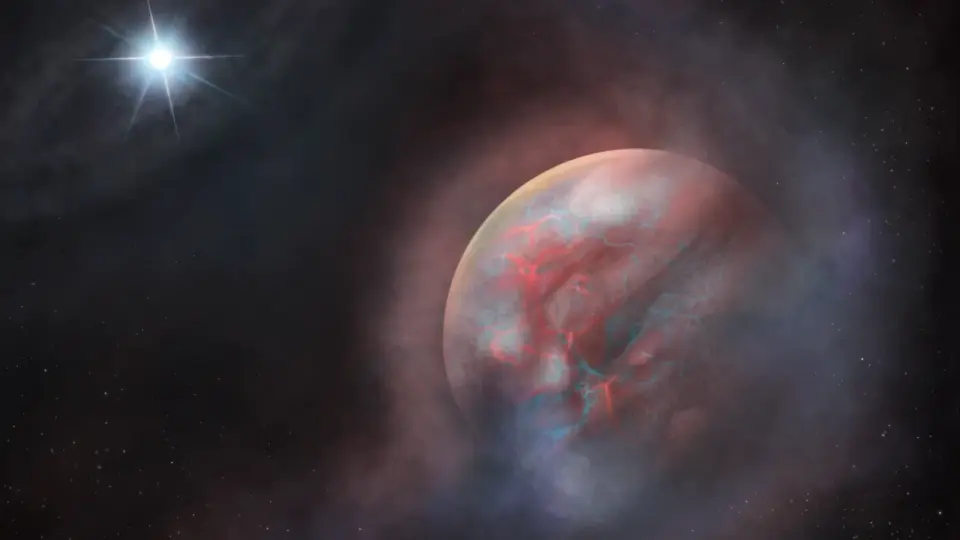
Astronomers have identified the first known 'second-generation' planet orbiting a white dwarf, a world formed from the ejected material of a dying star rather than the original protoplanetary disk. The discovery, centered on the white dwarf HS 0209+0832, reveals a gas giant whose atmosphere is being stripped by intense radiation, feeding heavy elements back into the star. This finding challenges previous assumptions about planetary formation around stellar remnants and offers a new method to detect similar systems.
Key points
- The white dwarf HS 0209+0832 is accreting material with an unusual chemical composition, rich in trans-iron elements like niobium, copper, and zinc, but depleted in rock-forming elements like silicon and iron.
- This chemical signature indicates the material originates from a 'second-generation' planet formed from the wind-driven mass loss of the star's asymptotic giant branch (AGB) progenitor, rather than from the original solar nebula.
- Data from the Transiting Exoplanet Survey Satellite (TESS) reveals a periodic brightness variation every 4.4 days, consistent with a tidally locked gas giant orbiting close to the white dwarf at approximately 0.04 AU.
- The intense radiation from the hot white dwarf (effective temperature ~35,800 K) is causing the planet's atmosphere to evaporate, with the resulting debris accreting onto the star and enriching its atmosphere with heavy elements.
- The formation of such a planet likely required a binary companion to create a circumstellar disk from the ejected stellar envelope, as a single star's symmetric mass loss would not typically form a disk.
Background
This discovery builds on earlier observations of white dwarfs accreting debris from disrupted planetary bodies, which typically show compositions similar to Solar System objects. Previous theories suggested second-generation planets might form around neutron stars (pulsars), but this is the first evidence of such formation around a white dwarf. The finding provides a new framework for understanding planetary formation in post-stellar environments and may lead to the identification of more such systems through their unique chemical signatures.
How outlets are covering it
Space.com and Popular Science emphasize the 'unexpected' nature of the discovery, highlighting that second-generation planets around white dwarfs were not previously confirmed. Nature provides the detailed chemical analysis, noting the high enrichment of s-process elements like niobium, which is over 1,000 times more abundant than in the Sun, and the absence of typical rock-forming elements. CNN focuses on the broader implication that dead stars can birth new worlds, while Popular Science notes the requirement for a binary companion to form the necessary disk. All sources agree on the rarity and significance of the finding, but Nature offers the most rigorous explanation of the chemical anomalies and the mechanism of atmospheric evaporation.
Why it matters
This discovery expands our understanding of planetary formation beyond the traditional protoplanetary disk model, showing that planets can form from the material ejected by dying stars. It provides a new method for detecting second-generation planets by looking for specific chemical signatures in white dwarf atmospheres, such as high carbon and s-process element abundances. The finding also has implications for the future of our own solar system, as the Sun will eventually become a white dwarf, and this research suggests that new planetary systems could form from its ejected material.
What to watch
Astronomers plan to search for more second-generation planet candidates by observing hot white dwarfs for high carbon abundances and s-process element enhancements in their ultraviolet spectra. Further studies will aim to determine the atmospheric abundances and formation mechanisms of these planets, potentially revealing more about the conditions required for post-stellar planetary formation.
- 'Completely unexpected' Phoenix planet was born from the ashes of a dying star Space
- Discovery of a second-generation planet candidate accreting onto a white dwarf Nature
- ‘Phoenix planet’ may have formed from a dead star’s ashes CNN
- Dead star likely birthed a new planet, in astronomical first Popular Science
- The phoenix planet: Astronomers find a world reborn from its star's ashes Phys.org
Want the full story? Read the original reporting
Read on Space