
JWST Identifies 'Black Hole Star' MoM-BH*-1 as a Gas-Enshrouded Cosmic Anomaly
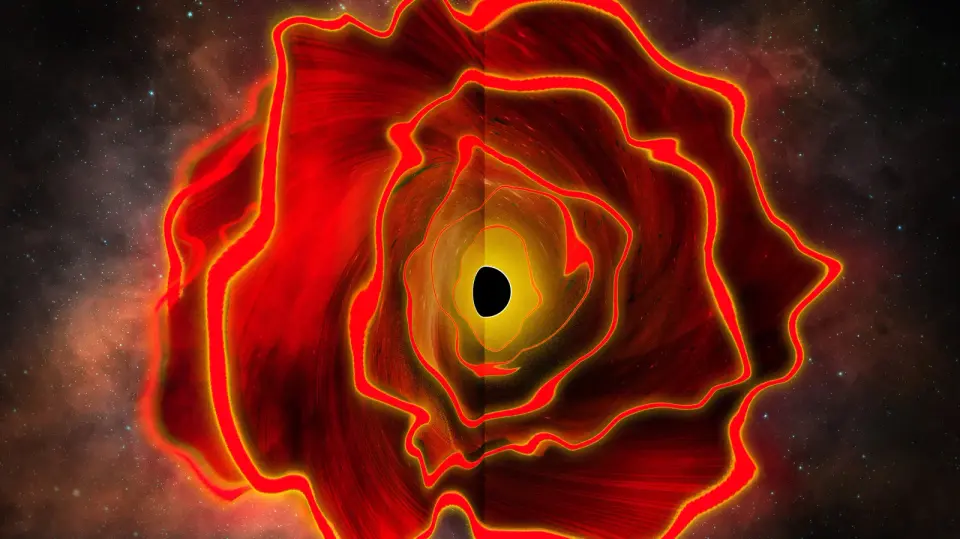
Astronomers have identified a new class of celestial object, termed a 'black hole star,' after analyzing a bright red anomaly in the early universe. This object, designated MoM-BH*-1, exists 660 million years after the Big Bang and is powered by a supermassive black hole rather than nuclear fusion. It is enveloped in a dense, dust-free gas cocoon that mimics stellar characteristics while emitting energy roughly 100 billion times brighter than the Sun. This discovery offers a potential explanation for the mysterious 'little red dots' observed by the James Webb Space Telescope, suggesting these are black holes embedded in dense gas rather than standard stars.
Key points
- The object MoM-BH*-1 was detected at a redshift of 7.7569, corresponding to a time 660 million years after the Big Bang.
- The source is powered by a black hole estimated to be 100,000 times the mass of the Sun, surrounded by a gas envelope roughly the size of the solar system.
- Spectroscopic data reveals an extreme Balmer break and broad hydrogen emission lines, indicating gas densities of approximately 10^11 cm^-3.
- The object's luminosity is approximately 100 billion times that of a typical star, far exceeding what nuclear fusion could produce.
- The red coloration is attributed to gas scattering and absorption rather than dust, distinguishing it from standard stellar models.
Background
The James Webb Space Telescope has identified numerous 'little red dots' in deep-field images since 2022, but their nature remained unexplained until recently. Prior to this discovery, these objects were unclassified anomalies in the early universe. The current finding provides a physical model for these anomalies, linking them to a specific configuration of black holes and gas envelopes during cosmic dawn.
How outlets are covering it
Jalopnik emphasizes the novelty of the 'black hole star' classification, highlighting that the object is powered by accretion rather than fusion and is 100 billion times brighter than a standard star. Nature provides the technical spectroscopic evidence, noting that the redness is caused by gas, not dust, and that the black hole mass may be overestimated by orders of magnitude due to scattering effects. Smithsonian Magazine focuses on the resolution of the 'little red dot' mystery, noting that 341 such dots have been observed and that MoM-BH*-1 is a prime example of a black hole outshining its host galaxy. Space.com frames the discovery as a potential solution to the little red dot mystery, though the source text is largely obscured by website interface code.
Why it matters
This discovery resolves a long-standing mystery regarding the 'little red dots' observed by the James Webb Space Telescope. It suggests that supermassive black holes in the early universe may have grown rapidly through super-Eddington accretion within dense gas envelopes. Understanding this mechanism is crucial for explaining how billion-solar-mass black holes formed within the first 700 million years of cosmic time, a period that remains a puzzle in astrophysics.
What to watch
Researchers will conduct further observations to test the gas-cocoon model and determine if other little red dots share the same physical properties. Future studies will aim to refine the mass estimates of these black holes, as current models suggest masses may be overestimated due to light scattering. The team will also investigate whether this configuration is a transient phase in the growth of supermassive black holes.
- James Webb Space Telescope Discovers New Type Of Star Powered By Black Holes Instead Of Fusion jalopnik.com
- A gas-enshrouded and gas-reddened black hole at cosmic dawn Nature
- Astronomers Peered at the Early Universe and May Have Discovered a New Kind of Celestial Object: Black Hole Stars Smithsonian Magazine
- Farthest 'black hole star' ever found could help solve the James Webb Space Telescope's little red dot mystery Space
- Astronomers Discover the Existence of a Black Hole Star WIRED
Want the full story? Read the original reporting
Read on jalopnik.com