
Lab-grown brain organoids mature over five years, retaining a cellular memory of time
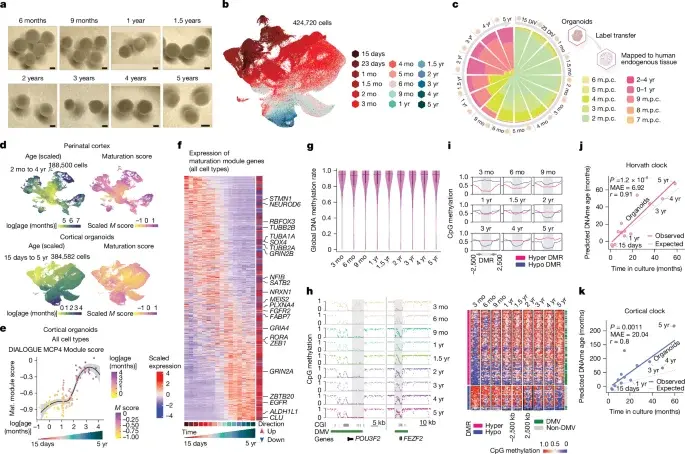
Researchers at Harvard University have successfully cultured human brain organoids for over five years, demonstrating that these lab-grown tissues can mimic the slow, protracted maturation of the human brain. The study reveals that organoids accumulate epigenetic markers consistent with biological aging and retain a 'memory' of their developmental history, allowing them to skip early stages when recombined with younger cells. This breakthrough provides a new platform for studying postnatal brain development and neurodevelopmental disorders that were previously inaccessible in short-term models.
Key points
- Harvard researchers led by Paola Arlotta cultured cortical organoids for over five years, extending previous limits of approximately 694 days.
- Organoids exhibited transcriptional and epigenetic changes that closely mirrored in vivo human brain development, including progressive DNA methylation at age-associated CpG sites.
- A specialized medium supporting spontaneous neuronal activity was crucial for maintaining excitatory neuron viability and synaptic density over long periods.
- Chimeric experiments showed that older progenitors retained a 'temporal memory,' skipping early developmental steps to produce late-stage neurons within two weeks, even when mixed with younger cells.
- The findings suggest a cell-intrinsic clock governs human brain maturation, offering a tool to study postnatal development and disorders like autism and schizophrenia.
Background
Previous organoid studies were limited to a few months, capturing only early developmental stages. Recent archive coverage highlighted ethical debates regarding organoid consciousness and biocomputing, as well as limitations in modeling in vivo niche cues. This new study addresses the gap in long-term maturation, moving beyond early embryonic phases to model postnatal processes that take nearly two decades in humans.
How outlets are covering it
Nature and the NIH emphasize the scientific breakthrough of achieving long-term viability and epigenetic aging, highlighting the potential for modeling neurodevelopmental disorders. Scientific American and ScienceAlert focus on the implications for studying adult-onset diseases like Alzheimer’s and the ethical considerations of creating complex brain-like tissues. While all sources agree on the significance of the longevity, Arlotta notes limitations, such as the lack of blood vessels and sensory input, which may cap the maturation potential of these models.
Why it matters
This research provides a unprecedented tool for studying the slow, species-specific maturation of the human brain, which is difficult to observe in vivo or in animal models. By demonstrating that organoids can record and recall developmental time, scientists can now investigate the molecular mechanisms of postnatal brain development and test interventions for disorders that emerge later in life, such as autism and schizophrenia.
What to watch
Researchers plan to further integrate organoids with additional biological drivers, such as sensory input and non-neural tissues, to enhance anatomical complexity. Future studies may use these long-lived models to simulate specific neurodevelopmental disorders or test experimental interventions, pushing the boundaries of what can be modeled in vitro.
- Human brain organoids record the passage of time over multiple years Nature
- Unprecedented: Scientists Have Built Miniature Brains That Experience The Passage Of Time ScienceAlert
- ‘Mini brains’ kept alive for years appear to age like real brains Scientific American
- Brain organoid maturation is driven by a lifelike developmental clock National Institutes of Health (NIH) | (.gov)
- 5-year-old brain organoids can sense the passing of time New Scientist
Want the full story? Read the original reporting
Read on Nature