
Sun's Surface Reveals Hidden Plasma Whirlpools
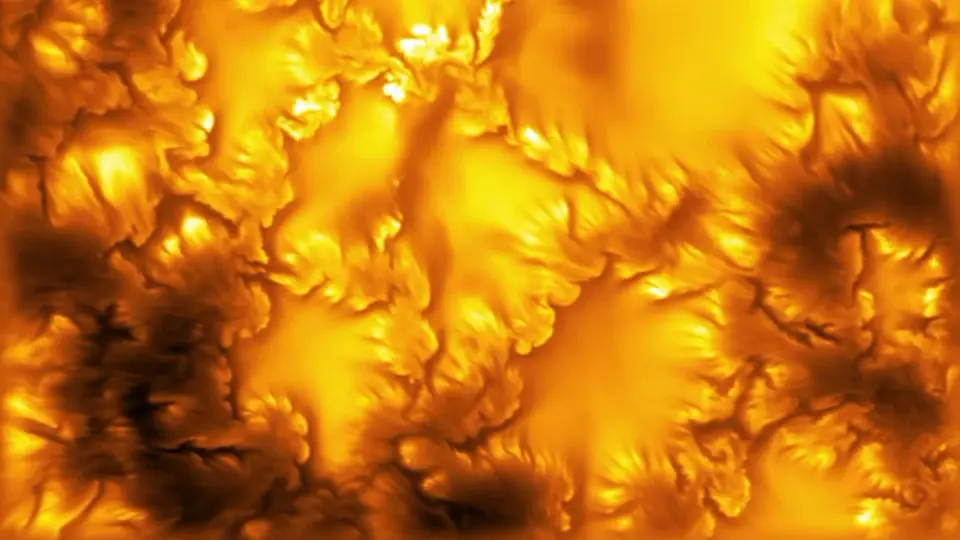
Scientists have captured the first direct visual evidence of Kelvin-Helmholtz instabilities on the Sun's surface. Using the Daniel K. Inouye Solar Telescope, researchers identified ubiquitous plasma whirlpools at the edges of magnetic regions. These vortices, previously only theorized, are now confirmed to drive magnetic energy buildup and heat the Sun's corona, offering a new explanation for solar activity.
Key points
- The Daniel K. Inouye Solar Telescope (DKIST) in Hawaii captured the highest-resolution images of the Sun's photosphere to date, revealing complex vortex structures.
- Researchers identified Kelvin-Helmholtz instabilities (KHIs) as the mechanism creating these whirlpools, which occur where fluids moving at different speeds interact.
- The findings, published in Nature, confirm long-standing theoretical predictions about plasma mixing and magnetic field braiding on the Sun.
- These instabilities are believed to contribute to the heating of the Sun's corona and the buildup of magnetic energy that leads to solar flares.
- Computer simulations using the MURaM code closely matched the telescope observations, validating the physical models of these solar phenomena.
Background
This discovery builds on earlier 2026 reports regarding high-resolution solar observations. Previous coverage noted that DKIST had already revealed turbulent plasma structures, but this new study provides definitive identification of the specific instability mechanism. It also follows other 2026 plasma research, such as the detection of audible plasma waves between Saturn and Enceladus, highlighting a broader trend in understanding plasma dynamics across the solar system.
How outlets are covering it
CNN and AP News emphasize the unprecedented resolution of the DKIST telescope and the surprise factor of seeing these structures for the first time. The Nature journal article provides the technical depth, detailing the specific measurements of vortex sizes (25-170 km) and growth rates, and confirming the findings through rigorous numerical simulations. While all sources agree on the significance of the discovery, the scientific publication focuses on the implications for magnetic field braiding and energy transport, whereas news outlets highlight the potential impact on space weather and Earth's infrastructure.
Why it matters
Understanding these small-scale plasma instabilities is crucial for predicting solar activity. By identifying how magnetic energy is built up and released, scientists can improve models for solar flares and coronal mass ejections, which directly affect satellites, power grids, and communications on Earth.
What to watch
Researchers plan to use future DKIST observations to pinpoint the exact physical connections that enable predictions of large solar flares. The discovery suggests that these micro-events are more influential for the Sun's thermal structure than rare, massive flares, shifting the focus of solar physics toward understanding small-scale dynamics.
- Plasma waves spotted on sun’s surface for the first time Yahoo
- Ubiquitous Kelvin–Helmholtz instabilities driving plasma mixing on the Sun Nature
- Unprecedented images reveal hidden process driving solar activity CNN
- New images of the sun show its surface in the finest detail yet AP News
- See the Sun like never before with most detailed images yet BBC
Want the full story? Read the original reporting
Read on Yahoo