Tag

Magnetic Fields

All articles tagged with #magnetic fields

Tiny vortex storms revealed on the Sun by the world’s largest solar telescope
science18 days ago

Tiny vortex storms revealed on the Sun by the world’s largest solar telescope

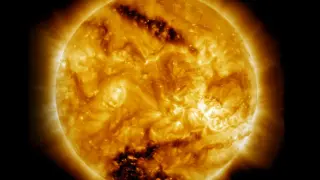
Researchers using the 4‑meter Daniel K. Inouye Solar Telescope imaged Kelvin‑Helmholtz vortexes at 416 nm on the Sun’s surface, showing 60–100 km spacing and 25–170 km-diameter structures that can grow quickly and travel 0.67–3 km/s. The observations, aided by high-speed imaging and advanced deconvolution, suggest a new mechanism for heat, mass, and magnetic-energy transport in the solar atmosphere and may affect convection and corona heating models. The study combines telescope data with simulations to confirm the effect, but is based on a short (about 3 minutes) observation window and calls for longer, magnetic-field–map measurements to fully quantify energy budgets.

Ice Giants Remain Unsolved: Why Uranus and Neptune Need a Return Mission
space1 month ago

Ice Giants Remain Unsolved: Why Uranus and Neptune Need a Return Mission

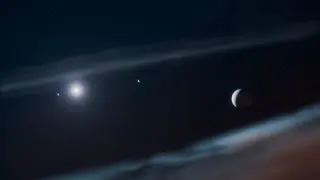
Voyager 2’s 1986 and 1989 flybys gave the first close look at Uranus and Neptune, but no orbiter has followed to study them over time. Key questions about their interiors, the peculiar tilted and offset magnetic fields, and the small, elusive rings and moons remain, in part because a flyby captures only a moment. A future Uranus Orbiter and Probe could map gravity and magnetism, monitor atmospheres, and test for subsurface oceans, advancing our understanding of ice giants and informing exoplanet science.

Close‑in planet’s magnetic bond lights up its star’s chromosphere
science2 months ago

Close‑in planet’s magnetic bond lights up its star’s chromosphere

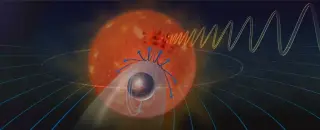
Astronomers studying the nearby red dwarf GJ 436 and its 2.6‑day, roughly four‑Earth‑mass planet found periodic brightenings in the star’s chromosphere that align with the planet’s orbit, likely caused by magnetic fields linking the two bodies. A model that also factors in the star’s rotation and surface activity explains a slight lag between the signal and the orbit. The study suggests the planet has a magnetic field of at least 6 gauss (around 10× Earth’s, similar to Jupiter’s), indicating that magnetic star–planet interactions may be a common way to probe exoplanet magnetism across close‑in systems.

AirPods and Heart Implants: How to Listen Safely
health2 months ago

AirPods and Heart Implants: How to Listen Safely

A 2022 study found that the magnetic fields from AirPods and similar devices can trigger magnet-safe modes in implanted cardiovascular devices (pacemakers and defibrillators), potentially impairing arrhythmia detection. While not a blanket ban on using AirPods, cardiologists and FDA guidance urge keeping devices at least six inches away from CIDs, avoiding carrying electronics in chest pockets, and consulting a physician if dizziness, fainting, or other heart symptoms occur.

Magnetic Weather Detected on Distant Giant Exoplanets
science2 months ago

Magnetic Weather Detected on Distant Giant Exoplanets

Astronomers using the Very Large Telescope and Gemini North studied seven hot giant exoplanets and found a surprising link between wind speeds and temperature: the hottest worlds have slower winds, explained by strong magnetic fields acting as brakes. The inferred magnetic fields are about four times stronger than Saturn’s and roughly half as strong as Jupiter’s, a finding that could affect atmospheric retention and planetary survival, and possibly hint at spectacular auroral activity. The work opens a new window for exoplanet research, with future observatories like the Extremely Large Telescope expected to extend these methods to Earth-sized worlds.

Backyard astrophotographer captures Godzilla-scale solar plume at the sun’s edge (video)
space2 months ago

Backyard astrophotographer captures Godzilla-scale solar plume at the sun’s edge (video)

Backyard astrophotographer Mark Johnston captured two timelapse views of solar prominences at the sun’s edge: a May 22, 2026 event showing plasma streams that appear to fall back as coronal rain, and a May 31, 2026 'Godzilla'-like plume looming above the solar surface. He explains the motion is driven by the Sun’s magnetic fields and gravity rather than flame. Filmed from Scottsdale, Arizona using a 160mm refractor with a hydrogen-alpha filter, the footage highlights giant plasma structures tethered by magnetic field lines and serves as a reminder to observe the Sun only with certified filters.

Unprecedented map reveals the universe’s magnetic fields in stunning detail
science2 months ago

Unprecedented map reveals the universe’s magnetic fields in stunning detail

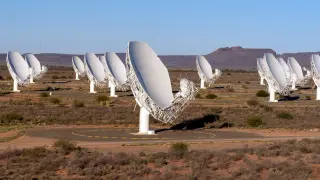
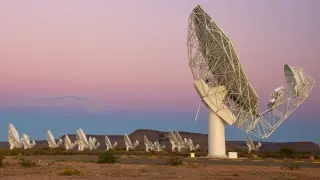
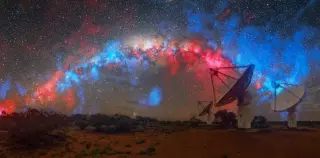
Australian researchers using the ASKAP radio telescope have produced SPICE-RACS, the largest and most detailed map of cosmic magnetic fields to date. By analyzing polarisation in radio light from about 350,000 galaxies (out of ~4 million detected in the Rapid ASKAP Continuum Surveys), the map traces magnetic fields ranging from our Milky Way to distant structures, with red and blue hues indicating field direction. The data, which is publicly available, will help scientists study how magnetic fields influence galaxy evolution and the history of the universe. The project is a collaboration centered on the POSSUM and RACS surveys, and researchers aim to expand the map by combining all RACS data; next-generation SKA precursors and the POSSUM project are expected to run through 2030.

First Signs of Exoplanet Magnetic Fields Seen in Furious Winds
astronomy2 months ago

First Signs of Exoplanet Magnetic Fields Seen in Furious Winds

Astronomers using the Very Large Telescope (VLT) and Gemini North measured wind speeds on seven tidally locked, hot Jupiter–like exoplanets and found winds up to 15,530 mph, offering the first direct evidence of magnetic fields around planets beyond the solar system. The winds appear to slow with higher planetary temperatures due to magnetospheric braking, allowing researchers to infer magnetic-field strengths—roughly four times Saturn’s and about half Jupiter’s. The findings, published in Nature Astronomy, imply these worlds could host dramatic auroras and provide a new way to study exoplanet magnetospheres and atmospheric evolution.

Helical Superionic Carbon-Hydrogen Emerges Inside Ice Giants
science4 months ago

Helical Superionic Carbon-Hydrogen Emerges Inside Ice Giants

New quantum simulations suggest carbon hydride (CH) can form a quasi-one-dimensional, spiral superionic state under extreme pressures (500–3,000 GPa) and temperatures (4,000–6,000 K) inside Uranus and Neptune, with hydrogen moving along corkscrew-like paths through a carbon lattice; this directional ion movement could affect heat and electrical transport and help explain the planets’ unusual magnetic fields.

Hidden Carbon-Hydrogen Phase May Shape Uranus and Neptune’s Interiors
space4 months ago

Hidden Carbon-Hydrogen Phase May Shape Uranus and Neptune’s Interiors

New computer simulations predict a quasi-1D superionic carbon-hydrogen phase inside Uranus and Neptune, where hydrogen atoms navigate spiral pathways through an ordered carbon lattice under 500–3,000 GPa and 4,000–6,000 K, potentially altering heat and electrical transport and helping explain the planets’ unusual magnetic fields.

Magnetism Steers Sun‑Like Stars’ Spin Across a Lifetime, Study Says
space5 months ago

Magnetism Steers Sun‑Like Stars’ Spin Across a Lifetime, Study Says

A high‑resolution magnetohydrodynamic simulation of solar‑type interiors on Japan’s Fugaku supercomputer shows sun‑like stars maintain a solar‑like rotation (equator speeds ahead of the poles) throughout their lifetimes, overturning a 45‑year theory of anti‑solar rotation and highlighting the dominant role of magnetic fields and turbulence; the model reproduces the Sun’s rotation and predicts the magnetic field weakens gradually with age, though direct observations remain challenging.

Quiet White Dwarf Sparks Mysterious Bow Shock
space7 months ago

Quiet White Dwarf Sparks Mysterious Bow Shock

Astronomers using ESO’s Very Large Telescope observed a glowing bow shock around the white dwarf RXJ0528+2838 in a binary system, even though the star shows no accretion disc or obvious outflow. The shock, visible in red, green, and blue, appears to have been powered for about 1,000 years, challenging standard models of how matter moves in such systems. A strong magnetic field could be funneling material from the companion directly onto the dead star without forming a disc, but this mechanism, if real, would only partly explain the phenomenon, leaving the exact origin of the outflow a mystery as reported in Nature Astronomy.